Checking is a crucial procedure in mapping, building and construction, and land development that has actually undertaken a remarkable development over the years. What is the Development Approach for Accuracy Checking in Montreal? Discover Plan a Study with 3D Laser Scanning! . Traditional checking approaches in Montreal, as in lots of other components of the world, counted heavily on hand-operated techniques and devices such as theodolites, chains, and degrees. These tools needed a significant quantity of time and workforce to determine ranges, angles, and elevations. Surveyors required to physically pass through the surface, often under challenging conditions, to gather the required information for developing maps or planning for building tasks. The precision of these methods was mostly based on the ability and experience of the land surveyors, and while quite precise, there was constantly some room for human error.
Modern strategies, on the other hand, leverage technological advancements to accomplish better accuracy, effectiveness, and simplicity of data collection. One such innovative device is 3D laser scanning, a non-intrusive approach that records detailed 3D pictures of items and landscapes. This technology is reinventing the way studies are conducted in Montreal.
3D laser scanning, additionally called LiDAR (Light Detection and Ranging), involves sending out laser beams in the direction of a target and determining the time it takes for the light to mirror back to the scanner. This information is after that utilized to determine accurate ranges, leading to a collection of points referred to as a "" factor cloud"" that represents the checked area in three measurements. The point cloud information can be refined to produce extremely accurate 3D versions, which are important for a wide variety of applications consisting of metropolitan preparation, heritage conservation, facilities growth, and construction.
The growth strategy for precision evaluating utilizing 3D laser scanning begins with preparing the study. This involves specifying the range and goals of the study, developing control factors, and figuring out the optimal settings for the laser scanner to cover the whole area of rate of interest. The planning stage is essential for making sure that the survey is performed efficiently, with minimal disruptions and redundancies.
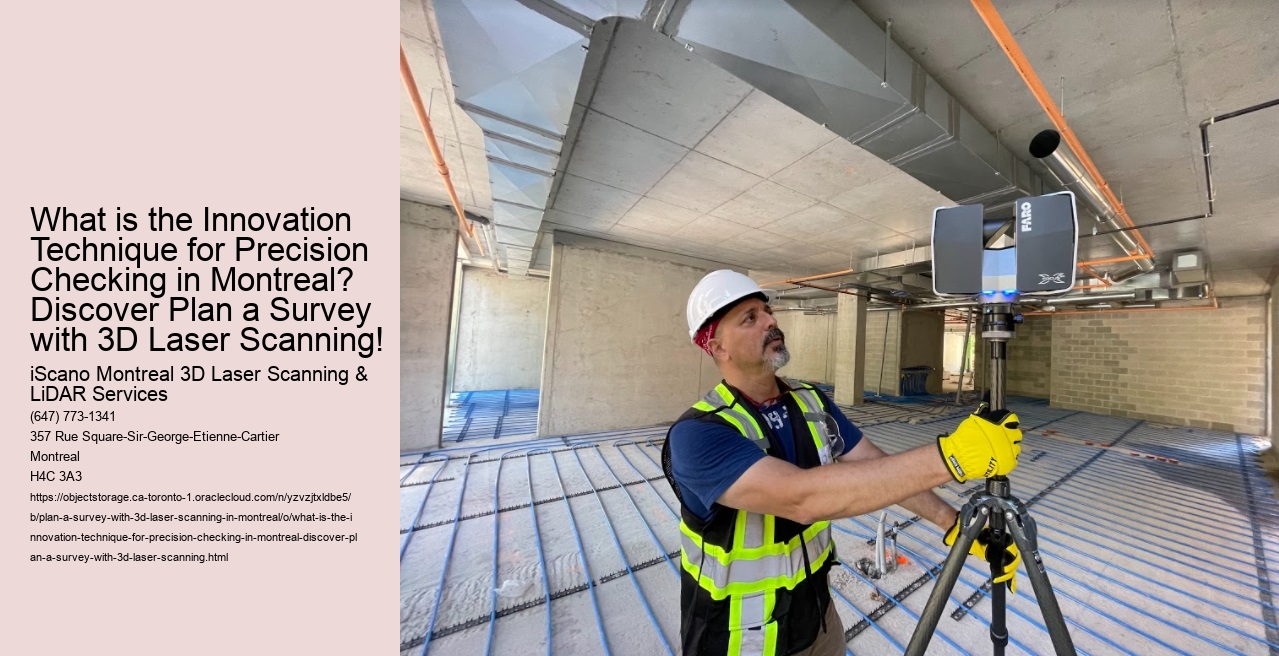
When the strategy remains in area, surveyors use 3D laser scanners to record the data. These devices are commonly installed on tripods and can be operated remotely, significantly lowering the demand for property surveyors to access hard or dangerous surface. The speed of information purchase is another major advantage; a site that would take days to evaluate with traditional methods can currently be checked in just a few hours.
After the data is accumulated, it is processed utilizing specialized software to create comprehensive 3D designs. These designs can be analyzed, shared electronically, and made use of for
The arrival of 3D laser scanning innovation has actually revolutionized the area of accuracy surveying, and nowhere is this extra obvious than in the dynamic metropolitan area of Montreal. This vibrant Canadian city, with its mix of historic design and modern-day framework, offers one-of-a-kind obstacles and chances for surveyors. The development method for precision surveying has developed significantly with the combination of 3D laser scanning, changing the means specialists in Montreal strategy and execute their studies.
3D laser scanning, additionally referred to as LiDAR (Light Discovery and Ranging), is a sophisticated modern technology that catches thorough three-dimensional info about physical objects and the atmosphere. It functions by releasing a laser beam towards a target and measuring the time it takes for the light to show back to the scanner. This process takes place at incredibly quick rates, enabling the capture of countless information points in a matter of minutes. These data factors, known as point clouds, form an exact electronic depiction of the scanned location.
In Montreal, where the preservation of heritage sites is as crucial as the construction of new growths, 3D laser scanning uses a non-intrusive and highly accurate technique of documenting existing conditions. Surveyors can capture the smallest details of a website without physical call, making it perfect for sensitive or inaccessible locations. For new building and constructions, this innovation aids in the production of as-built models, making sure that the last build adapts specifically to the style specs.
The process of planning a survey with 3D laser scanning in Montreal starts with a clear understanding of the project needs. Land surveyors should think about the scope of the project, the degree of information called for, and the end-use of the information. As soon as the purposes are set, they can choose the suitable scanning tools and methods to accomplish the desired results.
Throughout the study, multiple scans from different settings are commonly required to obtain a complete picture of the site. These individual scans are after that lined up and merged into a detailed 3D design. Advanced software program devices allow land surveyors to procedure and evaluate the factor cloud data, extracting important info such as dimensions, volumes, and architectural deformations.
The advantages of using 3D laser scanning for precision evaluating in Montreal are many. It substantially minimizes the moment and labor required for typical checking methods, and the high level of precision reduces the threat of pricey errors. Moreover, the electronic nature of the information makes it conveniently shareable amongst task stakeholders, helping with far better communication and partnership.
In conclusion, the development method for accuracy surveying in Montreal has actually been
Precise surveying has actually constantly been the foundation of effective building and construction, improvement, and paperwork projects. In Montreal, a city where historic beauty mixes with modern style, the demand for precision tackles an also higher significance. The development strategy for accuracy surveying has actually seen an advanced shift with the development of 3D laser scanning technology. This modern technology has actually redefined the typical techniques by providing quicker, a lot more accurate, and exceptionally comprehensive depictions of physical spaces. Here's a step-by-step procedure of planning a survey utilizing 3D laser scanning in the context of Montreal's checking landscape.
Action 1: Specify the Job Scope
Before starting the study, it's crucial to define the task extent. In Montreal, this might involve intricate building details on a heritage building, a vast industrial site, or a complicated infrastructure network. Understanding completion goal, whether it's for renovation, construction, or historical conservation, establishes the stage for all the succeeding actions.
Action 2: Select the Right Equipment
The following step is selecting the ideal 3D laser scanning devices. Not all scanners are produced equivalent; some excel in indoor atmospheres, while others are much better fit to substantial outdoor areas. Montreal's varied landscape demands a versatile scanner that can catch great details with high accuracy. Aspects such as array, resolution, and speed of the scanner need to line up with job demands.
Action 3: Survey the Area
Montreal's diverse climate can pose challenges, so it is very important to intend the survey for ideal problems. When on site, the survey team establishes recommendation factors and checks for any barriers that may impede the scanning procedure. The team additionally establishes the number of scans required and the most effective locations to position the scanner to make sure complete protection.
Tip 4: Conduct the Scanning
With whatever in place, the actual scanning starts. The 3D laser scanner works by sending out laser light beams and catching the reflected light, which is then utilized to create a factor cloud. This factor cloud will certainly function as an electronic representation of the surveyed location, supplying a degree of information that typical approaches can not match.
Step 5: Information Handling
After the scan is total, the raw data undergoes handling. This entails tidying up the point cloud, lining up several scans for a natural model, and potentially converting the data into layouts compatible with CAD or BIM software application. This action is where the data begins to handle a useful form, enabling engineers, designers, and organizers to communicate with the number
The evolution of precision surveying has actually been noted by significant technical improvements, and one of the most revolutionary developments in this area is the arrival of 3D laser scanning, especially in the facility and vibrant urban environments such as Montreal. This sophisticated strategy has actually reinvented the means surveyors accumulate information and has promoted the production of highly accurate and comprehensive designs of urban landscapes.
3D laser scanning, likewise known as LiDAR (Light Discovery and Ranging), is a non-intrusive method that captures the physical properties of things and the setting via using laser light. This modern technology emits numerous laser pulses per second toward the target area, and the time it considers each pulse to return is determined to compute accurate ranges. The result is a thick collection of data points, known as a point cloud, which can be used to create detailed three-dimensional depictions of the checked area.
One of the main benefits of 3D laser scanning for accuracy checking in metropolitan settings is its unmatched precision. The high integrity of data captured allows for the production of electronic doubles of buildings, infrastructures, and landscapes with millimeter-level precision. This is essential in a city like Montreal where historical structures, contemporary architecture, and elaborate infrastructure coexist, and where exact measurements are required for both conservation and development purposes.
One more benefit is the rate of information collection. Conventional checking methods can be taxing, especially in dense urban areas with various features to gauge. 3D laser scanning dramatically minimizes the moment needed to check a site, as it can capture comprehensive information in a matter of mins or hours, depending on the dimension and intricacy of the location. This effectiveness not only lowers labor prices yet also reduces interruptions in hectic metropolitan settings.
Furthermore, 3D laser scanning enhances safety for both the property surveyors and the general public. By allowing remote data collection, land surveyors can stay clear of hazardous locations or scenarios, such as high web traffic areas or unpredictable frameworks. The safety and security of the public is likewise guaranteed as the modern technology allows for minimal disturbance with everyday tasks, minimizing the danger of crashes associated with typical surveying tools set up on-site.
Information caught via 3D laser scanning can additionally be quickly shared and integrated into different software application systems for further evaluation, which is essential for joint metropolitan advancement projects. Designers, designers, and building specialists can deal with the very same precise models, making certain uniformity and lowering mistakes throughout the task lifecycle.
In Montreal, a city with an abundant history and a vibrant urban fabric, planning
In the busy city of Montreal, the growth of accuracy surveying has actually taken a considerable jump ahead with the integration of 3D laser scanning modern technology. This advanced strategy to checking is transforming the means experts catch and assess information, delivering unequaled accuracy and efficiency in a variety of building and restoration projects. In this essay, we will check out the development method for accuracy surveying in Montreal and exactly how 3D laser scanning is utilized to prepare surveys with impressive precision.
The core of accuracy checking in Montreal rests on the use of 3D laser scanning, also referred to as LiDAR (Light Detection and Ranging). This innovative innovation uses a laser to determine and capture the physical attributes of a space or framework in three measurements. The scanner produces millions of laser beam of lights per 2nd, which bounce off surface areas and go back to the sensor, offering specific measurements of distance.
When planning a survey with 3D laser scanning, the very first step is to develop the study purposes. This might include recognizing the structural stability of a heritage structure, mapping out energy networks, or preparing for a complex building project. Surveyors should determine what degree of information is needed and the very best perspective for positioning the scanner to cover the entire area of rate of interest.
Once the goals are established, land surveyors carry out a website visit to familiarize themselves with the location and identify any potential barriers that could interfere with the laser scanning process. These might consist of relocating vehicles, pedestrians, or ecological aspects such as lights and weather. This reconnaissance is vital for making sure that the scanning process goes smoothly which the data accumulated is of the highest quality.
The real study procedure includes establishing the laser scanner on a tripod and methodically catching information from different areas. Overlapping scans make sure full insurance coverage and are later sewn together using specialized software program to develop a detailed digital depiction of the checked area. This digital model, referred to as a factor cloud, contains millions of specific information points that can be controlled and analyzed to remove useful understandings.
The charm of 3D laser scanning lies in its convenience and precision. It can record minute information of complex geometries and large-scale environments, making it important for architects, designers, and building professionals. As an example, in a successful study, accuracy surveying was employed to record the detailed façades of historical buildings in Old Montreal. The resulting 3D models given engineers with the in-depth info required to prepare repair job while protecting the unique building heritage.
An additional effective application of accuracy checking in Montreal involved the development of
The advancement of accuracy evaluating techniques has actually been transformed by the advent of 3D laser scanning technology, which has actually offered land surveyors with the capacity to record comprehensive and accurate depictions of atmospheres and structures. In Montreal, as in various other components of the world, this modern technology has ended up being an indispensable device for experts in construction, architecture, and city preparation. Nevertheless, regardless of its countless benefits, 3D laser scanning is accompanied by a collection of challenges and constraints that should be acknowledged and dealt with.
One of the key difficulties dealt with by property surveyors making use of 3D laser scanning in Montreal is the high preliminary cost of tools. The financial investment required for a high-quality 3D laser scanner can be substantial, which can be an obstacle for small firms or specific property surveyors. Along with the upfront cost, the maintenance and possible updates to software application and hardware can even more include in the economic burden.
One more constraint is the dependence on line-of-sight. Laser scanners can only capture surfaces that are straight noticeable to them. In complicated urban settings such as Montreal, with its blend of historic and contemporary design, this can lead to information voids where the laser can not get to because of obstructions. Surveyors have to consequently prepare their scans meticulously and may need to execute numerous scans from various places to guarantee complete coverage.
Weather can also influence the performance of 3D laser scanning. Damaging weather condition, such as heavy rainfall or snow, which Montreal can experience, can interfere with the precision of the laser scans. Cold temperature levels can affect tools performance and battery life, while intense sunshine can fill sensing units, decreasing the top quality of the data captured.
Information handling is an additional area where obstacles develop. The raw information accumulated from 3D laser scans is commonly voluminous and requires significant computational power and time to process right into useful versions. This handling can end up being a bottleneck, specifically for large projects, requiring durable equipment and proficient drivers who can handle and manipulate the information effectively.
Moreover, while 3D laser scanning supplies high accuracy, it is not unsusceptible to mistakes. Calibration, instrument stability, and customer experience all play important functions in the accuracy of the final outcome. Incorrect data can bring about expensive blunders in the preparation and building stages of a project, highlighting the demand for strenuous quality control procedures.
Lastly, there is a learning curve associated with 3D laser scanning innovation. Checking professionals have to remain abreast of the most up to date advancements and be adept at utilizing complex software for data analysis. This needs continuous training and specialist growth,
Future Improvements in Precision Checking Technologies and Techniques
In the bustling city of Montreal, the development of precision surveying strategies is a necessary facet of city development, infrastructure maintenance, and building projects. The growth method for accuracy evaluating in Montreal is increasingly accepting innovative modern technologies, with 3D laser scanning at the leading edge of this transformative period. Allow's look into exactly how this innovation is reinventing the evaluating landscape and what future improvements might additionally enhance accuracy in surveying techniques.
Discovering the Possible of 3D Laser Scanning
3D laser scanning, also referred to as LiDAR (Light Discovery and Ranging), has reinvented the field of accuracy surveying by giving quick, exact, and detailed dimensions of physical rooms. This non-intrusive technique includes producing laser beams towards the target area and capturing the shown light to create factor clouds. These point clouds develop high-resolution digital 3D designs of the checked area.
In Montreal, the application of 3D laser scanning is crucial in the preservation of historic design, the building and construction of new growths, and the growth of transport networks. Surveyors can currently catch the ins and outs of complex facades, display construction development in real-time, and make sure that jobs comply with strict resistances, all with minimal interruption to the surrounding setting.
Planning a Survey with 3D Laser Scanning
Planning a survey with 3D laser scanning modern technology begins with establishing clear purposes. In Montreal, where both modern high-rise buildings and historic piles exist together, it's essential to tailor the study technique according to the project's needs. Land surveyors should think about aspects such as the degree of information required, the size of the area to be checked, and the potential obstacles that could hinder the scanning procedure.
When the goals are set, the following step is to place the laser scanning devices purposefully around the site to make sure detailed protection. As the data is gathered, it's processed via sophisticated software that stitches with each other the point clouds, producing a natural 3D version. This electronic representation after that serves as a fundamental device for designers, engineers, and stakeholders to assess and make notified choices.
Picturing Future Developments
The future of precision surveying in Montreal looks brilliant, with the potential for substantial developments coming up. One such growth is the assimilation of expert system (AI) with 3D laser scanning. AI algorithms can enhance information processing, automate attribute acknowledgment, and detect changes gradually, leading to also
In 1603, French explorer Samuel de Champlain reported that the St Lawrence Iroquoians and their settlements had disappeared altogether from the St Lawrence valley. This is believed to be due to outmigration, epidemics of European diseases, or intertribal wars.[54][55] In 1611, Champlain established a fur trading post on the Island of Montreal on a site initially named La Place Royale. At the confluence of Petite Riviere and St. Lawrence River, it is where present-day Pointe-à-Callière stands.[56] On his 1616 map, Champlain named the island Lille de Villemenon in honour of the sieur de Villemenon, a French dignitary who was seeking the viceroyship of New France.[57] In 1639, Jérôme Le Royer de La Dauversière obtained the Seigneurial title to the Island of Montreal in the name of the Notre Dame Society of Montreal to establish a Roman Catholic mission to evangelize natives.
Dauversiere hired Paul Chomedey de Maisonneuve, then age 30, to lead a group of colonists to build a mission on his new seigneury. The colonists left France in 1641 for Quebec and arrived on the island the following year. On May 17, 1642, Ville-Marie was founded on the southern shore of Montreal island, with Maisonneuve as its first governor. The settlement included a chapel and a hospital, under the command of Jeanne Mance.[58] By 1643, Ville-Marie had come under Iroquois raids. In 1652, Maisonneuve returned to France to raise 100 volunteers to bolster the colonial population. If the effort had failed, Montreal was to be abandoned and the survivors re-located downriver to Quebec City. Before these 100 arrived in the fall of 1653, the population of Montreal was barely 50 people.
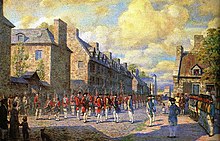
French authorities surrender the city of Montreal to the British after the Articles of Capitulation was signed in 1760.
By 1685, Ville-Marie was home to some 600 colonists, most of them living in modest wooden houses. Ville-Marie became a centre for the fur trade and a base for further exploration.[58] In 1689, the English-allied Iroquois attacked Lachine on the Island of Montreal, committing the worst massacre in the history of New France.[59] By the early 18th century, the Sulpician Order was established there. To encourage French settlement, it wanted the Mohawk to move away from the fur trading post at Ville-Marie. It had a mission village, known as Kahnewake, south of the St Lawrence River. The fathers persuaded some Mohawk to make a new settlement at their former hunting grounds north of the Ottawa River. This became Kanesatake.[60] In 1745, several Mohawk families moved upriver to create another settlement, known as Akwesasne. All three are now Mohawk reserves in Canada. The Canadian territory was ruled as a French colony until 1760, when Montreal fell to a British offensive during the Seven Years' War. The colony then surrendered to Great Britain.[61]
Ville-Marie was the name for the settlement that appeared in all official documents until 1705, when Montreal appeared for the first time, although people referred to the "Island of Montreal" long before then.[62]
iScano Montreal employs cutting-edge 3D laser scanning technology to deliver precise and reliable data, elevating the standards of construction practices in Montreal.
iScano's services extend beyond construction, benefiting industries such as architecture, real estate, manufacturing, and urban planning in Montreal.