Checking is an important procedure in mapping, building and construction, and land advancement that has undergone a remarkable development over the years. What is the Innovation Technique for Accuracy Checking in Montreal? Discover Strategy a Study with 3D Laser Scanning! . Conventional surveying techniques in Montreal, as in several various other components of the world, relied greatly on manual techniques and devices such as theodolites, chains, and levels. These tools required a significant amount of time and manpower to gauge ranges, angles, and altitudes. Surveyors required to literally go across the terrain, usually under challenging problems, to gather the necessary information for producing maps or planning for building jobs. The accuracy of these approaches was mainly based on the ability and experience of the surveyors, and while quite precise, there was always some area for human mistake.
Modern strategies, on the various other hand, take advantage of technical developments to achieve better accuracy, performance, and simplicity of information collection. One such sophisticated tool is 3D laser scanning, a non-intrusive method that records comprehensive 3D photos of things and landscapes. This technology is revolutionizing the way studies are performed in Montreal.
3D laser scanning, also referred to as LiDAR (Light Detection and Ranging), includes sending laser beam of lights in the direction of a target and measuring the time it considers the light to mirror back to the scanner. This info is after that utilized to compute exact distances, leading to a collection of factors known as a "" point cloud"" that stands for the scanned location in 3 measurements. The factor cloud information can be refined to produce highly exact 3D designs, which are important for a plethora of applications consisting of urban planning, heritage preservation, infrastructure development, and building and construction.
The growth method for precision checking using 3D laser scanning starts with intending the study. This includes specifying the range and goals of the study, developing control factors, and identifying the optimum settings for the laser scanner to cover the whole location of interest. The preparation stage is important for ensuring that the study is executed successfully, with marginal disturbances and redundancies.
As soon as the plan is in location, land surveyors utilize 3D laser scanners to record the information. These tools are generally placed on tripods and can be run remotely, significantly minimizing the requirement for surveyors to accessibility tough or harmful surface. The speed of information acquisition is one more major benefit; a site that would certainly take days to evaluate with conventional approaches can now be checked in simply a few hours.
After the information is collected, it is processed utilizing specialized software application to create in-depth 3D versions. These designs can be assessed, shared digitally, and utilized for
The arrival of 3D laser scanning innovation has actually reinvented the field of precision surveying, and no place is this more obvious than in the busy metropolis of Montreal. This vibrant Canadian city, with its mix of historical style and contemporary framework, presents one-of-a-kind difficulties and possibilities for surveyors. The advancement method for accuracy surveying has actually progressed substantially with the combination of 3D laser scanning, changing the way professionals in Montreal strategy and execute their studies.
3D laser scanning, also known as LiDAR (Light Detection and Ranging), is an innovative modern technology that catches comprehensive three-dimensional details concerning physical items and the atmosphere. It functions by releasing a laser beam in the direction of a target and gauging the time it takes for the light to mirror back to the scanner. This process happens at exceptionally fast rates, allowing the capture of countless data points in a matter of minutes. These data factors, known as point clouds, create an accurate electronic depiction of the scanned area.
In Montreal, where the conservation of heritage sites is as essential as the building of brand-new developments, 3D laser scanning supplies a non-intrusive and extremely exact method of recording status quo. Surveyors can record the minutest information of a site without physical call, making it suitable for delicate or hard to reach areas. For brand-new constructions, this technology help in the production of as-built versions, guaranteeing that the final develop adapts specifically to the layout requirements.
The process of planning a study with 3D laser scanning in Montreal starts with a clear understanding of the job requirements. Land surveyors have to think about the extent of the job, the level of detail required, and the end-use of the information. Once the purposes are established, they can choose the appropriate scanning devices and techniques to accomplish the desired results.
Throughout the study, numerous scans from different positions are frequently needed to obtain a complete picture of the website. These private scans are then straightened and combined right into an extensive 3D design. Advanced software application devices permit property surveyors to process and examine the factor cloud information, drawing out valuable information such as measurements, volumes, and architectural contortions.
The benefits of making use of 3D laser scanning for accuracy checking in Montreal are numerous. It dramatically reduces the moment and labor required for typical checking methods, and the high degree of precision decreases the risk of pricey mistakes. Moreover, the electronic nature of the data makes it quickly shareable among project stakeholders, helping with better interaction and cooperation.
To conclude, the development strategy for accuracy checking in Montreal has actually been
Exact surveying has always been the foundation of successful building and construction, restoration, and paperwork jobs. In Montreal, a city where historic appeal mixes with modern design, the requirement for precision tackles an also greater significance. The advancement strategy for accuracy surveying has actually seen an innovative shift with the arrival of 3D laser scanning technology. This innovation has redefined the traditional approaches by giving faster, much more exact, and incredibly detailed depictions of physical spaces. Below's a detailed process of preparing a survey making use of 3D laser scanning in the context of Montreal's evaluating landscape.
Action 1: Define the Project Range
Before starting the survey, it's essential to specify the project extent. In Montreal, this could entail complex architectural information on a heritage structure, an expansive business site, or an intricate framework network. Recognizing the end goal, whether it's for restoration, building and construction, or historical conservation, establishes the phase for all the succeeding steps.
Action 2: Pick the Right Devices
The following step is selecting the appropriate 3D laser scanning devices. Not all scanners are developed equivalent; some excel in interior settings, while others are much better suited to huge outdoor spaces. Montreal's varied landscape needs a versatile scanner that can capture fine details with high precision. Factors such as array, resolution, and speed of the scanner must line up with project requirements.
Action 3: Study the Area
Montreal's varied climate can pose obstacles, so it's important to plan the study for perfect conditions. As soon as on site, the study group establishes recommendation points and checks for any type of barriers that could impede the scanning process. The team likewise figures out the number of scans needed and the best areas to put the scanner to make certain complete protection.
Step 4: Conduct the Scanning
With whatever in position, the real scanning begins. The 3D laser scanner functions by discharging laser beams and capturing the reflected light, which is then utilized to create a factor cloud. This point cloud will certainly serve as a digital representation of the evaluated area, providing a degree of information that standard techniques can not match.
Step 5: Data Handling
After the scan is full, the raw data goes through processing. This involves tidying up the point cloud, aligning multiple scans for a cohesive version, and possibly transforming the data into formats compatible with CAD or BIM software application. This action is where the data begins to tackle a useful kind, making it possible for architects, engineers, and planners to interact with the figure
The development of accuracy surveying has actually been marked by significant technological developments, and one of the most innovative developments in this area is the development of 3D laser scanning, specifically in the complex and dynamic metropolitan atmospheres such as Montreal. This innovative strategy has reinvented the method property surveyors collect data and has actually helped with the creation of very exact and in-depth models of metropolitan landscapes.
3D laser scanning, additionally called LiDAR (Light Detection and Ranging), is a non-intrusive approach that catches the physical properties of objects and the environment with making use of laser light. This modern technology releases countless laser pulses per second toward the target location, and the moment it considers each pulse to return is gauged to calculate exact distances. The outcome is a thick collection of data points, known as a point cloud, which can be utilized to generate in-depth three-dimensional depictions of the checked area.
One of the key benefits of 3D laser scanning for accuracy evaluating in metropolitan settings is its exceptional accuracy. The high fidelity of data recorded permits the creation of electronic twins of structures, frameworks, and landscapes with millimeter-level precision. This is essential in a city like Montreal where historical buildings, modern-day architecture, and detailed facilities exist side-by-side, and where specific dimensions are necessary for both conservation and advancement purposes.
An additional benefit is the speed of information collection. Standard surveying methods can be lengthy, particularly in thick city locations with countless attributes to determine. 3D laser scanning considerably decreases the moment called for to check a website, as it can capture extensive information in a matter of minutes or hours, depending on the dimension and intricacy of the location. This efficiency not just cuts down on labor expenses but likewise minimizes disturbances in busy metropolitan settings.
Additionally, 3D laser scanning improves safety and security for both the surveyors and the general public. By allowing remote data collection, land surveyors can prevent dangerous locations or situations, such as high website traffic areas or unsteady frameworks. The safety of the general public is likewise guaranteed as the innovation permits very little disturbance with daily tasks, decreasing the threat of crashes connected with typical surveying devices established on-site.
Information caught via 3D laser scanning can also be easily shared and incorporated into numerous software systems for more analysis, which is crucial for joint city growth projects. Designers, designers, and building experts can collaborate with the same precise designs, ensuring consistency and lowering errors throughout the project lifecycle.
In Montreal, a city with a rich history and a lively metropolitan material, preparing
In the bustling city of Montreal, the advancement of precision surveying has taken a significant jump forward with the assimilation of 3D laser scanning modern technology. This advanced method to checking is transforming the method experts catch and examine information, delivering unrivaled precision and efficiency in a range of construction and improvement projects. In this essay, we will explore the advancement strategy for precision checking in Montreal and just how 3D laser scanning is used to intend studies with amazing precision.
The core of accuracy checking in Montreal hinges on making use of 3D laser scanning, also referred to as LiDAR (Light Detection and Ranging). This cutting-edge technology employs a laser to gauge and catch the physical qualities of a room or framework in 3 measurements. The scanner discharges millions of laser beam of lights per second, which bounce off surfaces and go back to the sensing unit, providing accurate dimensions of distance.
When intending a survey with 3D laser scanning, the very first step is to develop the study goals. This can include comprehending the architectural stability of a heritage building, mapping out utility networks, or getting ready for a complicated construction project. Property surveyors have to identify what degree of information is called for and the very best vantage points for positioning the scanner to cover the entire area of passion.
As soon as the objectives are established, land surveyors perform a website see to acquaint themselves with the area and identify any type of possible challenges that can hinder the laser scanning procedure. These could include moving cars, pedestrians, or ecological variables such as illumination and weather. This reconnaissance is important for making sure that the scanning procedure goes smoothly and that the data collected is of the finest quality.
The real study procedure involves establishing the laser scanner on a tripod and systematically catching data from various areas. Overlapping scans make sure total coverage and are later stitched with each other using specialized software program to develop a comprehensive electronic depiction of the evaluated location. This electronic design, known as a point cloud, consists of countless individual data points that can be manipulated and evaluated to draw out beneficial understandings.
The charm of 3D laser scanning lies in its adaptability and accuracy. It can catch minute details of complicated geometries and large-scale atmospheres, making it very useful for engineers, engineers, and building and construction specialists. As an example, in an effective study, precision checking was employed to document the detailed façades of historic buildings in Old Montreal. The resulting 3D versions offered architects with the in-depth information required to intend remediation job while maintaining the distinct building heritage.
Another effective application of accuracy surveying in Montreal involved the expansion of
The growth of accuracy evaluating strategies has actually been revolutionized by the advent of 3D laser scanning technology, which has actually given surveyors with the ability to record thorough and exact depictions of atmospheres and frameworks. In Montreal, as in various other components of the world, this technology has become an important tool for specialists in construction, design, and urban preparation. Nonetheless, regardless of its various benefits, 3D laser scanning is gone along with by a collection of difficulties and limitations that need to be acknowledged and addressed.
Among the main challenges dealt with by surveyors utilizing 3D laser scanning in Montreal is the high first cost of tools. The financial investment needed for a top notch 3D laser scanner can be considerable, which can be an obstacle for small firms or private surveyors. In addition to the upfront price, the upkeep and prospective updates to software application and hardware can even more include in the monetary burden.
An additional limitation is the dependence on line-of-sight. Laser scanners can only catch surface areas that are straight noticeable to them. In complex metropolitan environments such as Montreal, with its blend of historic and contemporary architecture, this can lead to data voids where the laser can not get to because of blockages. Property surveyors must as a result prepare their scans meticulously and may need to do multiple scans from different locations to make certain full coverage.
Weather can likewise impact the effectiveness of 3D laser scanning. Adverse weather, such as heavy rainfall or snow, which Montreal can experience, can hinder the precision of the laser scans. Cold temperatures can affect tools efficiency and battery life, while bright sunshine can saturate sensing units, reducing the high quality of the data caught.
Data handling is one more area where challenges emerge. The raw data collected from 3D laser scans is typically extensive and requires substantial computational power and time to refine into usable models. This handling can come to be a traffic jam, particularly for massive projects, necessitating durable hardware and proficient drivers who can take care of and manipulate the information successfully.
Moreover, while 3D laser scanning supplies high accuracy, it is not immune to errors. Calibration, instrument stability, and individual experience all play critical roles in the precision of the final outcome. Imprecise data can result in expensive errors in the planning and building phases of a project, stressing the demand for extensive quality assurance procedures.
Lastly, there is a finding out curve related to 3D laser scanning innovation. Evaluating specialists must stay abreast of the latest innovations and be experienced at utilizing facility software program for information analysis. This calls for continuous training and expert advancement,
Future Advancements in Accuracy Checking Technologies and Techniques
In the dynamic city of Montreal, the evolution of accuracy surveying techniques is an essential element of city development, facilities upkeep, and building tasks. The development technique for precision evaluating in Montreal is increasingly accepting advanced modern technologies, with 3D laser scanning at the forefront of this transformative age. Allow's look into exactly how this technology is transforming the surveying landscape and what future developments might better boost precision in checking methods.
Finding the Possible of 3D Laser Scanning
3D laser scanning, also called LiDAR (Light Discovery and Ranging), has changed the field of precision evaluating by providing fast, accurate, and in-depth dimensions of physical rooms. This non-intrusive method entails emitting laser beam of lights towards the target area and recording the reflected light to produce point clouds. These factor clouds create high-resolution electronic 3D designs of the checked location.
In Montreal, the application of 3D laser scanning is pivotal in the conservation of historic design, the building of new advancements, and the expansion of transport networks. Surveyors can now catch the details of complex facades, screen building and construction progression in real-time, and guarantee that jobs abide by rigorous resistances, all with very little disruption to the surrounding atmosphere.
Preparation a Survey with 3D Laser Scanning
Preparation a study with 3D laser scanning technology begins with developing clear purposes. In Montreal, where both contemporary skyscrapers and historical towers exist side-by-side, it's necessary to tailor the survey approach according to the job's needs. Surveyors have to think about elements such as the degree of detail called for, the dimension of the area to be checked, and the prospective obstacles that could hinder the scanning process.
As soon as the objectives are established, the next step is to position the laser scanning equipment tactically around the website to ensure comprehensive coverage. As the information is gathered, it's refined via advanced software application that stitches together the point clouds, producing a cohesive 3D version. This electronic representation then acts as a fundamental tool for designers, engineers, and stakeholders to evaluate and make notified decisions.
Picturing Future Advancements
The future of accuracy evaluating in Montreal looks intense, with the capacity for significant developments coming up. One such development is the integration of expert system (AI) with 3D laser scanning. AI algorithms can enhance information processing, automate function acknowledgment, and discover adjustments over time, resulting in also
See also: Municipal history of Quebec
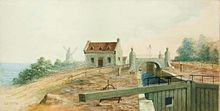
View of Lachine Canal in 1826, a year after it opened. It bypassed the rapids west of the city, linking Montreal with other continental markets.
Montreal was incorporated as a city in 1832.[63] The opening of the Lachine Canal permitted ships to bypass the unnavigable Lachine Rapids,[64] while the construction of the Victoria Bridge established Montreal as a major railway hub. The leaders of Montreal's business community had started to build their homes in the Golden Square Mile from about 1850. By 1860, it was the largest municipality in British North America and the undisputed economic and cultural centre of Canada.[65][66]
In the 19th century, maintaining Montreal's drinking water became increasingly difficult with the rapid increase in population. A majority of the drinking water was still coming from the city's harbour, which was busy and heavily trafficked, leading to the deterioration of the water within. In the mid-1840s, the City of Montreal installed a water system that would pump water from the St. Lawrence and into cisterns. The cisterns would then be transported to the desired location. This was not the first water system of its type in Montreal, as there had been one in private ownership since 1801. In the middle of the 19th century, water distribution was carried out by "fontainiers". The fountainiers[clarification needed] would open and close water valves outside of buildings, as directed, all over the city. As they lacked modern plumbing systems it was impossible to connect all buildings at once and it also acted as a conservation method. However, the population was not finished rising — it rose from 58,000 in 1852 to 267,000 by 1901.[67][68][69]
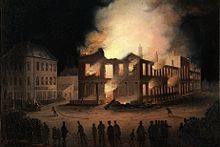
Political protests from Tories led to the burning of the Parliament Buildings in Montreal in 1849.
Montreal was the capital of the Province of Canada from 1844 to 1849, but lost its status when a Tory mob burnt down the Parliament building to protest the passage of the Rebellion Losses Bill.[70] Thereafter, the capital rotated between Quebec City and Toronto until in 1857, Queen Victoria herself established Ottawa as the capital due to strategic reasons. The reasons were twofold. First, because it was located more in the interior of the Province of Canada, it was less susceptible to attack from the United States. Second, and perhaps more importantly, because it lay on the border between French and English Canada, Ottawa was seen as a compromise between Montreal, Toronto, Kingston and Quebec City, which were all vying to become the young nation's official capital. Ottawa retained the status as capital of Canada when the Province of Canada joined with Nova Scotia and New Brunswick to form the Dominion of Canada in 1867.[citation needed]
An internment camp was set up at Immigration Hall in Montreal from August 1914 to November 1918.[71]
iScano Montreal seamlessly integrates 3D laser scanning data into BIM processes, enhancing collaboration, reducing errors, and streamlining construction workflows.
iScano contributes to sustainable construction by optimizing project efficiency, reducing material waste, and promoting precise resource management in Montreal.
iScano's services facilitate accurate project planning, reducing risks and improving overall execution for local construction companies in Montreal.
Yes, iScano Montreal provides training programs and consultations to empower local professionals with the knowledge and skills needed to leverage 3D laser scanning in construction projects.