Evaluating is a critical procedure in mapping, building, and land development that has actually undergone a tremendous evolution for many years. What is the Development Technique for Accuracy Checking in Montreal? Discover Strategy a Survey with 3D Laser Scanning! . Standard evaluating methods in Montreal, as in many various other parts of the globe, depended greatly on manual techniques and devices such as theodolites, chains, and degrees. These devices needed a considerable quantity of time and workforce to determine ranges, angles, and altitudes. Surveyors needed to literally go across the surface, frequently under difficult problems, to collect the necessary data for developing maps or preparing for construction jobs. The precision of these methods was largely depending on the skill and experience of the land surveyors, and while fairly accurate, there was constantly some area for human mistake.
Modern techniques, on the various other hand, utilize technical innovations to accomplish greater accuracy, performance, and convenience of information collection. One such innovative tool is 3D laser scanning, a non-intrusive technique that catches detailed 3D images of objects and landscapes. This innovation is revolutionizing the way studies are carried out in Montreal.
3D laser scanning, likewise known as LiDAR (Light Discovery and Ranging), involves sending laser light beams in the direction of a target and determining the moment it takes for the light to mirror back to the scanner. This info is then used to calculate precise distances, leading to a collection of points called a "" point cloud"" that represents the checked location in three dimensions. The point cloud information can be refined to produce highly accurate 3D models, which are invaluable for a plethora of applications including city preparation, heritage conservation, framework development, and building.
The development technique for precision checking using 3D laser scanning starts with planning the survey. This includes defining the scope and objectives of the survey, establishing control factors, and figuring out the ideal positions for the laser scanner to cover the entire area of passion. The preparation stage is important for guaranteeing that the survey is implemented efficiently, with marginal disruptions and redundancies.
When the strategy is in place, property surveyors make use of 3D laser scanners to catch the data. These devices are typically placed on tripods and can be operated remotely, substantially reducing the requirement for property surveyors to gain access to tough or hazardous terrain. The speed of data acquisition is an additional significant benefit; a website that would take days to check with standard techniques can now be scanned in simply a few hours.
After the data is collected, it is refined utilizing specialized software application to produce detailed 3D versions. These versions can be examined, shared digitally, and utilized for
The development of 3D laser scanning technology has revolutionized the area of precision surveying, and nowhere is this more noticeable than in the busy city of Montreal. This vivid Canadian city, with its blend of historic style and modern infrastructure, provides distinct difficulties and chances for land surveyors. The advancement technique for precision surveying has actually developed significantly with the combination of 3D laser scanning, transforming the method experts in Montreal plan and implement their studies.
3D laser scanning, also called LiDAR (Light Detection and Ranging), is a sophisticated innovation that catches comprehensive three-dimensional info regarding physical items and the atmosphere. It works by producing a laser light beam towards a target and measuring the moment it considers the light to mirror back to the scanner. This process takes place at exceptionally rapid prices, allowing the capture of millions of information factors in a matter of mins. These information factors, called factor clouds, form a precise digital representation of the scanned area.
In Montreal, where the preservation of heritage websites is as crucial as the construction of new developments, 3D laser scanning uses a non-intrusive and highly precise approach of documenting existing conditions. Surveyors can catch the minutest information of a site without physical get in touch with, making it optimal for sensitive or unattainable locations. For brand-new buildings, this technology help in the development of as-built models, making sure that the final construct adapts exactly to the design specs.
The procedure of planning a study with 3D laser scanning in Montreal starts with a clear understanding of the job needs. Property surveyors must take into consideration the extent of the project, the level of information needed, and the end-use of the data. When the objectives are set, they can select the proper scanning devices and approaches to achieve the wanted results.
Throughout the study, multiple scans from different positions are often needed to acquire a total picture of the site. These private scans are then lined up and combined into an extensive 3D design. Advanced software tools allow property surveyors to procedure and examine the point cloud information, removing important info such as dimensions, volumes, and structural deformations.
The advantages of utilizing 3D laser scanning for precision evaluating in Montreal are various. It substantially decreases the moment and labor needed for standard evaluating techniques, and the high degree of precision minimizes the threat of expensive mistakes. Furthermore, the digital nature of the information makes it easily shareable amongst job stakeholders, promoting far better interaction and cooperation.
To conclude, the development strategy for precision surveying in Montreal has been
Specific surveying has constantly been the cornerstone of successful building and construction, renovation, and paperwork jobs. In Montreal, a city where historical charm mixes with modern style, the need for accuracy handles an also better value. The growth technique for accuracy surveying has actually seen a cutting edge shift with the advent of 3D laser scanning technology. This technology has redefined the traditional methods by giving faster, a lot more precise, and incredibly in-depth representations of physical rooms. Below's a detailed process of intending a study making use of 3D laser scanning in the context of Montreal's surveying landscape.
Action 1: Specify the Job Scope
Before starting the survey, it's crucial to define the job extent. In Montreal, this may involve intricate building details on a heritage structure, a vast commercial site, or an intricate infrastructure network. Recognizing completion objective, whether it's for remodelling, construction, or historic conservation, sets the stage for all the succeeding actions.
Action 2: Choose the Right Tools
The following action is picking the appropriate 3D laser scanning tools. Not all scanners are produced equivalent; some excel in interior environments, while others are better suited to vast outdoor areas. Montreal's varied landscape needs a versatile scanner that can capture great information with high precision. Elements such as variety, resolution, and speed of the scanner need to align with project requirements.
Step 3: Study the Place
Montreal's varied weather can pose challenges, so it's important to prepare the study for perfect conditions. As soon as on website, the survey team establishes reference factors and checks for any kind of challenges that could prevent the scanning procedure. The group additionally establishes the variety of scans required and the most effective areas to put the scanner to ensure full coverage.
Step 4: Conduct the Scanning
With whatever in place, the actual scanning starts. The 3D laser scanner works by sending out laser beams and capturing the reflected light, which is after that used to produce a point cloud. This point cloud will certainly serve as a digital representation of the surveyed area, offering a level of information that conventional methods can not match.
Step 5: Data Handling
After the scan is complete, the raw data undertakes handling. This includes cleaning up the point cloud, lining up multiple scans for a cohesive design, and potentially converting the information right into layouts suitable with CAD or BIM software program. This action is where the information starts to take on a usable kind, making it possible for architects, designers, and coordinators to interact with the digit
The development of accuracy surveying has actually been noted by substantial technical advancements, and among the most cutting-edge developments in this area is the development of 3D laser scanning, specifically in the facility and dynamic urban atmospheres such as Montreal. This sophisticated strategy has actually revolutionized the means land surveyors accumulate data and has facilitated the creation of highly precise and thorough models of metropolitan landscapes.
3D laser scanning, additionally known as LiDAR (Light Detection and Ranging), is a non-intrusive approach that records the physical buildings of objects and the setting through making use of laser light. This innovation sends out numerous laser pulses per 2nd towards the target location, and the time it takes for each pulse to return is determined to compute exact ranges. The outcome is a dense collection of data factors, called a factor cloud, which can be used to create in-depth three-dimensional depictions of the scanned location.
One of the key benefits of 3D laser scanning for accuracy evaluating in metropolitan settings is its unmatched accuracy. The high fidelity of information recorded permits the development of electronic twins of structures, infrastructures, and landscapes with millimeter-level precision. This is important in a city like Montreal where historic buildings, contemporary design, and intricate facilities exist side-by-side, and where specific dimensions are required for both preservation and growth objectives.
Another benefit is the speed of data collection. Typical checking techniques can be time-consuming, particularly in dense metropolitan locations with countless functions to measure. 3D laser scanning dramatically lowers the moment called for to evaluate a website, as it can record extensive information in an issue of mins or hours, depending upon the size and complexity of the area. This efficiency not just cuts down on labor costs but additionally decreases interruptions in hectic city settings.
Furthermore, 3D laser scanning boosts security for both the property surveyors and the general public. By enabling remote information collection, surveyors can avoid hazardous places or scenarios, such as high web traffic areas or unstable structures. The security of the public is also ensured as the innovation allows for marginal interference with day-to-day activities, minimizing the danger of accidents associated with traditional surveying tools established on-site.
Information caught via 3D laser scanning can likewise be quickly shared and integrated right into various software program platforms for further analysis, which is important for collaborative metropolitan advancement projects. Engineers, designers, and building and construction specialists can work with the very same exact versions, making certain uniformity and reducing mistakes throughout the project lifecycle.
In Montreal, a city with an abundant background and a lively metropolitan fabric, intending
In the dynamic city of Montreal, the development of precision surveying has actually taken a substantial leap onward with the integration of 3D laser scanning modern technology. This advanced strategy to checking is transforming the method professionals capture and analyze data, providing unrivaled accuracy and efficiency in a variety of construction and remodelling tasks. In this essay, we will certainly discover the advancement strategy for accuracy evaluating in Montreal and how 3D laser scanning is made use of to plan studies with remarkable precision.
The core of precision checking in Montreal rests on using 3D laser scanning, additionally referred to as LiDAR (Light Discovery and Ranging). This advanced innovation uses a laser to gauge and capture the physical characteristics of a space or framework in 3 dimensions. The scanner sends out numerous laser light beams per 2nd, which jump off surfaces and return to the sensing unit, supplying precise dimensions of range.
When planning a study with 3D laser scanning, the primary step is to develop the study goals. This could entail understanding the structural stability of a heritage building, drawing up energy networks, or preparing for a complicated building and construction task. Property surveyors need to identify what level of detail is required and the most effective perspective for positioning the scanner to cover the entire location of rate of interest.
Once the goals are set, property surveyors perform a website visit to acquaint themselves with the area and identify any prospective obstacles that might interfere with the laser scanning process. These could consist of relocating vehicles, pedestrians, or environmental aspects such as lighting and weather. This reconnaissance is essential for guaranteeing that the scanning procedure goes smoothly which the data accumulated is of the highest quality.
The real study process involves establishing the laser scanner on a tripod and methodically recording data from various areas. Overlapping scans make sure full insurance coverage and are later stitched with each other using specialized software program to develop a thorough electronic depiction of the evaluated location. This electronic design, known as a factor cloud, contains countless individual data factors that can be manipulated and assessed to remove beneficial insights.
The elegance of 3D laser scanning depends on its adaptability and precision. It can record minute details of complex geometries and large settings, making it indispensable for architects, designers, and building specialists. For example, in a successful study, precision checking was used to record the detailed façades of historic structures in Old Montreal. The resulting 3D versions given engineers with the thorough information required to plan reconstruction job while preserving the distinct architectural heritage.
One more effective application of precision evaluating in Montreal included the development of
The growth of precision checking methods has actually been revolutionized by the arrival of 3D laser scanning technology, which has provided surveyors with the capacity to record detailed and precise representations of atmospheres and frameworks. In Montreal, as in various other parts of the world, this technology has come to be a vital device for experts in construction, design, and urban preparation. Nonetheless, regardless of its numerous advantages, 3D laser scanning is accompanied by a set of difficulties and restrictions that must be recognized and resolved.
Among the main challenges faced by land surveyors using 3D laser scanning in Montreal is the high first expense of equipment. The investment needed for a high-grade 3D laser scanner can be considerable, which can be a barrier for tiny firms or private surveyors. In addition to the ahead of time cost, the maintenance and possible updates to software application and equipment can better contribute to the financial concern.
One more constraint is the dependancy on line-of-sight. Laser scanners can only catch surface areas that are directly visible to them. In intricate metropolitan environments such as Montreal, with its blend of historic and contemporary style, this can cause information gaps where the laser can not get to due to obstructions. Surveyors have to for that reason plan their scans thoroughly and may need to carry out numerous scans from different locations to ensure complete protection.
Weather can also affect the effectiveness of 3D laser scanning. Damaging weather condition, such as heavy rain or snow, which Montreal can experience, can disrupt the accuracy of the laser scans. Cold temperature levels can influence devices performance and battery life, while bright sunlight can fill sensors, minimizing the quality of the information recorded.
Information processing is an additional area where difficulties develop. The raw data accumulated from 3D laser scans is frequently extensive and needs significant computational power and time to process into functional models. This processing can come to be a bottleneck, especially for large projects, demanding durable equipment and proficient operators that can handle and control the data efficiently.
Furthermore, while 3D laser scanning offers high accuracy, it is not immune to errors. Calibration, instrument security, and individual experience all play crucial functions in the precision of the last result. Imprecise data can cause costly errors in the planning and building phases of a job, stressing the need for rigorous quality control procedures.
Lastly, there is a finding out contour connected with 3D laser scanning modern technology. Checking specialists must stay abreast of the most recent innovations and be adept at using complicated software program for information analysis. This requires ongoing training and expert development,
Future Innovations in Precision Surveying Technologies and Methods
In the bustling metropolis of Montreal, the advancement of accuracy evaluating strategies is a crucial aspect of city development, framework maintenance, and construction jobs. The development technique for accuracy surveying in Montreal is progressively embracing cutting-edge technologies, with 3D laser scanning at the center of this transformative age. Allow's explore how this technology is reinventing the evaluating landscape and what future innovations may additionally boost accuracy in evaluating techniques.
Uncovering the Potential of 3D Laser Scanning
3D laser scanning, additionally called LiDAR (Light Discovery and Ranging), has actually revolutionized the area of precision checking by supplying rapid, exact, and comprehensive dimensions of physical rooms. This non-intrusive technique entails sending out laser beam of lights towards the target area and catching the mirrored light to create point clouds. These factor clouds develop high-resolution electronic 3D versions of the surveyed area.
In Montreal, the application of 3D laser scanning is pivotal in the preservation of historical design, the building of new growths, and the growth of transportation networks. Surveyors can now capture the complexities of intricate exteriors, monitor building and construction progression in real-time, and make sure that jobs abide by stringent resistances, all with marginal disruption to the surrounding atmosphere.
Planning a Study with 3D Laser Scanning
Planning a study with 3D laser scanning technology starts with establishing clear objectives. In Montreal, where both contemporary high-rises and historical edifices exist together, it's vital to customize the survey approach according to the task's demands. Land surveyors should think about variables such as the degree of information required, the dimension of the area to be surveyed, and the potential barriers that could hinder the scanning process.
As soon as the objectives are established, the following action is to position the laser scanning devices strategically around the site to ensure comprehensive coverage. As the data is collected, it's processed via advanced software that stitches with each other the point clouds, producing a cohesive 3D design. This digital depiction then functions as a fundamental tool for architects, engineers, and stakeholders to assess and make educated decisions.
Visualizing Future Advancements
The future of accuracy surveying in Montreal looks bright, with the capacity for considerable advancements on the horizon. One such development is the assimilation of expert system (AI) with 3D laser scanning. AI formulas can boost information handling, automate function acknowledgment, and find changes gradually, resulting in also
After World War I, the prohibition movement in the United States led to Montreal becoming a destination for Americans looking for alcohol.[72] Unemployment remained high in the city and was exacerbated by the Stock Market Crash of 1929 and the Great Depression.[73]
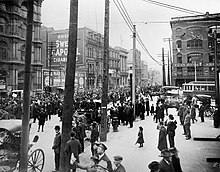
An anti-conscription rally in Montreal, 1917. During both World Wars, the city saw protest against the implementation of conscription.
During World War II, Mayor Camillien Houde protested against conscription and urged Montrealers to disobey the federal government's registry of all men and women.[74] The federal government, part of the Allied forces, was furious over Houde's stand and held him in a prison camp until 1944.[75] That year, the government decided to institute conscription to expand the armed forces and fight the Axis powers. (See Conscription Crisis of 1944.)[74]
Montreal was the official residence of the Luxembourg royal family in exile during World War II.[76]
By 1951, Montreal's population had surpassed one million.[77] However, Toronto's growth had begun challenging Montreal's status as the economic capital of Canada. Indeed, the volume of stocks traded at the Toronto Stock Exchange had already surpassed that traded at the Montreal Stock Exchange in the 1940s.[78] The Saint Lawrence Seaway opened in 1959, allowing vessels to bypass Montreal. In time, this development led to the end of the city's economic dominance as businesses moved to other areas.[79] During the 1960s, there was continued growth as Canada's tallest skyscrapers, new expressways and the subway system known as the Montreal Metro were finished during this time. Montreal also held the World's Fair of 1967, better known as Expo67.
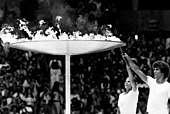
Lighting of the Olympic Torch inside Montreal's Olympic Stadium. The city hosted the 1976 Summer Olympics.
The 1970s ushered in a period of wide-ranging social and political changes, stemming largely from the concerns of the French-speaking majority about the conservation of their culture and language, given the traditional predominance of the English Canadian minority in the business arena.[80] The October Crisis and the 1976 election of the Parti Québécois, which supported sovereign status for Quebec, resulted in the departure of many businesses and people from the city.[81] In 1976, Montreal hosted the Summer Olympics. While the event brought the city international prestige and attention, the Olympic Stadium built for the event resulted in massive debt for the city.[82] During the 1980s and early 1990s, Montreal experienced a slower rate of economic growth than many other major Canadian cities. Montreal was the site of the 1989 École Polytechnique massacre, one of Canada's worst mass shootings, where 25-year-old Marc Lépine shot and killed 14 people, all of them women, and wounded 14 other people before shooting himself at École Polytechnique.
Montreal was merged with the 27 surrounding municipalities on the Island of Montreal on January 1, 2002, creating a unified city encompassing the entire island. There was substantial resistance from the suburbs to the merger, with the perception being that it was forced on the mostly English suburbs by the Parti Québécois. As expected, this move proved unpopular and several mergers were later rescinded. Several former municipalities, totalling 13% of the population of the island, voted to leave the unified city in separate referendums in June 2004. The demerger took place on January 1, 2006, leaving 15 municipalities on the island, including Montreal. Demerged municipalities remain affiliated with the city through an agglomeration council that collects taxes from them to pay for numerous shared services.[83] The 2002 mergers were not the first in the city's history. Montreal annexed 27 other cities, towns and villages beginning with Hochelaga in 1883, with the last prior to 2002 being Pointe-aux-Trembles in 1982.
The 21st century has brought with it a revival of the city's economic and cultural landscape. The construction of new residential skyscrapers, two super-hospitals (the Centre hospitalier de l'Université de Montréal and McGill University Health Centre), the creation of the Quartier des Spectacles, reconstruction of the Turcot Interchange, reconfiguration of the Decarie and Dorval interchanges, construction of the new Réseau express métropolitain, gentrification of Griffintown, subway line extensions and the purchase of new subway cars, the complete revitalization and expansion of Trudeau International Airport, the completion of Quebec Autoroute 30, the reconstruction of the Champlain Bridge and the construction of a new toll bridge to Laval are helping Montreal continue to grow.[citation needed]
iScano Montreal seamlessly integrates 3D laser scanning data into BIM processes, enhancing collaboration, reducing errors, and streamlining construction workflows.
iScano contributes to sustainable construction by optimizing project efficiency, reducing material waste, and promoting precise resource management in Montreal.
iScano's services facilitate accurate project planning, reducing risks and improving overall execution for local construction companies in Montreal.
Yes, iScano Montreal provides training programs and consultations to empower local professionals with the knowledge and skills needed to leverage 3D laser scanning in construction projects.