Surveying is a vital procedure in mapping, building and construction, and land growth that has undertaken a tremendous development over the years. What is the Development Technique for Precision Checking in Montreal? Discover Plan a Survey with 3D Laser Scanning! . Typical surveying methods in Montreal, as in many various other components of the globe, depended greatly on hand-operated techniques and tools such as theodolites, chains, and levels. These devices called for a substantial amount of time and manpower to gauge ranges, angles, and altitudes. Surveyors needed to physically pass through the terrain, commonly under difficult conditions, to gather the required data for creating maps or planning for construction jobs. The precision of these methods was mostly depending on the skill and experience of the land surveyors, and while fairly precise, there was always some area for human error.
Modern techniques, on the various other hand, leverage technical improvements to accomplish greater accuracy, performance, and ease of data collection. One such advanced device is 3D laser scanning, a non-intrusive approach that catches detailed 3D photos of things and landscapes. This technology is reinventing the way studies are performed in Montreal.
3D laser scanning, also known as LiDAR (Light Discovery and Ranging), includes sending laser light beams towards a target and gauging the time it takes for the light to show back to the scanner. This details is after that made use of to calculate precise ranges, causing a collection of points referred to as a "" factor cloud"" that stands for the scanned area in 3 dimensions. The point cloud information can be refined to develop extremely precise 3D models, which are important for a multitude of applications including urban preparation, heritage preservation, infrastructure growth, and construction.
The growth technique for accuracy checking utilizing 3D laser scanning starts with intending the survey. This entails specifying the scope and goals of the survey, establishing control points, and figuring out the optimum positions for the laser scanner to cover the whole location of rate of interest. The planning stage is vital for guaranteeing that the survey is carried out efficiently, with marginal disturbances and redundancies.
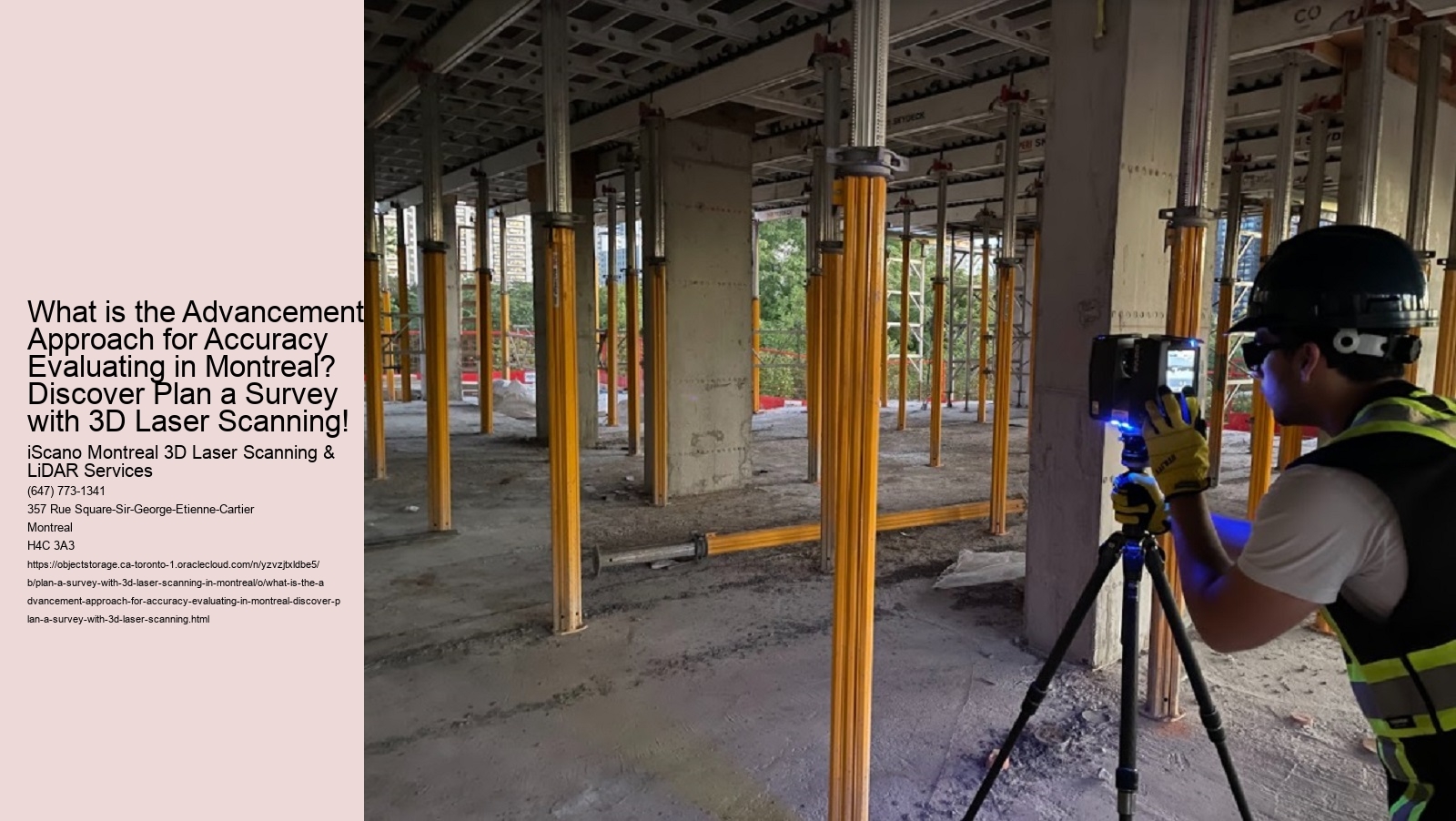
Once the strategy is in place, property surveyors use 3D laser scanners to record the information. These tools are usually placed on tripods and can be operated from another location, substantially decreasing the requirement for surveyors to accessibility tough or dangerous terrain. The speed of data purchase is another major advantage; a website that would certainly take days to check with standard approaches can currently be scanned in simply a couple of hours.
After the data is collected, it is processed making use of specialized software to develop detailed 3D versions. These models can be evaluated, shared electronically, and utilized for
The development of 3D laser scanning technology has reinvented the area of precision surveying, and no place is this extra evident than in the dynamic metropolis of Montreal. This dynamic Canadian city, with its blend of historical style and modern-day infrastructure, provides one-of-a-kind challenges and chances for land surveyors. The development method for precision surveying has actually progressed significantly with the integration of 3D laser scanning, changing the method professionals in Montreal plan and implement their surveys.
3D laser scanning, likewise referred to as LiDAR (Light Detection and Ranging), is a cutting-edge technology that records thorough three-dimensional info about physical things and the atmosphere. It works by giving off a laser beam in the direction of a target and gauging the time it takes for the light to reflect back to the scanner. This procedure happens at unbelievably fast prices, enabling the capture of numerous information points in a matter of mins. These data points, referred to as point clouds, form an exact electronic representation of the scanned area.
In Montreal, where the conservation of heritage sites is as important as the building of brand-new growths, 3D laser scanning offers a non-intrusive and very precise approach of recording existing conditions. Surveyors can capture the smallest details of a site without physical contact, making it perfect for sensitive or hard to reach areas. For new constructions, this innovation help in the creation of as-built versions, making certain that the last develop adheres precisely to the style requirements.
The process of planning a study with 3D laser scanning in Montreal starts with a clear understanding of the job needs. Land surveyors should think about the range of the project, the degree of detail called for, and the end-use of the information. Once the goals are set, they can select the suitable scanning equipment and methodologies to attain the wanted end results.
Throughout the study, several scans from various positions are typically required to acquire a total picture of the site. These private scans are then lined up and combined right into an extensive 3D design. Advanced software application tools allow surveyors to process and assess the factor cloud data, drawing out beneficial information such as dimensions, quantities, and architectural deformations.
The advantages of using 3D laser scanning for precision surveying in Montreal are countless. It considerably decreases the time and labor needed for typical checking approaches, and the high degree of precision lowers the threat of pricey mistakes. In addition, the digital nature of the data makes it conveniently shareable amongst job stakeholders, helping with better communication and collaboration.
Finally, the development strategy for accuracy evaluating in Montreal has been
Accurate surveying has actually always been the keystone of effective building and construction, improvement, and documents tasks. In Montreal, a city where historical beauty blends with contemporary design, the demand for accuracy takes on an also greater significance. The growth method for precision surveying has actually seen a cutting edge shift with the introduction of 3D laser scanning technology. This innovation has actually redefined the conventional approaches by supplying faster, much more exact, and extremely detailed depictions of physical areas. Below's a detailed procedure of planning a study making use of 3D laser scanning in the context of Montreal's evaluating landscape.
Step 1: Specify the Project Range
Before embarking on the survey, it's essential to define the project range. In Montreal, this may involve intricate architectural details on a heritage building, a sprawling commercial site, or a complicated infrastructure network. Recognizing the end goal, whether it's for remodelling, construction, or historical conservation, sets the phase for all the subsequent steps.
Action 2: Choose the Right Devices
The following action is choosing the appropriate 3D laser scanning tools. Not all scanners are developed equivalent; some excel in indoor environments, while others are much better matched to large outside rooms. Montreal's varied landscape demands a versatile scanner that can catch great information with high accuracy. Variables such as variety, resolution, and speed of the scanner need to line up with job demands.
Action 3: Study the Location
Montreal's varied climate can present difficulties, so it is essential to intend the study for ideal problems. As soon as on website, the survey group establishes recommendation factors and checks for any kind of challenges that might impede the scanning procedure. The group also establishes the variety of scans required and the very best areas to position the scanner to make certain total coverage.
Tip 4: Conduct the Scanning
With whatever in position, the actual scanning begins. The 3D laser scanner functions by giving off laser light beams and recording the reflected light, which is after that made use of to create a factor cloud. This point cloud will act as an electronic representation of the surveyed area, providing a degree of information that standard techniques can not match.
Step 5: Data Processing
After the scan is full, the raw data undergoes processing. This involves cleaning up the point cloud, lining up numerous scans for a natural version, and perhaps converting the information right into formats compatible with CAD or BIM software application. This step is where the information starts to handle a usable type, allowing engineers, engineers, and organizers to engage with the digit
The development of accuracy surveying has actually been noted by significant technical innovations, and among the most revolutionary growths in this area is the advent of 3D laser scanning, specifically in the facility and vibrant city atmospheres such as Montreal. This innovative strategy has changed the method land surveyors gather data and has actually facilitated the development of extremely exact and detailed designs of city landscapes.
3D laser scanning, also referred to as LiDAR (Light Detection and Ranging), is a non-intrusive approach that catches the physical properties of items and the atmosphere with using laser light. This innovation gives off millions of laser pulses per 2nd towards the target area, and the moment it takes for each pulse to return is measured to calculate exact distances. The result is a thick collection of information points, called a factor cloud, which can be used to produce comprehensive three-dimensional depictions of the checked area.
Among the primary benefits of 3D laser scanning for accuracy evaluating in urban environments is its unparalleled precision. The high fidelity of data caught allows for the creation of digital doubles of structures, infrastructures, and landscapes with millimeter-level accuracy. This is essential in a city like Montreal where historic structures, contemporary style, and detailed facilities exist together, and where accurate dimensions are necessary for both conservation and advancement purposes.
An additional advantage is the rate of information collection. Typical checking approaches can be taxing, particularly in thick urban areas with various functions to gauge. 3D laser scanning significantly reduces the moment called for to check a website, as it can capture comprehensive information in an issue of minutes or hours, relying on the size and complexity of the location. This efficiency not just cuts down on labor expenses yet also lessens interruptions in active metropolitan settings.
In addition, 3D laser scanning enhances safety and security for both the property surveyors and the public. By allowing remote information collection, land surveyors can prevent harmful locations or circumstances, such as high traffic areas or unpredictable structures. The security of the general public is likewise ensured as the innovation allows for marginal disturbance with daily activities, minimizing the danger of crashes associated with conventional surveying tools established on-site.
Information recorded through 3D laser scanning can also be conveniently shared and integrated into various software systems for more evaluation, which is important for collaborative urban development tasks. Architects, designers, and building experts can work with the very same accurate designs, making certain consistency and minimizing errors throughout the task lifecycle.
In Montreal, a city with a rich background and a vivid city fabric, preparing
In the dynamic city of Montreal, the development of accuracy surveying has actually taken a considerable jump ahead with the combination of 3D laser scanning technology. This innovative approach to checking is changing the means specialists record and analyze information, supplying exceptional accuracy and effectiveness in a variety of building and construction and restoration projects. In this essay, we will certainly check out the advancement method for precision checking in Montreal and exactly how 3D laser scanning is used to intend surveys with remarkable accuracy.
The core of precision evaluating in Montreal depends upon the use of 3D laser scanning, likewise known as LiDAR (Light Detection and Ranging). This innovative modern technology uses a laser to determine and catch the physical attributes of an area or framework in 3 dimensions. The scanner discharges millions of laser beam of lights per 2nd, which jump off surface areas and return to the sensor, offering accurate dimensions of range.
When intending a survey with 3D laser scanning, the very first step is to develop the survey purposes. This could entail understanding the structural stability of a heritage structure, mapping out utility networks, or getting ready for an intricate building project. Land surveyors have to determine what degree of information is required and the very best viewpoint for placing the scanner to cover the entire area of rate of interest.
When the goals are established, property surveyors carry out a website see to familiarize themselves with the location and recognize any kind of prospective obstacles that can disrupt the laser scanning procedure. These might include moving lorries, pedestrians, or environmental aspects such as illumination and weather. This reconnaissance is crucial for guaranteeing that the scanning procedure goes efficiently which the data accumulated is of the best.
The real survey process entails setting up the laser scanner on a tripod and methodically capturing information from different places. Overlapping scans ensure complete insurance coverage and are later stitched together utilizing specialized software application to develop a detailed electronic depiction of the surveyed area. This electronic version, known as a factor cloud, contains numerous specific data factors that can be adjusted and evaluated to draw out valuable insights.
The elegance of 3D laser scanning lies in its convenience and precision. It can capture minute details of complicated geometries and large settings, making it vital for architects, designers, and building and construction specialists. For example, in a successful study, accuracy checking was used to document the elaborate façades of historical structures in Old Montreal. The resulting 3D models given designers with the thorough info needed to prepare reconstruction work while protecting the unique building heritage.
One more successful application of precision checking in Montreal entailed the growth of
The advancement of precision evaluating techniques has actually been transformed by the advent of 3D laser scanning technology, which has provided surveyors with the ability to record thorough and accurate depictions of settings and frameworks. In Montreal, as in various other parts of the globe, this innovation has actually become a vital tool for professionals in building and construction, style, and metropolitan planning. Nevertheless, despite its numerous advantages, 3D laser scanning is accompanied by a set of challenges and limitations that must be recognized and addressed.
Among the key obstacles dealt with by land surveyors using 3D laser scanning in Montreal is the high preliminary price of devices. The investment needed for a top notch 3D laser scanner can be considerable, which can be a barrier for little firms or private land surveyors. Along with the in advance expense, the maintenance and potential updates to software program and hardware can further include in the economic concern.
One more limitation is the dependancy on line-of-sight. Laser scanners can only record surface areas that are directly noticeable to them. In intricate metropolitan environments such as Montreal, with its blend of historic and modern architecture, this can cause information voids where the laser can not reach as a result of obstructions. Land surveyors have to therefore plan their scans diligently and might require to do numerous scans from various areas to ensure full protection.
Climate condition can additionally influence the efficiency of 3D laser scanning. Adverse weather condition, such as heavy rain or snow, which Montreal can experience, can disrupt the precision of the laser scans. Cold temperatures can affect equipment efficiency and battery life, while intense sunshine can saturate sensors, lowering the high quality of the information caught.
Information processing is another location where difficulties arise. The raw information accumulated from 3D laser scans is usually extensive and calls for considerable computational power and time to process right into useful versions. This handling can come to be a bottleneck, particularly for large projects, demanding durable equipment and proficient drivers who can handle and adjust the data effectively.
Furthermore, while 3D laser scanning supplies high precision, it is not unsusceptible to mistakes. Calibration, instrument security, and individual experience all play essential duties in the accuracy of the last output. Unreliable information can bring about pricey blunders in the planning and building stages of a task, stressing the demand for rigorous quality assurance procedures.
Lastly, there is a discovering curve related to 3D laser scanning modern technology. Surveying experts have to stay abreast of the most recent innovations and be experienced at utilizing complicated software application for data interpretation. This calls for continuous training and expert advancement,
Future Developments in Accuracy Surveying Technologies and Approaches
In the dynamic city of Montreal, the advancement of precision checking techniques is an essential aspect of city growth, infrastructure maintenance, and building and construction tasks. The advancement method for precision checking in Montreal is progressively embracing innovative modern technologies, with 3D laser scanning at the leading edge of this transformative era. Allow's explore exactly how this modern technology is revolutionizing the checking landscape and what future developments may even more boost precision in checking approaches.
Discovering the Possible of 3D Laser Scanning
3D laser scanning, also referred to as LiDAR (Light Discovery and Ranging), has reinvented the field of precision surveying by providing rapid, accurate, and comprehensive measurements of physical spaces. This non-intrusive method includes giving off laser beam of lights in the direction of the target location and catching the reflected light to develop point clouds. These point clouds create high-resolution digital 3D designs of the checked area.
In Montreal, the application of 3D laser scanning is essential in the conservation of historic architecture, the building of new growths, and the development of transport networks. Surveyors can now capture the details of elaborate facades, screen construction progress in real-time, and ensure that tasks comply with stringent resistances, all with minimal disruption to the surrounding atmosphere.
Preparation a Survey with 3D Laser Scanning
Planning a survey with 3D laser scanning modern technology starts with establishing clear objectives. In Montreal, where both modern high-rise buildings and historical piles coexist, it's vital to tailor the survey method according to the job's needs. Property surveyors have to consider aspects such as the degree of detail required, the size of the location to be surveyed, and the prospective challenges that might impede the scanning process.
When the goals are set, the following action is to place the laser scanning equipment purposefully around the site to make sure extensive insurance coverage. As the information is gathered, it's refined with innovative software application that stitches together the factor clouds, creating a cohesive 3D design. This electronic depiction then works as a foundational device for designers, engineers, and stakeholders to evaluate and make informed choices.
Envisioning Future Improvements
The future of precision evaluating in Montreal looks bright, with the capacity for considerable innovations on the horizon. One such development is the integration of expert system (AI) with 3D laser scanning. AI formulas can improve information handling, automate feature recognition, and spot modifications gradually, causing also
As of the 2021 Census,[126] 47.0% of Montreal residents spoke French alone as a first language, while 13.0% spoke English alone. 2% spoke both English and French as first languages, 2.6% spoke both French and a non-official language and 1.5% spoke both English and a non-official language. 0.8% of residents spoke English, French and a non-official language as first languages. 32.8% of residents had a non-official language as a mother tongue. The most common were Arabic (5.7%), Spanish (4.6%), Italian (3.3%), Chinese Languages (2.7%), Haitian Creole (1.6%), Vietnamese (1.1%), and Portuguese (1.0%).
iScano Montreal employs state-of-the-art laser scanners, including [insert specific models], ensuring high-quality and detailed data capture.
iScano Montreal serves as a catalyst for innovation by introducing advanced 3D laser scanning technologies and methodologies to the construction and engineering sectors in Montreal.
iScano Montreal's expertise includes navigating and overcoming challenges presented by Montreal's urban landscape, ensuring accurate and reliable 3D scanning results.
Yes, iScano's services can be applied for quality control and assurance, ensuring the integrity of construction materials in the manufacturing process.