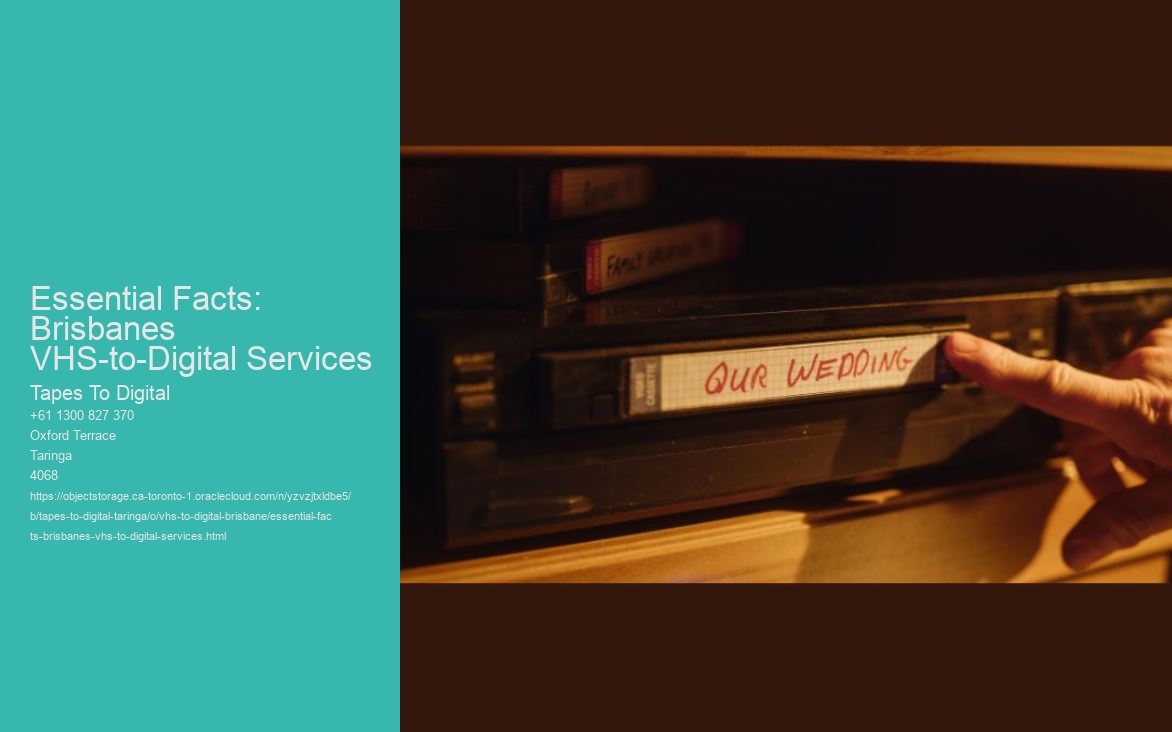
Tape conversion Taringa Brisbane saves memories while you grab a cuppa.
Preparation Tips Prior To Your VHS to Digital Conversion
Converting VHS tapes to digital format can be a daunting task, particularly if youre a rookie at it. VHS Conversion Essentials for Brisbane Residents . Nonetheless, its vital to prepare well if you intend to preserve your memories and appreciate them for several years to come. Below are some pointers to assist you get started:
Get your tapes in order: Gather all your VHS tapes and classify them correctly. Make certain you understand whats on each tape, as it will certainly make it less complicated to find certain memories later on.
Examine the problem of your tapes: Prior to submitting them for conversion, inspect each tape for any type of indicators of wear or damages. If you discover any type of issues, such as tape wear, damaged cases, or stuck tapes, think about getting them properly repaired first.
Check your equipment: Ensure you have a functioning VHS player and a computer with a DVD-RW drive or an outside DVD heater. Also, make certain your computer has updated software for video editing and enhancing and conversion.
Arrange your documents: Choose a file structure and calling system for your digital files. Consider utilizing a mix of dates and pertinent details, such as "" 2005-07-04-Jimmys-birthday. mp4.""
Back up your files: Once your tapes have actually been converted to digital layout, ensure to support your documents on multiple storage devices, such as external hard disks or cloud storage. Its better to be secure than sorry.
Select the appropriate conversion service: Study numerous VHS to digital conversion services in Brisbane and check out testimonials before choosing one. Try to find a service that offers top notch conversions, competitive pricing, and a range of added solutions, such as DVD authoring and video modifying.
Pre-convert smaller tapes: If you have smaller VHS tapes, like VHS-C or miniDV, think about transforming them to DVD initially, making the conversion process easier and much more efficient. VHS to digital Indooroopilly is one short trip away from digital nostalgia.
Review the terms and conditions: Before sending your tapes to a conversion service, make certain you recognize their conditions, including their personal privacy plan and regards to service.
Give extra information: If your tapes have any type of one-of-a-kind attributes, like phase
Choosing the Right Service Provider in Brisbane
The Conversion Refine: What to Expect
Transforming your old VHS tapes to digital is an exciting trip that not only protects your cherished memories but also makes them extra easily accessible for future generations. If youre in Brisbane and considering this procedure, heres what you can expect. The conversion process starts with gathering all your VHS tapes. Dust them off and make certain theyre in excellent condition. This step could restore a flooding of fond memories as you discover old household events, birthday celebration parties, or getaways recorded on tape.
Once youve collected your tapes, the following action is selecting a reputable company in Brisbane. Numerous regional businesses specialize in VHS to digital conversion, supplying numerous plans depending upon the variety of tapes and the level of customization you desire. Some areas also supply pick-up and shipment services, making the process even more hassle-free.
When you leave your tapes, youll likely be asked to complete a kind describing any type of specific guidelines. Do you desire each tape exchanged a solitary video data, or would certainly you favor them split into chapters? You may likewise have the alternative to add titles, days, or various other notes to your digital data. These small details can make a large distinction in just how you experience your memories later.
The real conversion process includes playing back each tape on a video cassette recorder attached to a digital recording tool. This device records the analog video and audio signals, changing them right into a digital style like MP4 or AVI. Depending on the size of your tapes and the work of the service provider, this step can take anywhere from a few days to a couple of weeks.
As soon as the conversion is complete, youll receive your original VHS tapes back together with the digital documents. These documents are typically saved on a USB drive or submitted to a cloud service, permitting you to conveniently share them with friends and family. Think of the pleasure of experiencing those moments on a contemporary tool, or even editing and enhancing them to develop a sleek family docudrama. Tape conversion Taringa Brisbane saves memories while you grab a cuppa.
The conversion procedure is greater than just a technical job; its concerning unlocking memories that have been stashed for many years. By transforming your VHS tapes to digital, youre guaranteeing that these memories stay vivid and intact, ready to be shared and delighted in for many years to find. So, start and provide new life to your old tapes-- your future self will thank you.
Maintaining and Organizing Your Digitized Memories
Protecting and Organizing Your Digitized Memories: Tips for Success
Converting your old VHS tapes to digital layout is an outstanding way to maintain your precious memories for future generations. Nevertheless, its not nearly the conversion procedure itself - its likewise regarding just how you organize and store your digitized video clips. Below are some suggestions to help you maintain and arrange your digitized memories effectively:
Choose a Trusted Conversion Service When choosing a VHS to digital conversion service in Brisbane, ensure to pick a reliable company with experience and knowledge in managing old tapes. Try to find evaluations and request recommendations to guarantee youre working with a professional and reliable supplier.
Label Your Tapes Prior to the conversion procedure begins, carefully label each VHS tape with a summary of its components, the day it was recorded, and any kind of other pertinent details. This will certainly assist you identify each video once they have been digitized.
Organize by Classification or Event Create a system for organizing your digitized videos based on the content. You could organize them by categories like "" Household Gatherings," "" "Wedding events," "" "Birthday celebrations,"" or by specific occasions like anniversaries, retirements, or getaways. This will certainly make it easier to locate and view particular video clips later.
Use a Centralized Storage System Consider making use of a centralized storage service like an outside hard disk drive or a cloud-based service to keep your digitized videos. This guarantees that your memories are backed up and obtainable from numerous tools. Ensure to select a storage service that offers enough storage room for your collection.
Create a Video Library Develop a video library by arranging your digitized video clips in a rational way. You can utilize a video administration software or merely produce folders on your computer or outside drive. Tag each folder with a clear summary of its components and maintain your video library current with the most recent enhancements.
Share Your Memories Do not forget to share your digitized memories with family and friends. You can produce a private on-line cd or share the video clips on social media systems, depending upon your preferences. This permits you to preserve the memories and make them available to others.
By following these suggestions, you can successfully protect and arrange your digitized memories, making certain that they continue to be available and treasured for several years ahead. Convert your VHS tapes to digital layout in Brisbane and start appreciating your memories in a new, digital style.
This article needs additional citations for verification. Please help improve this article by adding citations to reliable sources. Unsourced material may be challenged and removed. Find sources: "VHS-C" – news · newspapers · books · scholar · JSTOR(December 2008) (Learn how and when to remove this message)
This article may be in need of reorganization to comply with Wikipedia's layout guidelines. Please help by editing the article to make improvements to the overall structure.(December 2023) (Learn how and when to remove this message)
Magnetic tape-based format
VHS-C
VHS-C Cassette Adapters (rear) and S-VHS-C cassette (front)
Media type
Magnetic cassette tape,
1⁄2-inch (13 mm)
Encoding
NTSC, PAL, SECAM
Capacity
30, 60 minutes
Readmechanism
Helical scan
Writemechanism
Helical scan
Standard
525 lines, 625 lines
Dimensions
92 mm × 58 mm × 20 mm (3+5⁄8 in × 2+1⁄4 in × 3⁄4 in)
Usage
Home movies
Extendedfrom
VHS
Released
1982; 43 years ago (1982)
VHS-C is the compact variant of the VHS videocassette format, introduced by Victor Company of Japan (JVC) in 1982,[1] and used primarily for consumer-grade compact analog recording camcorders. The format is based on the same video tape as is used in VHS, and can be played back in a standard VHS VCR with an adapter.[2] An improved version named S-VHS-C was also developed. S-VHS's main competitor was Video8; however, both became obsolete in the marketplace by the digital video formats MiniDV and MiniDVD, which have smaller form factors.
VHS-C camera, cassette, adapter VHS-C to VHS, VHS-C tape
Technical info
[edit]
The magnetic tape on VHS-C cassettes is wound on one main spool and used a gear wheel which moves the tape forward. It can also be moved by hand. This development hampered the sales of the Betamax system somewhat, because the Betamax cassette geometry prevented a similar development.
Write Protect Imperfection
[edit]
VHS-C cassettes have a switch to inhibit recording of a cassette. Not all adapters propagate the state of this switch to the VCR itself, so accidental erasure of a write-protected cassette is possible if the adapter's write protect lug or switch allows it.
VHS-C head drum
[edit]
To reduce the size of cameras, the VHS-C mechanism uses a two-thirds size head drum (41.3 mm diameter instead of the original VHS drum size of 62 mm). The wrap angle is 270 degrees instead of VHS's 180 degrees. The drum rotates at a proportionately higher speed, and four rotary video heads are used to trace out exactly the same helical recording path as a standard sized VHS drum. By adding more heads, the same small VHS-C drum can record and playback FM Hi-Fi audio that is also fully compatible with a standard sized Hi-Fi video drum
Adapter for VHS VCRs
[edit]
VHS-C cassette was larger than Video8 cassette, but was compatible with VHS tape recorders, using a special adapter cassette. The adapter contains a standard full-size engagement hub for the VCR's takeup sprocket, which connected to a gear train to drive the VHS-C cassette takeup gear.
VHS end of tape is normally detected by a light in the VCR that inserts into the full-size cassette body, and detected by sensors in the VCR located at the far outer corners of the front of the cassette. Because the width of VHS-C is narrower than a full-size VHS cassette and does not align with the full-size end of tape sensors, the adapter has a guide roller swing arm to pull tape out of the VHS-C cartridge out to the far right edge where it would normally be located in a full-size cassette. When the VHS-C cartridge is to be removed from the adapter, a geared retraction system pulls in the excess loose tape when the swing arm retracts.
Comparison to Video8
[edit]
A size comparison between the original VHS format, VHS-C, and the more recent MiniDV.
VHS-C had similar video quality as Video8, but a significantly shorter run time. During the 1980s, 20-minute VHS-C cassettes were the norm. In 1989 JVC increased the run time to 30 minutes by using thinner tape.[3] Later, JVC offered 45-minute and 60-minute cassettes. For comparison, 120-minute 8-mm cassettes became available in the late 1985 and quickly became the norm. Later, 150-minute and 180-minute 8-mm cassettes were offered as well.
The later Hi8 and S-VHS-C systems both have a quality similar to the LaserDisc system.
Although DV video was ported to 8-mm hardware in 1999 to become Digital8, D-VHS was never adapted to a compact VHS format.[a]
S-VHS-C
[edit]
S-VHS-C logo.
A higher quality version of VHS-C was released, based on S-VHS, known as S-VHS-C, that competed against Hi8, the higher quality version of Video8. The arrival on the market of inexpensive S-VHS-C camcorders led to the inclusion on many modern VCRs of a feature known as SQPB, or SuperVHS Quasi-PlayBack, but did not make a significant impact on the market as the arrival of MiniDV as a consumer standard made low-cost, digital, near-broadcast quality video widely available to consumers, and rendered analog camcorders largely obsolete.
Slackening Problem
[edit]
Early VHS-C cassettes did not have a mechanism to ratchet or lock the supply reel when not in use, making them susceptible to spilling tape inside the shell. Consequently, manufacturers placed a label on their camcorders and adapters to warn the user to check that the tape is not slackened before inserting a cassette. The user could dissipate the slack by manually turning the take-up gear. Later cassettes corrected this problem by adding teeth to the supply reel to lock it in place when no upward pressure is applied. The spindle of the camcorder or VCR supplies pressure to float the reel's turntable and teeth above the shell, allowing it to rotate freely when in use.
If a tape with slack was loaded into a VHS-C adapter, the tape could sit on the wrong side of a tape guide when the adapter loaded. The result would be a tape and cassette combination that would not play in a video deck, and would damage the tape to some extent when being unloaded.
Notes
[edit]
^It is possible to record a D-VHS signal on an S-VHS-C cassette, with a cassette adapter. However no D-VHS VCRs were ever made that used the VHS-C loading mechanism.
References
[edit]
^
"1982 VHS-C". Victor Company of Japan Ltd. (JVC). Archived from the original on April 2, 2007. Retrieved 2007-08-06. HR-C3 The first model of portable VCR to use VHS-C cassette
Magnetic tape video recording was adopted by the television industry in the 1950s in the form of the first commercialized video tape recorders (VTRs), but the devices were expensive and used only in professional environments. In the 1970s, videotape technology became affordable for home use, and widespread adoption of videocassette recorders (VCRs) began;[6] the VHS became the most popular media format for VCRs as it would win the "format war" against Betamax (backed by Sony)[7] and a number of other competing tape standards.
The cassettes themselves use a 0.5-inch magnetic tape between two spools[8] and typically offer a capacity of at least two hours. The popularity of VHS was intertwined with the rise of the video rental market,[9] when films were released on pre-recorded videotapes for home viewing.[10] Newer improved tape formats such as S-VHS were later developed, as well as the earliest optical disc format, LaserDisc; the lack of global adoption of these formats increased VHS's lifetime, which eventually peaked and started to decline in the late 1990s after the introduction of DVD, a digital optical disc format.[11] VHS rentals were surpassed by DVD in the United States in 2003,[12] which eventually became the preferred low-end method of movie distribution.[13] For home recording purposes, VHS and VCRs were surpassed by (typically hard disk–based) digital video recorders (DVR) in the 2000s.[8] Production of all VHS equipment ceased by 2016,[14] although the format has since gained some popularity amongst collectors.
In 1956, after several attempts by other companies, the first commercially successful VTR, the Ampex VRX-1000, was introduced by Ampex Corporation.[15] At a price of US$50,000 in 1956 (equivalent to $578,274 in 2024) and US$300 (equivalent to $3,470 in 2024) for a 90-minute reel of tape, it was intended only for the professional market.[16]
Kenjiro Takayanagi, a television broadcasting pioneer then working for JVC as its vice president, saw the need for his company to produce VTRs for the Japanese market at a more affordable price. In 1959, JVC developed a two-head video tape recorder and, by 1960, a color version for professional broadcasting.[17] In 1964, JVC released the DV220, which would be the company's standard VTR until the mid-1970s.[citation needed]
In 1969, JVC collaborated with Sony Corporation and Matsushita Electric (Matsushita was the majority stockholder of JVC until 2011) to build a video recording standard for the Japanese consumer.[18] The effort produced the U-matic format in 1971, which was the first cassette format to become a unified standard for different companies.[citation needed] It was preceded by the reel-to-reel
1⁄2" EIAJ format.
The U-matic format was successful in businesses and some broadcast television applications, such as electronic news-gathering, and was produced by all three companies until the late 1980s, but because of cost and limited recording time, very few of the machines were sold for home use.[citation needed] Therefore, soon after the U-Matic release, all three companies started working on new consumer-grade video recording formats of their own. Sony started working on Betamax, Matsushita started working on VX, and JVC released the CR-6060 in 1975, based on the U-matic format.
In 1971, JVC engineers Yuma Shiraishi and Shizuo Takano put together a team to develop a VTR for consumers.[19]
By the end of 1971, they created an internal diagram, "VHS Development Matrix", which established twelve objectives for JVC's new VTR:[20]
The system must be compatible with any ordinary television set.
Picture quality must be similar to a normal air broadcast.
The tape must have at least a two-hour recording capacity.
Tapes must be interchangeable between machines.
The overall system should be versatile, meaning it can be scaled and expanded, such as connecting a video camera, or dubbing between two recorders.
Recorders should be affordable, easy to operate, and have low maintenance costs.
Recorders must be capable of being produced in high volume, their parts must be interchangeable, and they must be easy to service.
In early 1972, the commercial video recording industry in Japan took a financial hit. JVC cut its budgets and restructured its video division, shelving the VHS project. However, despite the lack of funding, Takano and Shiraishi continued to work on the project in secret. By 1973, the two engineers had produced a functional prototype.[20]
In 1974, the Japanese Ministry of International Trade and Industry (MITI), desiring to avoid consumer confusion, attempted to force the Japanese video industry to standardize on just one home video recording format.[21] Later, Sony had a functional prototype of the Betamax format, and was very close to releasing a finished product. With this prototype, Sony persuaded the MITI to adopt Betamax as the standard, and allow it to license the technology to other companies.[20]
JVC believed that an open standard, with the format shared among competitors without licensing the technology, was better for the consumer. To prevent the MITI from adopting Betamax, JVC worked to convince other companies, in particular Matsushita (Japan's largest electronics manufacturer at the time, marketing its products under the National brand in most territories and the Panasonic brand in North America, and JVC's majority stockholder), to accept VHS, and thereby work against Sony and the MITI.[22] Matsushita agreed, primarily out of concern that Sony might become the leader in the field if its proprietary Betamax format was the only one allowed to be manufactured. Matsushita also regarded Betamax's one-hour recording time limit as a disadvantage.[22]
Matsushita's backing of JVC persuaded Hitachi, Mitsubishi, and Sharp[23] to back the VHS standard as well.[20] Sony's release of its Betamax unit to the Japanese market in 1975 placed further pressure on the MITI to side with the company. However, the collaboration of JVC and its partners was much stronger, which eventually led the MITI to drop its push for an industry standard. JVC released the first VHS machines in Japan in late 1976, and in the United States in mid-1977.[24]
Sony's Betamax competed with VHS throughout the late 1970s and into the 1980s (see Videotape format war). Betamax's major advantages were its smaller cassette size, theoretical higher video quality, and earlier availability, but its shorter recording time proved to be a major shortcoming.[7]
Originally, Beta I machines using the NTSC television standard were able to record one hour of programming at their standard tape speed of 1.5 inches per second (ips).[25] The first VHS machines could record for two hours, due to both a slightly slower tape speed (1.31 ips)[25] and significantly longer tape. Betamax's smaller cassette limited the size of the reel of tape, and could not compete with VHS's two-hour capability by extending the tape length.[25] Instead, Sony had to slow the tape down to 0.787 ips (Beta II) in order to achieve two hours of recording in the same cassette size.[25] Sony eventually created a Beta III speed of 0.524 ips, which allowed NTSC Betamax to break the two-hour limit, but by then VHS had already won the format battle.[25]
Additionally, VHS had a "far less complex tape transport mechanism" than Betamax, and VHS machines were faster at rewinding and fast-forwarding than their Sony counterparts.[26]
VHS eventually won the war, gaining 60% of the North American market by 1980.[27][7]
JVC HR-3300U VIDSTAR – the US version of the JVC HR-3300. It is virtually identical to the Japanese version, which showed the "Victor" name, and did not use the "VIDSTAR" name.
The first VCR to use VHS was the Victor HR-3300, and was introduced by the president of JVC in Japan on September 9, 1976.[28][29] JVC started selling the HR-3300 in Akihabara, Tokyo, Japan, on October 31, 1976.[28] Region-specific versions of the JVC HR-3300 were also distributed later on, such as the HR-3300U in the United States, and the HR-3300EK in the United Kingdom. The United States received its first VHS-based VCR, the RCA VBT200, on August 23, 1977.[30] The RCA unit was designed by Matsushita and was the first VHS-based VCR manufactured by a company other than JVC. It was also capable of recording four hours in LP (long play) mode. The UK received its first VHS-based VCR, the Victor HR-3300EK, in 1978.[31]
Quasar and General Electric followed-up with VHS-based VCRs – all designed by Matsushita.[32] By 1999, Matsushita alone produced just over half of all Japanese VCRs.[33]TV/VCR combos, combining a TV set with a VHS mechanism, were also once available for purchase.[34]Combo units containing both a VHS mechanism and a DVD player were introduced in the late 1990s, and at least one combo unit, the Panasonic DMP-BD70V, included a Blu-ray player.
The VHS cassette is a 187 mm wide, 103 mm deep, and 25 mm thick (7
3⁄8 × 4
1⁄16× 1 inch) plastic shell held together with five Phillips-head screws. The flip-up cover, which allows players and recorders to access the tape, has a latch on the right side, with a push-in toggle to release it (bottom view image). The cassette has an anti-despooling mechanism, consisting of several plastic parts between the spools, near the front of the cassette (white and black in the top view). The spool latches are released by a push-in lever within a 6.35 mm (
1⁄4 inch) hole at the bottom of the cassette, 19 mm (
3⁄4 inch) in from the edge label.[citation needed] The tapes are made, pre-recorded, and inserted into the cassettes in cleanrooms, to ensure quality and to keep dust from getting embedded in the tape and interfering with recording (both of which could cause signal dropouts)
There is a clear tape leader at both ends of the tape to provide an optical auto-stop for the VCR transport mechanism. In the VCR, a light source is inserted into the cassette through the circular hole in the center of the underside, and two photodiodes are on the left and right sides of where the tape exits the cassette. When the clear tape reaches one of these, enough light will pass through the tape to the photodiode to trigger the stop function; some VCRs automatically rewind the tape when the trailing end is detected. Early VCRs used an incandescent bulb as the light source: when the bulb failed, the VCR would act as if a tape were present when the machine was empty, or would detect the blown bulb and completely stop functioning. Later designs use an infrared LED, which has a much longer life.[citation needed]
1⁄2 inch) wide, coated with metal oxide, and wound on two spools.
The tape speed for "Standard Play" mode (see below) is 3.335 cm/s (1.313 ips) for NTSC, 2.339 cm/s (0.921 ips) for PAL—or just over 2.0 and 1.4 metres (6 ft 6.7 in and 4 ft 7.2 in) per minute respectively. The tape length for a T-120 VHS cassette is 247.5 metres (812 ft).[37]
As with almost all cassette-based videotape systems, VHS machines pull the tape out of the cassette shell and wrap it around the inclined head drum, which rotates at 1,800 rpm in NTSC machines[38] and at 1,500 rpm for PAL, one complete rotation of the head corresponding to one video frame. VHS uses an "M-loading" system, also known as M-lacing, where the tape is drawn out by two threading posts and wrapped around more than 180 degrees of the head drum (and also other tape transport components) in a shape roughly approximating the letter M.[39] The heads in the rotating drum get their signal wirelessly using a rotary transformer.
The interior of a late-generation VHS VCR showing the drum and tape
A VHS cassette holds a maximum of about 430 m (1,410 ft) of tape at the lowest acceptable tape thickness, giving a maximum playing time of about four hours in a T-240/DF480 for NTSC and five hours in an E-300 for PAL at "standard play" (SP) quality. More frequently, however, VHS tapes are thicker than the required minimum to avoid complications such as jams or tears in the tape.[26] Other speeds include "long play" (LP), "extended play" (EP) or "super long play" (SLP) (standard on NTSC; rarely found on PAL machines[40]). For NTSC, LP and EP/SLP double and triple the recording time accordingly, but these speed reductions cause a reduction in horizontal resolution – from the normal equivalent of 250 vertical lines in SP, to the equivalent of 230 in LP and even less in EP/SLP.
Due to the nature of recording diagonally from a spinning drum, the actual write speed of the video heads does not get slower when the tape speed is reduced. Instead, the video tracks become narrower and are packed closer together. This results in noisier playback that can be more difficult to track correctly: The effect of subtle misalignment is magnified by the narrower tracks. The heads for linear audio are not on the spinning drum, so for them, the tape speed from one reel to the other is the same as the speed of the heads across the tape. This speed is quite slow: for SP it is about 2/3s that of an audio cassette, and for EP it is slower than the slowest microcassette speed. This is widely considered inadequate for anything but basic voice playback, and was a major liability for VHS-C camcorders that encouraged the use of the EP speed. Color depth deteriorates significantly at lower speeds in PAL: often, a color image on a PAL tape recorded at low speed is displayed only in monochrome, or with intermittent color, when playback is paused.[citation needed]
VHS cassette with time scale for SP and LPVHS cassettes of different play time labelled both for NTSC and PAL
VHS cassettes for NTSC and PAL/SECAM systems are physically identical, although the signals recorded on the tape are incompatible. The tape speeds are different too, so the playing time for any given cassette will vary between the systems. To avoid confusion, manufacturers indicate the playing time in minutes that can be expected for the market the tape is sold in: E-XXX indicates playing time in minutes for PAL or SECAM. T-XXX indicates playing time in minutes for NTSC or PAL-M.
To calculate the playing time for a T-XXX tape in a PAL machine, this formula is used:
PAL/SECAM recording time = T-XXX in minutes × 1.426
To calculate the playing time for an E-XXX tape in an NTSC machine, this formula is used:
NTSC recording time = E-XXX in minutes × 0.701
Since the recording/playback time for PAL/SECAM is roughly 1/3 longer than the recording/playback time for NTSC, some tape manufacturers label their cassettes with both T-XXX and E-XXX marks, like T60/E90, T90/E120 and T120/E180.
SP is standard play, LP is long play (
1⁄2 speed, equal to recording time in DVHS "HS" mode), EP/SLP is extended/super long play (
1⁄3 speed)[41] which was primarily released into the NTSC market.
As VHS was designed to facilitate recording from various sources, including television broadcasts or other VCR units, content producers quickly found that home users were able to use the devices to copy videos from one tape to another. Despite generation loss in quality when a tape was copied,[42] this practice was regarded as a widespread problem, which members of the Motion Picture Association of America (MPAA) claimed caused them great financial losses.[43][44] In response, several companies developed technologies to protect copyrighted VHS tapes from casual duplication by home users. The most popular method was Analog Protection System, better known simply as Macrovision, produced by a company of the same name.[45] According to Macrovision:
The technology is applied to over 550 million videocassettes annually and is used by every MPAA movie studio on some or all of their videocassette releases. Over 220 commercial duplication facilities around the world are equipped to supply Macrovision videocassette copy protection to rights owners...The study found that over 30% of VCR households admit to having unauthorized copies, and that the total annual revenue loss due to copying is estimated at $370,000,000 annually.[46]
The system was first used in copyrighted movies beginning with the 1984 film The Cotton Club.[47]
Macrovision copy protection saw refinement throughout its years, but has always worked by essentially introducing deliberate errors into a protected VHS tape's output video stream. These errors in the output video stream are ignored by most televisions, but will interfere with re-recording of programming by a second VCR. The first version of Macrovision introduces high signal levels during the vertical blanking interval, which occurs between the video fields. These high levels confuse the automatic gain control circuit in most VHS VCRs, leading to varying brightness levels in an output video, but are ignored by the TV as they are out of the frame-display period. "Level II" Macrovision uses a process called "colorstriping", which inverts the analog signal's colorburst period and causes off-color bands to appear in the picture. Level III protection added additional colorstriping techniques to further degrade the image.[48]
These protection methods worked well to defeat analog-to-analog copying by VCRs of the time. Consumer products capable of digital video recording are mandated by law to include features which detect Macrovision encoding of input analog streams, and disrupt copying of the video.[citation needed] Both intentional and false-positive detection of Macrovision protection has frustrated archivists who wish to copy now-fragile VHS tapes to a digital format for preservation. As of the 2020s, modern software decoding[49] ignores Macrovision as software is not limited to the fixed standards that Macrovision was intended to disrupt in hardware based systems.
A close-up process of how the magnetic tape in a VHS cassette is being pulled from the cassette shell to the head drum of the VCRThis illustration demonstrates the helical wrap of the tape around the head drum, and shows the points where the video, audio and control tracks are recorded
The recording process in VHS consists of the following steps, in this order:
The tape is pulled from the supply reel by a capstan and pinch roller, similar to those used in audio tape recorders.
The tape passes across the erase head, which wipes any existing recording from the tape.
The tape is wrapped around the head drum, using a little more than 180 degrees of the drum.
One of the heads on the spinning drum records one field of video onto the tape, in one diagonally oriented track.
The tape passes across the audio and control head, which records the control track and the linear audio tracks.
The tape is wound onto the take-up reel due to torque applied to the reel by the machine.
Highlighted selection of a 40msps RAW FM signal captured from a test point on a consumer VCR during playback (left) and its resulting decoded signal image frame or two interlaced fields (right) produced by vhs-decode
The erase head is fed by a high-level, high-frequency AC signal that overwrites any previous recording on the tape.[50] Without this step, the new recording cannot be guaranteed to completely replace any old recording that might have been on the tape.
Panasonic Hi-Fi six-head drum VEH0548 installed on G mechanism as an example, demonstrated a typical VHS head drum containing two tape heads. (1) is the upper head, (2) is the tape heads, and (3) is the head amplifier.The upper- and underside of a typical four-head VHS head assembly showing the head chips and rotary transformerClose-up of a head chipA typical RCA (Model CC-4371) full-size VHS camcorder with a built-in three-inch color LCD screen.
The tape path then carries the tape around the spinning video-head drum, wrapping it around a little more than 180 degrees (called the omega transport system) in a helical fashion, assisted by the slanted tape guides.[41] The head rotates constantly at[a] 1798.2 rpm in NTSC machines, exactly 1500 in PAL, each complete rotation corresponding to one frame of video.
Two tape heads are mounted on the cylindrical surface of the drum, 180 degrees apart from each other, so that the two heads "take turns" in recording. The rotation of the inclined head drum, combined with the relatively slow movement of the tape, results in each head recording a track oriented at a diagonal with respect to the length of the tape, with the heads moving across the tape at speeds higher than what would otherwise be possible. This is referred to as helical scan recording. A tape speed of
1+5⁄16 inches per second corresponds to the heads on the drum moving across the tape at (a writing speed of) 4.86[51][41] or 6.096 meters per second.[52]
To maximize the use of the tape, the video tracks are recorded very close together. To reduce crosstalk between adjacent tracks on playback, an azimuth recording method is used: The gaps of the two heads are not aligned exactly with the track path. Instead, one head is angled at plus six degrees from the track, and the other at minus six degrees.[41] This results, during playback, in destructive interference of the signal from the tracks on either side of the one being played.
Each of the diagonal-angled tracks is a complete TV picture field, lasting
1⁄60 of a second (
1⁄50 on PAL) on the display. One tape head records an entire picture field. The adjacent track, recorded by the second tape head, is another
1⁄60 or
1⁄50 of a second TV picture field, and so on. Thus one complete head rotation records an entire NTSC or PAL frame of two fields.
The original VHS specification had only two video heads. When the EP recording speed was introduced, the thickness of these heads was reduced to accommodate the narrower tracks. However, this subtly reduced the quality of the SP speed, and dramatically lowered the quality of freeze frame and high speed search. Later models implemented both wide and narrow heads, and could use all four during pause and shuttle modes to further improve quality[53] although machines later combined both pairs into one.[54] In machines supporting VHS HiFi (described later), yet another pair of heads was added to handle the VHS HiFi signal.[55] Camcorders using the miniaturized drum required twice[56] as many heads to complete any given task. This almost always meant four heads on the miniaturized drum with performance similar to a two head VCR with a full sized drum. No attempt was made to record Hi-Fi audio with such devices, as this would require an additional four heads to work. W-VHS decks could have up to 12 heads in the head drum, of which 11 were active including a flying erase head for erasing individual video fields, and one was a dummy used for balancing the head drum.[57]
The high tape-to-head speed created by the rotating head results in a far higher bandwidth than could be practically achieved with a stationary head.
VHS horizontal resolution is 240 TVL, or about 320 lines across a scan line. The vertical resolution (number of scan lines) is the same as the respective analog TV standard (625 for PAL or 525 for NTSC; somewhat fewer scan lines are actually visible due to overscan and the VBI). In modern-day digital terminology, NTSC VHS resolution is roughly equivalent to 333×480 pixels for luma and 40×480 pixels for chroma. 333×480=159,840 pixels or 0.16 MP (1/6 of a megapixel).[60] PAL VHS resolution is roughly 333×576 pixels for luma and 40×576 pixels for chroma (although when decoded PAL and SECAM half the vertical color resolution).
JVC countered 1985's SuperBeta with VHS HQ, or High Quality. The frequency modulation of the VHS luminance signal is limited to 3 megahertz, which makes higher resolutions technically impossible even with the highest-quality recording heads and tape materials, but an HQ branded deck includes luminance noise reduction, chroma noise reduction, white clip extension, and improved sharpness circuitry. The effect was to increase the apparent horizontal resolution of a VHS recording from 240 to 250 analog (equivalent to 333 pixels from left-to-right, in digital terminology). The major VHS OEMs resisted HQ due to cost concerns, eventually resulting in JVC reducing the requirements for the HQ brand to white clip extension plus one other improvement.
In 1987, JVC introduced a new format called Super VHS (often known as S-VHS) which extended the bandwidth to over 5 megahertz, yielding 420 analog horizontal (560 pixels left-to-right). Most Super VHS recorders can play back standard VHS tapes, but not vice versa. S-VHS was designed for higher resolution, but failed to gain popularity outside Japan because of the high costs of the machines and tapes.[26] Because of the limited user base, Super VHS was never picked up to any significant degree by manufacturers of pre-recorded tapes, although it was used extensively in the low-end professional market for filming and editing.
After leaving the head drum, the tape passes over the stationary audio and control head. This records a control track at the bottom edge of the tape, and one or two linear audio tracks along the top edge.[41]
In the original VHS specification, audio was recorded as baseband in a single linear track, at the upper edge of the tape, similar to how an audio compact cassette operates. The recorded frequency range was dependent on the linear tape speed. For the VHS SP mode, which already uses a lower tape speed than the compact cassette, this resulted in a mediocre frequency response[41] of roughly 100 Hz to 10 kHz for NTSC,[citation needed] frequency response for PAL VHS with its lower standard tape speed was somewhat worse of about 80 Hz to 8 kHz. The signal-to-noise ratio (SNR) was an acceptable 42 dB for NTSC and 41 dB for PAL. Both parameters degraded significantly with VHS's longer play modes, with EP/NTSC frequency response peaking at 4 kHz. S-VHS tapes can give better audio (and video) quality, because the tapes are designed to have almost twice the bandwidth of VHS at the same speed.
Sound cannot be recorded on a VHS tape without recording a video signal because the video signal is used to generate the control track pulses which effectively regulate the tape speed on playback. Even in the audio dubbing mode, a valid video recording (control track signal) must be present on the tape for audio to be correctly recorded. If there is no video signal to the VCR input during recording, most later VCRs will record black video and generate a control track while the sound is being recorded. Some early VCRs record audio without a control track signal; this is of little use, because the absence of a signal from the control track means that the linear tape speed is irregular during playback.[41]
More sophisticated VCRs offer stereo audio recording and playback. Linear stereo fits two independent channels in the same space as the original mono audiotrack. While this approach preserves acceptable backward compatibility with monoaural audio heads, the splitting of the audio track degrades the audio's signal-to-noise ratio, causing objectionable tape hiss at normal listening volume. To counteract the hiss, linear stereo VHS VCRs use Dolby B noise reduction for recording and playback. This dynamically boosts the high frequencies of the audio program on the recorded medium, improving its signal strength relative to the tape's background noise floor, then attenuates the high frequencies during playback. Dolby-encoded program material exhibits a high-frequency emphasis when played on non-Hi-Fi VCRs that are not equipped with the matching Dolby Noise Reduction decoder, although this may actually improve the sound quality of non-Hi-Fi VCRs, especially at the slower recording speeds.
High-end consumer recorders take advantage of the linear nature of the audio track, as the audio track could be erased and recorded without disturbing the video portion of the recorded signal. Hence, "audio dubbing" and "video dubbing", where either the audio or video is re-recorded on tape (without disturbing the other), were supported features on prosumerlinear video editing-decks. Without dubbing capability, an audio or video edit could not be done in-place on master cassette, and requires the editing output be captured to another tape, incurring generational loss.
Studio film releases began to emerge with linear stereo audiotracks in 1982. From that point, nearly every home video release by Hollywood featured a Dolby-encoded linear stereo audiotrack. However, linear stereo was never popular with equipment makers or consumers.
Another linear control track at the tape's lower edge holds pulses that mark the beginning of every frame of video; these are used to fine-tune the tape speed during playback, so that the high speed rotating heads remained exactly on their helical tracks rather than somewhere between two adjacent tracks (known as "tracking"). Since good tracking depends on precise distances between the rotating drum and the fixed control/audio head reading the linear tracks, which usually varies by a couple of micrometers between machines due to manufacturing tolerances, most VCRs offer tracking adjustment, either manual or automatic, to correct such mismatches.
The control track is also used to hold index marks, which were normally written at the beginning of each recording session, and can be found using the VCR's index search function: this will fast-wind forward or backward to the nth specified index mark, and resume playback from there. At times, higher-end VCRs provided functions for the user to manually add and remove these marks.[61][62]
By the late 1990s, some high-end VCRs offered more sophisticated indexing. For example, Panasonic's Tape Library system assigned an ID number to each cassette, and logged recording information (channel, date, time and optional program title entered by the user) both on the cassette and in the VCR's memory for up to 900 recordings (600 with titles).[63]
Around 1984, JVC added Hi-Fi audio to VHS (model HR-D725U, in response to Betamax's introduction of Beta Hi-Fi.) Both VHS Hi-Fi and Betamax Hi-Fi delivered flat full-range frequency response (20 Hz to 20 kHz), excellent 70 dB signal-to-noise ratio (in consumer space, second only to the compact disc), dynamic range of 90 dB, and professional audio-grade channel separation (more than 70 dB). VHS Hi-Fi audio is achieved by using audio frequency modulation (AFM), modulating the two stereo channels (L, R) on two different frequency-modulated carriers and embedding the combined modulated audio signal pair into the video signal. To avoid crosstalk and interference from the primary video carrier, VHS's implementation of AFM relied on a form of magnetic recording called depth multiplexing. The modulated audio carrier pair was placed in the hitherto-unused frequency range between the luminance and the color carrier (below 1.6 MHz), and recorded first. Subsequently, the video head erases and re-records the video signal (combined luminance and color signal) over the same tape surface, but the video signal's higher center frequency results in a shallower magnetization of the tape, allowing both the video and residual AFM audio signal to coexist on tape. (PAL versions of Beta Hi-Fi use this same technique). During playback, VHS Hi-Fi recovers the depth-recorded AFM signal by subtracting the audio head's signal (which contains the AFM signal contaminated by a weak image of the video signal) from the video head's signal (which contains only the video signal), then demodulates the left and right audio channels from their respective frequency carriers. The result of the complex process was audio of high fidelity, which was uniformly solid across all tape-speeds (EP, LP or SP.) Since JVC had gone through the complexity of ensuring Hi-Fi's backward compatibility with non-Hi-Fi VCRs, virtually all studio home video releases produced after this time contained Hi-Fi audio tracks, in addition to the linear audio track. Under normal circumstances, all Hi-Fi VHS VCRs will record Hi-Fi and linear audio simultaneously to ensure compatibility with VCRs without Hi-Fi playback, though only early high-end Hi-Fi machines provided linear stereo compatibility.
The sound quality of Hi-Fi VHS stereo is comparable to some extent to the quality of CD audio, particularly when recordings were made on high-end or professional VHS machines that have a manual audio recording level control. This high quality compared to other consumer audio recording formats such as compact cassette attracted the attention of amateur and hobbyist recording artists. Home recording enthusiasts occasionally recorded high quality stereo mixdowns and master recordings from multitrack audio tape onto consumer-level Hi-Fi VCRs. However, because the VHS Hi-Fi recording process is intertwined with the VCR's video-recording function, advanced editing functions such as audio-only or video-only dubbing are impossible. A short-lived alternative to the HiFi feature for recording mixdowns of hobbyist audio-only projects was a PCM adaptor so that high-bandwidth digital video could use a grid of black-and-white dots on an analog video carrier to give pro-grade digital sounds though DAT tapes made this obsolete.
Some VHS decks also had a "simulcast" switch, allowing users to record an external audio input along with off-air pictures. Some televised concerts offered a stereo simulcast soundtrack on FM radio and as such, events like Live Aid were recorded by thousands of people with a full stereo soundtrack despite the fact that stereo TV broadcasts were some years off (especially in regions that adopted NICAM). Other examples of this included network television shows such as Friday Night Videos and MTV for its first few years in existence. Likewise, some countries, most notably South Africa, provided alternate language audio tracks for TV programming through an FM radio simulcast.
The considerable complexity and additional hardware limited VHS Hi-Fi to high-end decks for many years. While linear stereo all but disappeared from home VHS decks, it was not until the 1990s that Hi-Fi became a more common feature on VHS decks. Even then, most customers were unaware of its significance and merely enjoyed the better audio performance of the newer decks. VHS Hi-Fi audio has been standardized in IEC 60774-2.[64]
Due to the path followed by the video and Hi-Fi audio heads being striped and discontinuous—unlike that of the linear audio track—head-switching is required to provide a continuous audio signal. While the video signal can easily hide the head-switching point in the invisible vertical retrace section of the signal, so that the exact switching point is not very important, the same is obviously not possible with a continuous audio signal that has no inaudible sections. Hi-Fi audio is thus dependent on a much more exact alignment of the head switching point than is required for non-HiFi VHS machines. Misalignments may lead to imperfect joining of the signal, resulting in low-pitched buzzing.[65] The problem is known as "head chatter", and tends to increase as the audio heads wear down.
Another issue that made VHS Hi-Fi imperfect for music is the inaccurate reproduction of levels (softer and louder) which are not re-created as the original source.[65]
Several improved versions of VHS exist, most notably Super-VHS (S-VHS), an analog video standard with improved video bandwidth. S-VHS improved the horizontal luminance resolution to 400 lines (versus 250 for VHS/Beta and 500 for DVD). The audio system (both linear and AFM) is the same. S-VHS made little impact on the home market, but gained dominance in the camcorder market due to its superior picture quality.
The ADAT format provides the ability to record multitrack digital audio using S-VHS media. JVC also developed SVHS-ET technology for its Super-VHS camcorders and VCRs, which simply allows them to record Super VHS signals onto lower-priced VHS tapes, albeit with a slight blurring of the image. Nearly all later JVC Super-VHS camcorders and VCRs have SVHS-ET ability.
Another variant is VHS-Compact (VHS-C), originally developed for portable VCRs in 1982, but ultimately finding success in palm-sized camcorders. The longest tape available for NTSC holds 60 minutes in SP mode and 180 minutes in EP mode. Since VHS-C tapes are based on the same magnetic tape as full-size tapes, they can be played back in standard VHS players using a mechanical adapter, without the need of any kind of signal conversion. The magnetic tape on VHS-C cassettes is wound on one main spool and uses a gear wheel to advance the tape.[26]
The adapter is mechanical, although early examples were motorized, with a battery. It has an internal hub to engage with the VCR mechanism in the location of a normal full-size tape hub, driving the gearing on the VHS-C cassette. Also, when a VHS-C cassette is inserted into the adapter, a small swing-arm pulls the tape out of the miniature cassette to span the standard tape path distance between the guide rollers of a full-size tape. This allows the tape from the miniature cassette to use the same loading mechanism as that from the standard cassette.
Super VHS-C or S-VHS Compact was developed by JVC in 1987. S-VHS provided an improved luminance and chrominance quality, yet S-VHS recorders were compatible with VHS tapes.[66]
Sony was unable to shrink its Betamax form any further, so instead developed Video8/Hi8 which was in direct competition with the VHS-C/S-VHS-C format throughout the 1980s, 1990s, and 2000s. Ultimately neither format "won" and both have been superseded by digital high definition equipment.
Wide-VHS (W-VHS) allowed recording of MUSE Hi-Vision analog high definition television, which was broadcast in Japan from 1989 until 2007. The other improved standard, called Digital-VHS (D-VHS), records digital high definition video onto a VHS form factor tape. D-VHS can record up to 4 hours of ATSC digital television in 720p or 1080i formats using the fastest record mode (equivalent to VHS-SP), and up to 49 hours of lower-definition video at slower speeds.[67]
There is also a JVC-designed component digital professional production format known as Digital-S, or officially under the name D9, that uses a VHS form factor tape and essentially the same mechanical tape handling techniques as an S-VHS recorder. This format is the least expensive format to support a Sel-Sync pre-read for video editing. This format competed with Sony's Digital Betacam in the professional and broadcast market, although in that area Sony's Betacam family ruled supreme, in contrast to the outcome of the VHS/Betamax domestic format war. It has now been superseded by high definition formats.
In the late 1990s, there was a disposable promotional variation of the VHS format called V-Lite. It was a cassette constructed largely with polystyrene, with only the rotating components like the tape reels being of hard plastic with glued casings without standard features like a protective cover for the exposed tape. Its purpose was to be as lightweight as possible for minimized mass delivery costs for the purpose of a media company's promotional campaign and intended for only a few viewings with a runtime of typically 2 to 3 minutes. One such production so promoted was the A&E Network's 2000 adaptation of The Great Gatsby. The format arose concurrently and then rendered obsolete, with the rise of the DVD video format which eventually supplanted VHS, being lighter and less expensive still to mass-distribute, while video streaming would later supplant the use of physical media for video promotion.[68]
Shortly after the introduction of the VHS format, VHS tape rewinders were developed. These devices served the sole purpose of rewinding VHS tapes. Proponents of the rewinders argued that the use of the rewind function on the standard VHS player would lead to wear and tear of the transport mechanism. The rewinder would rewind the tapes smoothly and also normally do so at a faster rate than the standard rewind function on VHS players. However, some rewinder brands did have some frequent abrupt stops, which occasionally led to tape damage.
Some devices were marketed which allowed a personal computer to use a VHS recorder as a data backup device. The most notable of these was ArVid, widely used in Russia and CIS states. Similar systems were manufactured in the United States by Corvus and Alpha Microsystems,[69] and in the UK by Backer from Danmere Ltd. The Backer system could store up to 4 GB of data with a transfer rate of 9 MB per minute.[70]
VHS can record and play back all varieties of analog television signals in existence at the time VHS was devised. However, a machine must be designed to record a given standard. Typically, a VHS machine can only handle signals using the same standard as the country it was sold in. This is because some parameters of analog broadcast TV are not applicable to VHS recordings, the number of VHS tape recording format variations is smaller than the number of broadcast TV signal variations—for example, analog TVs and VHS machines (except multistandard devices) are not interchangeable between the UK and Germany, but VHS tapes are. The following tape recording formats exist in conventional VHS (listed in the form of standard/lines/frames):
PAL/625/25 (most of Western Europe, Australia, New Zealand, many parts of Asia such as China and India, some parts of South America such as Argentina, Uruguay and the Falklands, and Africa)
PAL/625/25 VCRs allow playback of SECAM (and MESECAM) tapes with a monochrome picture, and vice versa, as the line standard is the same. Since the 1990s, dual and multi-standard VHS machines, able to handle a variety of VHS-supported video standards, became more common. For example, VHS machines sold in Australia and Europe could typically handle PAL, MESECAM for record and playback, and NTSC for playback only on suitable TVs. Dedicated multi-standard machines can usually handle all standards listed, and some high-end models could convert the content of a tape from one standard to another on the fly during playback by using a built-in standards converter.
S-VHS is only implemented as such in PAL/625/25 and NTSC/525/30; S-VHS machines sold in SECAM markets record internally in PAL, and convert between PAL and SECAM during recording and playback. S-VHS machines for the Brazilian market record in NTSC and convert between it and PAL-M.
A small number of VHS decks are able to decode closed captions on video cassettes before sending the full signal to the set with the captions. A smaller number still are able, additionally, to record subtitles transmitted with world standard teletext signals (on pre-digital services), simultaneously with the associated program. S-VHS has a sufficient resolution to record teletext signals with relatively few errors,[71] although for some years now it has been possible to recover teletext pages and even complete "page carousels" from regular VHS recordings using non-real-time computer processing.[72]
VHS was popular for long-form content, such as feature films or documentaries, as well as short-play content, such as music videos, in-store videos, teaching videos, distribution of lectures and talks, and demonstrations. VHS instruction tapes were sometimes included with various products and services, including exercise equipment, kitchen appliances, and computer software. The aforementioned V-Lite format was designed specifically for this purpose for minimizing distribution costs.
Size comparison between Betamax (top) and VHS (bottom) videocassettes
VHS was the winner of a protracted and somewhat bitter format war during the late 1970s and early 1980s against Sony's Betamax format as well as other formats of the time.[4]
Betamax was widely perceived at the time as the better format, as the cassette was smaller in size, and Betamax offered slightly better video quality than VHS – it had lower video noise, less luma-chroma crosstalk, and was marketed as providing pictures superior to those of VHS. However, the sticking point for both consumers and potential licensing partners of Betamax was the total recording time.[22] To overcome the recording limitation, Beta II speed (two-hour mode, NTSC regions only) was released in order to compete with VHS's two-hour SP mode, thereby reducing Betamax's horizontal resolution to 240 lines (vs 250 lines).[73] In turn, the extension of VHS to VHS HQ produced 250 lines (vs 240 lines), so that overall a typical Betamax/VHS user could expect virtually identical resolution. (Very high-end Betamax machines still supported recording in the Beta I mode and some in an even higher resolution Beta Is (Beta I Super HiBand) mode, but at a maximum single-cassette run time of 1:40 [with an L-830 cassette].)
Because Betamax was released more than a year before VHS, it held an early lead in the format war. However, by 1981, United States' Betamax sales had dipped to only 25-percent of all sales.[74] There was debate between experts over the cause of Betamax's loss. Some, including Sony's founder Akio Morita, say that it was due to Sony's licensing strategy with other manufacturers, which consistently kept the overall cost for a unit higher than a VHS unit, and that JVC allowed other manufacturers to produce VHS units license-free, thereby keeping costs lower.[75] Others say that VHS had better marketing, since the much larger electronics companies at the time (Matsushita, for example) supported VHS.[22] Sony would make its first VHS players/recorders in 1988, although it continued to produce Betamax machines concurrently until 2002.[76]
A Rasputin Music retailer (Fresno, California) selling used VHS cassettes from 50¢ to $1.98 each (2019)Fig Garden Regional Library, a branch of Fresno County Public Library, is giving away their weeded VHS collections for free (2019).
VHS was widely used in television-equipped American and Europeanliving rooms for more than twenty years from its introduction in the late 1970s. The home television recording market, also known as the VHS market, as well as the camcorder market, has since transitioned to digital recording on solid-state memory cards. The introduction of the DVD format to American consumers in March 1997 triggered the market share decline of VHS.[11]
DVD rentals surpassed those on the VHS format in the United States for the first time in June 2003.[77]The Hill said that David Cronenberg's movie A History of Violence, sold on VHS in 2006, was "widely believed to be the last instance of a major motion picture to be released in that format".[78][79] By December 2008, the Los Angeles Times reported on "the final truckload of VHS tapes" being shipped from a warehouse in Palm Harbor, Florida, citing Ryan J. Kugler's Distribution Video Audio Inc. as "the last major supplier".[79]
Though 94.5 million Americans still owned VHS format VCRs in 2005,[11] market share continued to drop. In the mid-2000s, several retail chains in the United States and Europe announced they would stop selling VHS equipment.[80][81][82] In the U.S., no major brick-and-mortar retailers stock VHS home-video releases, focusing only on DVD and Blu-ray media. Sony Pictures Home Entertainment along with other companies ceased production of VHS in late 2010 in South Korea.[83]
The last known company in the world to manufacture VHS equipment was Funai of Japan, who produced video cassette recorders under the Sanyo brand in North America. Funai ceased production of VHS equipment (VCR/DVD combos) in July 2016, citing falling sales and a shortage of components.[14][84]
A badly molded VHS tape. Mold can prevent modern use. See Media preservation.
Despite the decline in both VHS players and programming on VHS machines, they are still owned in some households worldwide. Those who still use or hold on to VHS do so for a number of reasons, including nostalgic value, ease of use in recording, keeping personal videos or home movies, watching content currently exclusive to VHS, and collecting. Some expatriate communities in the United States also obtain video content from their native countries in VHS format.[85]
Although VHS has been discontinued in the United States, VHS recorders and blank tapes were still sold at stores in other developed countries prior to digital television transitions.[86][87] As an acknowledgement of the continued use of VHS, Panasonic announced the world's first dual deck VHS-Blu-ray player in 2009.[88] The last standalone JVC VHS-only unit was produced October 28, 2008.[89] JVC, and other manufacturers, continued to make combination DVD+VHS units even after the decline of VHS. Countries like South Korea released films on VHS until December 2010, with Inception being the last Hollywood film to be released on VHS in the country.
A market for pre-recorded VHS tapes has continued, and some online retailers such as Amazon still sell new and used pre-recorded VHS cassettes of movies and television programs. None of the major Hollywood studios generally issues releases on VHS. The last major studio film to be released in the format in the United States and Canada, other than as part of special marketing promotions, was A History of Violence in 2006. In October 2008, Distribution Video Audio Inc., the last major American supplier of pre-recorded VHS tapes, shipped its final truckload of tapes to stores in America.[13]
However, there have been a few exceptions. For example, The House of the Devil was released on VHS in 2010 as an Amazon-exclusive deal, in keeping with the film's intent to mimic 1980s horror films.[90] The first Paranormal Activity film, produced in 2007, had a VHS release in the Netherlands in 2010. The horror film V/H/S/2 was released as a combo in North America that included a VHS tape in addition to a Blu-ray and a DVD copy on September 24, 2013.[91] In 2019, Paramount Pictures produced limited quantities of the 2018 film Bumblebee to give away as promotional contest prizes.[92] In 2021, professional wrestling promotion Impact Wrestling released a limited run of VHS tapes containing that year's Slammiversary, which quickly sold out. The company later announced future VHS runs of pay-per-view events.[93][94]
The VHS medium has a cult following. For instance, in February 2021, it was reported that VHS was once again doing well as an underground market.[95] In January 2023, it was reported that VHS tapes were once again becoming valuable collectors items.[96] VHS collecting would make a comeback in the 2020s.[97][96] The 2024 horror film, Alien: Romulus, will have a limited release on VHS, marking the first major Hollywood film to receive an official VHS release since 2007.[98]
The Video CD (VCD) was created in 1993, becoming an alternative medium for video, in a CD-sized disc. Though occasionally showing compression artifacts and color banding that are common discrepancies in digital media, the durability and longevity of a VCD depends on the production quality of the disc, and its handling. The data stored digitally on a VCD theoretically does not degrade (in the analog sense like tape). In the disc player, there is no physical contact made with either the data or label sides. When handled properly, a VCD will last a long time.
Since a VCD can hold only 74 minutes of video, a movie exceeding that mark has to be divided into two or more discs.
The DVD-Video format was introduced first on November 1, 1996, in Japan; to the United States on March 26, 1997 (test marketed); and mid-to-late 1998 in Europe and Australia.
While the DVD was highly successful in the pre-recorded retail market, it failed to displace VHS for in home recording of video content (e.g. broadcast or cable television). A number of factors hindered the commercial success of the DVD in this regard, including:
A reputation for being temperamental and unreliable, as well as the risk of scratches and hairline cracks.[99]
Incompatibilities in playing discs recorded on a different manufacturer's machines to that of the original recording machine.[100]
Compression artifacts. MPEG-2 video compression can result in visible artifacts such as macroblocking, mosquito noise and ringing which become accentuated in extended recording modes (more than three hours on a DVD-5 disc). Standard VHS will not suffer from any of these problems, all of which are characteristic of certain digital video compression systems, but VHS will result in reduced luminance and chroma resolution, which makes the picture look horizontally blurred (resolution decreases further with LP and EP recording modes).[101] VHS also adds considerable noise to both the luminance and chroma channels.[citation needed]
Hard disk-based systems include TiVo as well as other digital video recorder (DVR) offerings. These types of systems provide users with a no-maintenance solution for capturing video content. Customers of subscriber-based TV generally receive electronic program guides, enabling one-touch setup of a recording schedule. Hard disk–based systems allow for many hours of recording without user-maintenance. For example, a 120 GB system recording at an extended recording rate (XP) of 10 Mbit/sMPEG-2 can record over 25 hours of video content.
Often considered an important medium of film history, the influence of VHS on art and cinema was highlighted in a retrospective staged at the Museum of Arts and Design in 2013.[102][103][104][105] In 2015, the Yale University Library collected nearly 3,000 horror and exploitation movies on VHS tapes, distributed from 1978 to 1985, calling them "the cultural id of an era."[106][107][108][109]
The documentary film Rewind This! (2013), directed by Josh Johnson, tracks the impact of VHS on film industry through various filmmakers and collectors.[110]
The last Blockbuster franchise is still renting out VHS tapes, and is based in Bend, Oregon, a town home to under 100,000 people as of 2020.[111][112]
The VHS aesthetic is also a central component of the analog horror genre, which is largely known for imitating recordings of late 20th century TV broadcasts.
^The 1800 rpm tape head speed, and corresponding field period time, etc., quoted in this article for NTSC machines are based on the old black and white RS-170 standard. When this was adapted for color under the NTSC standard the actual field time was altered to 60000⁄1001 of a second, so the actual VHS head rotation speed is accordingly 1798.2 rpm. The pre-color timings are quoted here for simplicity. The corresponding numbers here for PAL are, on the other hand, exact, as PAL's field rate is exactly 1⁄50 of a second.
^Glinis, Shawn Michael (May 2015). VCRs: The End of TV as Ephemera (M.A.). University of Wisconsin-Milwaukee. Archived from the original on July 22, 2016. Retrieved November 11, 2016.
^ abcdJohn Howells. "The Management of Innovation and Technology: The Shaping of Technology and Institutions of the Market Economy" [hardcopy], pp. 76–81.
^Media College "The Betamax vs VHS Format War", by Dave Owen, published: May 1, 2005
^Taylor, Jim; Johnson, Mark; Crawford, Charles (2006). DVD Demystified (3rd ed.). McGraw-Hill Professional. p. 9-36. ISBN0-07-142396-6. Retrieved March 4, 2024.
May 1825; 200 years ago (1825-05)
(exact date unknown) [3]
Elevation
32 m (105 ft)
Area
15,842 km2 (6,116.6 sq mi)[2][4]
Time zone
AEST (UTC+10:00)
Location
910 km (565 mi) N of Sydney[5]
945 km (587 mi) NNE of Canberra[6]
1,374 km (854 mi) NNE of Melbourne[7]
1,600 km (994 mi) NE of Adelaide[8]
3,604 km (2,239 mi) ENE of Perth[9]
LGA(s)
City of Brisbane
City of Ipswich
Lockyer Valley Region (partial)
Logan City
City of Moreton Bay
Redland City
Scenic Rim Region
Somerset Region
Region
South East Queensland
County
Stanley, Canning, Cavendish, Churchill, Ward
State electorate(s)
41 divisions
Federal division(s)
17 divisions
Mean max temp
Mean min temp
Annual rainfall
26.6 °C
80 °F
16.4 °C
62 °F
1,012 mm
39.8 in
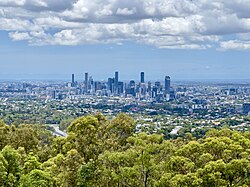
Brisbane (/ˈbrɪzbən/ⓘBRIZ-bən,[10] Turrbal/Yagara: Meanjin, Meaanjin, Maganjin or Magandjin) is the capital and largest city of the state of Queensland[11] and the third-most populous city in Australia, with a population of approximately 2.8 million.[1] Brisbane lies at the centre of South East Queensland, an urban agglomeration with a population of over 4 million. The central business district is situated within a peninsula of the Brisbane River about 15 km (9 mi) from its mouth at Moreton Bay.[12] Brisbane's metropolitan area sprawls over the hilly floodplain of the Brisbane River Valley between Moreton Bay and the Taylor and D'Aguilar mountain ranges,[13][14] encompassing several local government areas, most centrally the City of Brisbane. The demonym of Brisbane is Brisbanite.[15][16]
The Moreton Bay penal settlement was founded in 1824 at Redcliffe as a place for secondary offenders from the Sydney colony, but in May 1825 moved to North Quay on the banks of the Brisbane River, so named for the Governor of New South Wales Sir Thomas Brisbane. German Lutherans established the first free settlement of Zion Hill at Nundah in 1838, and in 1859 Brisbane was chosen as Queensland's capital when the state separated from New South Wales. During World War II, the Allied command in the South West Pacific was based in the city, along with the headquarters for General Douglas MacArthur of the United States Army.[17]
Brisbane is a global centre for research and innovation[18][19] and is a transportation hub, being served by large rail, bus and ferry networks, as well as Brisbane Airport and the Port of Brisbane, Australia's third-busiest airport and seaport. A diverse city with over 36% of its metropolitan population being foreign-born, Brisbane is frequently ranked highly in lists of the most liveable cities.[20][21] Brisbane has hosted major events including the 1982 Commonwealth Games, World Expo 88, the 2014 G20 summit, and will host the 2032 Summer Olympics.[22]
Brisbane is one of Australia's most popular tourist destinations and is Australia's most biodiverse and greenest city.[23] Brisbane's attractions include the Queensland Cultural Centre (which includes the Queensland Art Gallery, the Gallery of Modern Art and the State Library of Queensland), South Bank Parklands, the City Botanic Gardens, the Mount Coot-tha Botanic Gardens, the Brisbane Riverwalk, Moreton Bay and the D'Aguilar National Park. Brisbane's inner-city neighbourhoods are known for their historic Queenslander houses.
Toponymy
[edit]
Brisbane is named after the Brisbane River, which in turn was named after Sir Thomas Brisbane, the governor of New South Wales from 1821 to 1825.[24][25][26] The name is derived from the Scottish Gaelic bris, meaning 'to break or smash' and the Old English word ban meaning 'bone'.[27][28] Popular nicknames for Brisbane include Brissie, Brisvegas, "Brizzie" and theRiver City.[29][30]
Part of the Brisbane conurbation is located on traditional indigenous land known also as Meanjin, Meaanjin, Maganjin or Magandjin amongst other spellings.[31] There is a difference of opinion between local traditional owners over the spelling, provenance and pronunciation of indigenous names for Brisbane.[32] Tom Petrie in 1901 stated that the name Meeannjin referred to the area that Brisbane CBD now straddles. Some sources state that the name means 'place shaped as a spike' or 'the spearhead' referencing the shape of the Brisbane River along the area of the Brisbane CBD.[33][34][35][36] A contemporary Turrbal organisation has also suggested it means 'the place of the blue water lilies'.[37] Local Elder Gaja Kerry Charlton posits that Meanjin is based on a European understanding of 'spike', and that the phonetically similar Yagara name Magandjin — after the native tulipwood trees (magan) at Gardens Point — is a more accurate and appropriate Aboriginal name for Brisbane.[38]
Aboriginal groups claiming traditional ownership of the area include the Yagara, Turrbal and Quandamooka peoples.[39][40] Brisbane is home to the land of a number of Aboriginal language groups, primarily the Yagara language group which includes the Turrbal language.[41][42][43][44]
History
[edit]
Main article: History of Brisbane
For a chronological guide, see Timeline of Brisbane.
Pre-colonisation
[edit]
Main article: History of Indigenous Australians
Aboriginal Australians have lived in coastal South East Queensland for at least 22,000 years, with an estimated population between 6,000 and 10,000 individuals before European settlement in the 1820s.[45][46] Aboriginal groups claiming traditional ownership of the area include the Yagara, Turrbal and Quandamooka peoples.[47][48][49] A website representing a Turrbal culture organisation claims that historical documents suggest that the Turrbal peoples were the only traditional owners of Brisbane when British settlers first arrived.[50]
Archaeological evidence suggests frequent habitation around the Brisbane River, and notably at the site now known as Musgrave Park.[51] The rivers were integral to life and supplied an abundance of food included fish, shellfish, crab, and prawns. Good fishing places became campsites and the focus of group activities. The district was defined by open woodlands with rainforest in some pockets or bends of the Brisbane River.[52]
Being a resource-rich area and a natural avenue for seasonal movement, Meanjin and the surrounding areas acted as a way station for groups travelling to ceremonies and spectacles. The region had several large (200–600 person) seasonal camps, the biggest and most important located along waterways north and south of the current city heart: Barambin or York's Hollow camp (today's Victoria Park) and Woolloon-cappem (Woolloongabba/South Brisbane), also known as Kurilpa. These camping grounds continued to function well into colonial times, and were the basis of European settlement in parts of Brisbane.[53]
18th and 19th centuries
[edit]
Main articles: European maritime exploration of Australia, Moreton Bay Penal Settlement, and Early Streets of Brisbane
In 1770, British navigator James Cook sailed through South Passage between the main offshore islands leading to the bay, which he named after James Douglas, 14th Earl of Morton, misspelled as "Moreton".[54]
Matthew Flinders initially explored the Moreton Bay area on behalf of the British authorities. On 17 July 1799, Flinders landed at present-day Woody Point, which he named Red Cliff Point after the red-coloured cliffs visible from the bay.[55]
In 1823 the Governor of New South Wales, Sir Thomas Brisbane, gave instructions for the development of a new northern penal settlement, and an exploration party commanded by John Oxley further explored Moreton Bay in November 1823.[56]
The Old Windmill built in 1828, a site of convict punishments and executions, is the oldest surviving building in Queensland
Oxley explored the Brisbane River as far as Goodna, 20 km (12 mi) upstream from the present-day central business district of Brisbane.[56] He also named the river after the governor of the time.[56] Oxley also recommended Red Cliff Point for the new colony, reporting that ships could land at any tide and easily get close to the shore.[57] The convict settlement party landed in Redcliffe on 13 September 1824 formally establishing the Moreton Bay Penal Settlement that would become Brisbane. The party was under the command of Lieutenant Henry Miller and consisted of 14 soldiers (some with wives and children) and 29 convicts. However, the settlers abandoned this site after a year and moved to an area on the Brisbane River now known as North Quay, 28 km (17 mi) south, which offered a more reliable water-supply. The newly selected Brisbane region was plagued by mosquitoes at the time.[58]
After visiting the Redcliffe settlement, Sir Thomas Brisbane then travelled 45 km (28 mi) up the Brisbane River in December 1824. Governor Brisbane stayed overnight in a tent and often landed ashore, thus bestowing upon the future Brisbane City the distinction of being the only Australian capital city visited by its namesake.[59] Chief Justice Forbes gave the new settlement the name of Edenglassie before it was named Brisbane.[60][need quotation to verify]
The penal settlement under the control of Captain Patrick Logan (Commandant from 1826 to 1830) flourished, with the numbers of convicts increasing dramatically from around 200 to over 1,000 men.[61] He developed a substantial settlement of brick and stone buildings, complete with school and hospital. He formed additional outstations and made several important journeys of exploration. Logan became infamous for his extreme use of the cat o' nine tails on convicts. The maximum allowed limit of lashes was 50; however, Logan regularly applied sentences of 150 lashes.[61]
During this period raids on maize fields were conducted by local Aboriginal groups in the Corn Field Raids of 1827-1828. These groups destroyed and plundered the maize fields in South Bank and Kangaroo Point, with the possible motive of extracting compensation from the settlers or warning them not to expand beyond their current area.[62][63]
An early sketch of the town of Brisbane including the Convict Hospital, 1835
Between 1824 and 1842, almost 2,400 men and 145 women were detained at the Moreton Bay convict settlement under the control of military commandants.[64] However, non-convict European settlement of the Brisbane region commenced in 1838 and the population grew strongly thereafter, with free settlers soon far outstripping the convict population.[65] German missionaries settled at Zions Hill, Nundah as early as 1837, five years before Brisbane was officially declared a free settlement. The band consisted of ministers Christopher Eipper (1813–1894), Carl Wilhelm Schmidt, and lay missionaries Haussmann, Johann Gottried Wagner, Niquet, Hartenstein, Zillman, Franz, Rode, Doege and Schneider.[66] They were allocated 260 hectares and set about establishing the mission, which became known as the German Station.[67] Later in the 1860s many German immigrants from the Uckermark region in Prussia as well as from other German regions settled in the areas of Bethania, Beenleigh and the Darling Downs. These immigrants were selected and assisted through immigration programs established by Rev Dr John Dunmore Lang and Johann Christian Heussler and were offered free passage, good wages, and selections of land.[68][69]
Scottish immigrants from the ship Fortitude arrived in Brisbane in 1849, enticed by Lang on the promise of free land grants. Denied land, the immigrants set up camp in York's Hollow waterholes in the vicinity of today's Victoria Park, Herston, Queensland. A number of the immigrants moved in and settled the suburb, naming it Fortitude Valley after the ship on which they arrived.[70]
Free settlers entered the area from 1835,[citation needed] and by the end of 1840, Robert Dixon had begun work on the first plan of Brisbane Town, in anticipation of future development.[71] The Roman Catholic church erected the Pugin Chapel in 1850, to the design by the gothic revivalist Augustus Pugin. Letters patent dated 6 June 1859, proclaimed by Sir George Ferguson Bowen on 10 December 1859, separated Queensland from New South Wales, whereupon Bowen became Queensland's first governor,[72] with Brisbane chosen as the capital.[73] Old Government House was constructed in 1862 to house Sir George Bowen's family, including his wife, the noblewoman Diamantina, Lady Bowen di Roma. During the tenure of Lord Lamington, Old Government House was the likely site of the origin of Lamingtons.[74]
During the War of Southern Queensland, Indigenous attacks occurred across the city, committing robberies and terrorising unarmed residents.[75][76] Reprisal raids took place against the Duke of York's clan in Victoria Park in 1846 and 1849 by British soldiers of the 11th Regiment, however the clan had been wrongfully targeted as the attacks on Brisbane had not been committed by the Turrbal themselves but other tribes farther north.[77][78] In 1855, Dundalli, a prominent leader during the conflict, was captured and executed by hanging at the present site of the GPO.
In 1862, the first sugarcane plantation in Queensland was established near Brisbane by Captain Louis Hope and John Buhôt.[citation needed]
In 1864, the Great Fire of Brisbane burned through the central parts of the city, destroying much of Queen Street.[79] The 1860s were a period of economic and political turmoil leading to high unemployment, in 1866 hundreds of impoverished workers convened a meeting at the Treasury Hotel, with a cry for "bread or blood", rioted and attempted to ransack the Government store.[80]
The City Botanic Gardens were originally established in 1825 as a farm for the Moreton Bay Penal Settlement, and were planted by convicts in 1825 with food crops to feed the prison colony.[81] In 1855, several acres was declared a Botanic Reserve under the Superintendent Walter Hill, a position he held until 1881.[82][83] Some trees planted in the Gardens were among the first of their species to be planted in Australia, including the jacaranda and poinciana.[84]
Edward Street looking west across the intersection with Queen Street, Brisbane, 1889
Charles Tiffin was appointed as Queensland Government Architect in 1859, and pursued an intellectual policy in the design of public buildings based on Italianate and Renaissance revivalism, with such buildings as Government House, the Department of Primary Industries Building in 1866, and the Queensland Parliament built in 1867. The 1880s brought a period of economic prosperity and a major construction boom in Brisbane, that produced an impressive number of notable public and commercial buildings. John James Clark was appointed Queensland Government Architect in 1883, and continuing in Tiffin's design for public buildings, asserted the propriety of the Italian Renaissance, drawing upon typological elements and details from conservative High Renaissance sources. Building in this trace of intellectualism, Clark designed the Treasury Building in 1886, and the Yungaba Immigration Centre in 1885.[85] Other major works of the era include Customs House in 1889, and the Old Museum Building completed in 1891.
Fort Lytton was constructed in 1882 at the mouth of the Brisbane river, to protect the city against foreign colonial powers such as Russia and France, and was the only moated fort ever built in Australia.
The city's slum district of Frog's Hollow, named so for its location being low-lying and swampy, was both the red light district of colonial Brisbane and its Chinatown, and was the site of prostitution, sly grog, and opium dens. In 1888, Frog's Hollow was the site of anti-Chinese riots, where more than 2000 people attacked Chinese homes and businesses.[86]
The Great Flood of 1893 was one of the worst disasters in the city's history, flooding in Queen Street
In 1893 Brisbane was affected by the Black February flood, when the Brisbane River burst its banks on three occasions in February and again in June in the same year, with the city receiving more than a year's rainfall during February 1893, leaving much of the city's population homeless. In 1896, the Brisbane river saw its worst maritime disaster with the capsize of the ferry Pearl, between the 80–100 people on board there were only 40 survivors.[87]
20th century
[edit]
Further information: Federation of Australia
When the colonies federated in 1901, celebrations were held in Brisbane to mark the event, with a triumphal arch erected in Queen Street. In May that year, the Duke of Cornwall and York (later King George V) laid the foundation stone of St John's Cathedral, one of the great cathedrals of Australia. The University of Queensland was founded in 1909 and first sited at Old Government House, which became vacated as the government planned for a larger residence. Fernberg House, built in 1865, became the temporary residence in 1910, and later made the permanent government house.
A demonstration in Albert Square during the 1912 general strike
In 1912, Tramway employees were stood down for wearing union badges which sparked Australia's first general strike, the 1912 Brisbane General Strike, which became known as Black Friday, for the savagery of the police baton charges on crowds of trade unionists and their supporters. In 1917, during World War I, the Commonwealth Government conducted a raid on the Queensland Government Printing Office, with the aim of confiscating copies of Hansard that covered debates in the Queensland Parliament where anti-conscription sentiments had been aired.
Russian immigration took place in the years 1911–1914. Many were radicals and revolutionaries seeking asylum from tsarist political repression in the final chaotic years of the Russian Empire; considerable numbers were Jews escaping state-inspired pogroms. They had fled Russia via Siberia and Northern China, most making their way to Harbin, in Manchuria, then taking passage from the port of Dalian to Townsville or Brisbane, the first Australian ports of call.[88]
Following the First World War, conflict arose between returned servicemen of the First Australian Imperial Force and socialists along with other elements of society that the ex-servicemen considered to be disloyal toward Australia.[89] Over the course of 1918–1919, a series of violent demonstrations and attacks known as the Red Flag riots, were waged throughout Brisbane. The most notable incident occurred on 24 March 1919, when a crowd of about 8,000 ex-servicemen clashed violently with police who were preventing them from attacking the Russian Hall in Merivale Street, South Brisbane, which was known as the Battle of Merivale Street. Over 20 small municipalities and shires were amalgamated in 1925 to form the City of Brisbane, governed by the Brisbane City Council.[90] A significant year for Brisbane was 1930, with the completion of Brisbane City Hall, then the city's tallest building and the Shrine of Remembrance, in ANZAC Square, which has become Brisbane's main war memorial.[91]
Queen street looking south, c. 1930
These historic buildings, along with the Story Bridge which opened in 1940, are key landmarks that help define the architectural character of the city. Following the death of King George V in 1936, Albert square was widened to include the area which had been Albert Street, and renamed King George Square in honour of the King. An equestrian statue of the king and two Bronze Lion sculptures were unveiled in 1938.[citation needed]
In 1939, armed farmers marched on the Queensland Parliament and stormed the building in an attempt to take hostage the Queensland Government led by Labor Premier William Forgan Smith, in an event that became known as the Pineapple rebellion.[92]
Parade of RAAF servicemen through Queen street, c. 1940
During World War II, Brisbane became central to the Allied campaign, since it was the northernmost city with adequate communications facilities. From July 1942 to September 1944, AMP Building (now called MacArthur Central) was used as the headquarters for South West Pacific Area under General MacArthur. MacArthur had previously rejected use of the University of Queensland complex as his headquarters, as the distinctive bends in the river at St Lucia could have aided enemy bombers. Also used as a headquarters by the American troops during World War II was the T & G Building.[93] About one million US troops passed through Australia during the war, as the primary co-ordination point for the South West Pacific.[94] Wartime Brisbane was defined by the racial segregation of African American servicemen, prohibition and sly grog, crime, and jazz ballrooms.[95][96]
In 1942, Brisbane was the site of a violent clash between visiting US military personnel and Australian servicemen and civilians, which resulted in one death and hundreds of injuries. This incident became known colloquially as the Battle of Brisbane.[97]
Post-war Brisbane had developed a big country town stigma, an image the city's politicians and marketers were very keen to remove.[98] In the late 1950s, an anonymous poet known as The Brisbane Bard generated much attention to the city which helped shake this stigma.[99][100] In 1955, Wickham Terrace was the site of a terrorist incident involving shootings and bombs, by the German immigrant Karl Kast. Despite steady growth, Brisbane's development was punctuated by infrastructure problems. The state government under Joh Bjelke-Petersen began a major program of change and urban renewal, beginning with the central business district and inner suburbs. Trams in Brisbane were a popular mode of public transport until the network was closed in 1969, in part the result of the Paddington tram depot fire.
Between 1968 and 1987, Queensland was governed by Bjelke-Petersen, whose government was characterised by social conservatism, police corruption, and the brutal suppression of protest and has been described as a police state.[101] However, during this time Brisbane developed a counterculture focused on the University of Queensland, street marches and Brisbane punk rock music.[citation needed]
In 1971, the touring Springboks were to play against the Australian Rugby team. This was met with plans for protests due to the growing international and local opposition to apartheid in South Africa. However, before their arrival Bjelke-Petersen declared a state of emergency for a month, citing the importance of the tour.[102] This did not stop the protest however with violent clashes between protestors and police erupting when several hundred demonstrators assembled outside a Brisbane motel on Thursday, 22 July 1971, where the Springbok team was staying. A second protest saw a large number of demonstrators assembled once more outside the Tower Mill Motel and after 15 minutes of peaceful protest, a brick was thrown into the motel room and police took action to clear the road and consequently disproportionate violence was used against demonstrators.[103]
In the lead up to the 1980s Queensland fell subject to many forms of censorship. In 1977 things had escalated from prosecutions and book burnings, under the introduction of the Literature Board of Review, to a statewide ban on protests and street marches. In September 1977 the Queensland Government introduced a ban on all street protests, resulting in a statewide civil liberties campaign of defiance.[104] This saw two thousand people arrested and fined, with another hundred being imprisoned, at a cost of almost five million dollars to the State Government.[105] Bjelke-Petersen publicly announced on 4 September 1977 that "the day of the political street march is over ... Don't bother to apply for a permit. You won't get one. That's government policy now."[106] In response to this, protesters came up with the idea of Phantom Civil Liberties Marches where protesters would gather and march until the police and media arrived. They would then disperse, and gather together again until the media and police returned, repeating the process over and over again.[107]
The end of the Bjelke-Petersen era began with the Fitzgerald Inquiry of 1987 to 1989, a judicial inquiry presided over by Tony Fitzgerald investigating Queensland Police corruption. The inquiry resulted in the resignation of Premier Bjelke-Petersen, the calling of two by-elections, the jailing of three former ministers and the Police Commissioner Terry Lewis (who also lost his knighthood). It also contributed to the end of the National Party of Australia's 32-year run as the governing political party in Queensland.[citation needed]
In 1973, the Whiskey Au Go Go nightclub in the city's entertainment district, was firebombed that resulted in 15 deaths, in what is one of Australia's worst mass killings.[108] The 1974 Brisbane flood was a major disaster which temporarily crippled the city, and saw a substantial landslip at Corinda. During this era, Brisbane grew and modernised, rapidly becoming a destination of interstate migration. Some of Brisbane's popular landmarks were lost to development in controversial circumstances, including the Bellevue Hotel in 1979 and Cloudland in 1982. Major public works included the Riverside Expressway, the Gateway Bridge, and later, the redevelopment of South Bank. Starting with the monumental Robin Gibson-designed Queensland Cultural Centre, with the first stage the Queensland Art Gallery completed in 1982, the Queensland Performing Arts Centre in 1985, and the Queensland Museum in 1986.[citation needed]
Brisbane hosted the World Expo 88 in 1988
Brisbane hosted the 1982 Commonwealth Games and World Expo 88. These events were accompanied by a scale of public expenditure, construction, and development not previously seen in the state of Queensland.[109][110] Brisbane's population growth far exceeded the national average in the last two decades of the 20th century, with a high level of interstate migration from Victoria and New South Wales. In the late 1980s Brisbane's inner-city areas were struggling with economic stagnation, urban decay and crime which resulted in an exodus of residents and business to the suburban fringe, in the early 1990s the city undertook an extensive and successful urban renewal of the Woolstore precinct as well as the development of South Bank Parklands.[111]
21st century
[edit]
The Kangaroo Point Green Bridge, one of several pedestrian bridges built over Brisbane River during the 21st century
Brisbane was impacted by major floods in January 2011 and February 2022. The Brisbane River did not reach the same height as the previous 1974 flood on either occasion, but caused extensive disruption and damage to infrastructure.[112][113]
The Queensland Cultural Centre was also expanded, with the completion of the State Library and the Gallery of Modern Art in 2006, and the Kurilpa Bridge in 2009, the world's largest hybrid tensegrity bridge.[114] Brisbane also hosted major international events including the final Goodwill Games in 2001, the Rugby League World Cup final in 2008 and again in 2017, as well as the 2014 G20 Brisbane summit.
Population growth has continued to be among the highest of the Australian capital cities in the first two decades of the 21st century, and major infrastructure including the Howard Smith Wharves, Roma Street Parklands, Queens Wharf, the Brisbane Riverwalk, the Queen's Wharf casino and resort precinct, the Brisbane International Cruise Terminal, the Clem Jones, Airport Link, and Legacy Way road tunnels, and the Airport, Springfield, Redcliffe Peninsula and Cross River Rail railway lines have been completed or are under construction.
Brisbane will host the 2032 Summer Olympics and 2032 Summer Paralympics.[115][116]
Geography and environment
[edit]
Main article: Geography of Brisbane
Satellite image of Brisbane metropolitan area taken in 2019New Farm Cliffs, formed from Brisbane tuff rock, behind Howard Smith WharvesScarborough Beach at Scarborough on the Redcliffe Peninsula
Brisbane is in the southeast corner of Queensland. The city is centred along the Brisbane River, and its eastern suburbs line the shores of Moreton Bay, a bay of the Coral Sea. The greater Brisbane region is on the coastal plain east of the Great Dividing Range, with the Taylor and D'Aguilar ranges extending into the metropolitan area. Brisbane's metropolitan area sprawls along the Moreton Bay floodplain between the Gold and Sunshine coasts, approximately from Caboolture in the north to Beenleigh in the south, and across to Ipswich in the south west.
The Brisbane River is a wide tidal estuary and its waters throughout most of the metropolitan area are brackish and navigable. The river takes a winding course through the metropolitan area with many steep curves from the southwest to its mouth at Moreton Bay in the east. The metropolitan area is also traversed by several other rivers and creeks including the North Pine and South Pine rivers in the northern suburbs, which converge to form the Pine River estuary at Bramble Bay, the Caboolture River further north, the Logan and Albert rivers in the south-eastern suburbs, and tributaries of the Brisbane River including the Bremer River in the south-western suburbs, Breakfast Creek in the inner-north, Norman Creek in the inner-south, Oxley Creek in the south, Bulimba Creek in the inner south-east and Moggill Creek in the west. The city is on a low-lying floodplain,[117] with the risk of flooding addressed by various state and local government regulations and plans.[118]
The waters of Moreton Bay are sheltered from large swells by Moreton, Stradbroke and Bribie islands, so whilst the bay can become rough in windy conditions, the waves at the Moreton Bay coastline are generally not surfable. Unsheltered surf beaches lie on the eastern coasts of Moreton, Stradbroke and Bribie islands and on the Gold Coast and Sunshine Coast to the south and north respectively. The southern part of Moreton Bay also contains smaller islands such as St Helena Island, Peel Island, Coochiemudlo Island, Russell Island, Lamb Island and Macleay Island.
The city of Brisbane is hilly.[119] The urban area, including the central business district, are partially elevated by spurs of the Herbert Taylor Range, such as the summit of Mount Coot-tha, reaching up to 300 m (980 ft) and Enoggera Hill. The D'Aguilar National Park, encompassing the D'Aguilar Range, bounds the north-west of Brisbane's built-up area, and contains the taller peaks of Mount Nebo, Camp Mountain, Mount Pleasant, Mount Glorious, Mount Samson and Mount Mee. Other prominent rises in Brisbane are Mount Gravatt, Toohey Mountain, Mount Petrie, Highgate Hill, Mount Ommaney, Stephens Mountain, and Whites Hill, which are dotted across the city.
Much of the rock upon which Brisbane is located is the characteristic Brisbane tuff, a form of welded ignimbrite,[120] which is most prominently found at the Kangaroo Point Cliffs at Kangaroo Point and the New Farm Cliffs on the Petrie Bight reach of the Brisbane River. The stone was used in the construction of historical buildings such as the Commissariat Store and Cathedral of St Stephen, and the roadside kerbs in inner areas of Brisbane are still manufactured of Brisbane tuff.
Ecology
[edit]
Jacaranda trees in bloom at New Farm Park
Brisbane is located within the South East Queensland biogeographic region, and is home to numerous Eucalyptus varieties. Common trees in Brisbane include the Moreton Bay fig, an evergreen banyan with large buttress roots named for the region which are often lit with decorative lights in the inner city, as well as the jacaranda, a subtropical tree native to South America which line many avenues and parks and bloom with purple flowers during October.[121] Other trees common to the metropolitan area include Moreton Bay chestnut, broad-leaved paperbark, poinciana, weeping lilli pilli and Bangalow palm. Some of the banks of the Brisbane River and Moreton Bay are home to mangrove wetlands. The red poinsettia is the original official floral emblem of Brisbane, however it is native to Central America.[122] An additional floral emblem, the Brisbane wattle, which is native to the Brisbane area, was added in 2023.[123]
Brisbane is home to numerous bird species, with common species including rainbow lorikeets, kookaburras, galahs, Australian white ibises, Australian brushturkeys, Torresian crows, Australian magpies and noisy miners. Common reptiles include common garden skinks, Australian water dragons, bearded dragons and blue-tongued lizards. Common ringtail possums and flying foxes are common in parks and yards throughout the city, as are common crow butterflies, blue triangle butterflies, golden orb-weaver spiders and St Andrew's Cross spiders. The Brisbane River is home to many fish species including yellowfin bream, flathead, Australasian snapper, and bull sharks. The waters of Moreton Bay are home to dugongs, humpback whales, dolphins, mud crabs, soldier crabs, Moreton Bay bugs and numerous shellfish species. The koala and the graceful tree frog are the official faunal emblems of Brisbane, however both are increasingly less common due to the effects of increased development and climate-change.[122][124]
Climate
[edit]
Main article: Climate of Brisbane
Lightning over the Brisbane city centre, February 2020
Brisbane has a humid subtropical climate (Köppen climate classification: Cfa)[125] with hot, wet summers and moderately drier, mild winters.[126][127] Brisbane experiences an annual mean minimum of 16.6 °C (62 °F) and mean maximum of 26.6 °C (80 °F), making it Australia's second-hottest capital city after Darwin.[128] Seasonality is not pronounced, and average maximum temperatures of above 26 °C (79 °F) persist from October through to April.
Due to its proximity to the Coral Sea and a warm ocean current, Brisbane's overall temperature variability is somewhat less than most Australian capitals. Summers are long, hot, and wet, but temperatures only occasionally reach 35 °C (95 °F) or more. Eighty percent of summer days record a maximum temperature of 27 to 33 °C (81 to 91 °F). Winters are short and warm, with average maximums of about 22 °C (72 °F); maximum temperatures below 20 °C (68 °F) are rare.
The city's highest recorded temperature was 43.2 °C (109.8 °F) on Australia Day 1940 at the Brisbane Regional Office,[129] with the highest temperature at the current station being 41.7 °C (107.1 °F) on 22 February 2004;[130] but temperatures above 38 °C (100 °F) are uncommon. On 19 July 2007, Brisbane's temperature fell below the freezing point for the first time since records began, registering −0.1 °C (31.8 °F) at the airport station.[131] The city station has never dropped below 2 °C (36 °F),[132] with the average coldest night during winter being around 6 °C (43 °F), however locations in the west of the metropolitan area such as Ipswich have dropped as low as −5 °C (23 °F) with heavy ground frost.[133]
In 2009, Brisbane recorded its hottest winter day (from June to August) at 35.4 °C (95.7 °F) on 24 August;[134] The average July day however is around 22 °C (72 °F) with sunny skies and low humidity, occasionally as high as 27 °C (81 °F), whilst maximum temperatures below 18 °C (64 °F) are uncommon and usually associated with brief periods of cloud and winter rain.[132] The highest minimum temperature ever recorded in Brisbane was 28.0 °C (82.4 °F) on 29 January 1940 and again on 21 January 2017, whilst the lowest maximum temperature was 10.2 °C (50.4 °F) on 12 August 1954.[129]
Sleet or snow is exceptionally rare in Brisbane. The Bureau of Meteorology has only three official records of snow in Brisbane: June 1927, June 1932 (witnessed by seven people), and September 1958 (light flakes were seen by four people at 5:15pm in Moorooka, Wooloowin, Bowen Hills and Taringa). Unofficial eports exist of earlier snowfalls, such as follows from July 1882:[This quote needs a citation] "The snow was most noticeable in Woolloongabba, but in Stanley Street, South Brisbane it was sufficiently heavy to allow of people wiping it from their clothing. "In the vicinity of the museum the fall was, though very slight, plainly noticeable. "It is said that snow fell in this city 35 years ago, and the summer following the period of the fall was remarkable for its excessive heat."
Annual precipitation is ample. From November to March, thunderstorms are common over Brisbane, with the more severe events accompanied by large damaging hail stones, torrential rain and destructive winds. On an annual basis, Brisbane averages 124 clear days, with overcast skies more common in the warmer months.[135] Dewpoints in the summer average at around 20 °C (68 °F); the apparent temperature exceeds 30 °C (86 °F) on almost all summer days.[132] Brisbane's wettest day occurred on 21 January 1887, when 465 millimetres (18.3 in) of rain fell on the city, the highest maximum daily rainfall of Australia's capital cities. The wettest month on record was February 1893, when 1,025.9 millimetres (40.39 in) of rain fell, although in the last 30 years the record monthly rainfall has been a much lower 479.8 millimetres (18.89 in) from December 2010. Very occasionally a whole month will pass with no recorded rainfall, the last time this happened was August 1991.[129] The city has suffered four major floods since its founding, in February 1893, January 1974 (partially a result of Cyclone Wanda), January 2011 (partially a result of Cyclone Tasha) and February 2022.
Brisbane is within the southern reaches of the tropical cyclone risk zone. Full-strength tropical cyclones rarely affect Brisbane, but occasionally do so. The biggest risk is from ex-tropical cyclones, which can cause destructive winds and flooding rains.[136]
The average annual temperature of the sea ranges from 21.0 °C (69.8 °F) in July to 27.0 °C (80.6 °F) in February.[137]
Climate data for Brisbane (1999–2024 normals)
Month
Jan
Feb
Mar
Apr
May
Jun
Jul
Aug
Sep
Oct
Nov
Dec
Year
Record high °C (°F)
40.0
(104.0)
41.7
(107.1)
37.9
(100.2)
33.7
(92.7)
30.7
(87.3)
29.0
(84.2)
29.1
(84.4)
35.4
(95.7)
37.0
(98.6)
38.7
(101.7)
38.9
(102.0)
41.2
(106.2)
41.7
(107.1)
Mean daily maximum °C (°F)
30.4
(86.7)
30.2
(86.4)
29.2
(84.6)
27.2
(81.0)
24.5
(76.1)
22.1
(71.8)
22.0
(71.6)
23.5
(74.3)
25.7
(78.3)
27.1
(80.8)
28.3
(82.9)
29.6
(85.3)
26.7
(80.1)
Daily mean °C (°F)
26.1
(79.0)
25.9
(78.6)
24.8
(76.6)
22.3
(72.1)
19.2
(66.6)
17.0
(62.6)
16.3
(61.3)
17.3
(63.1)
19.8
(67.6)
21.8
(71.2)
23.6
(74.5)
25.1
(77.2)
21.6
(70.9)
Mean daily minimum °C (°F)
21.7
(71.1)
21.5
(70.7)
20.3
(68.5)
17.4
(63.3)
13.9
(57.0)
11.8
(53.2)
10.5
(50.9)
11.1
(52.0)
13.9
(57.0)
16.5
(61.7)
18.8
(65.8)
20.6
(69.1)
16.5
(61.7)
Record low °C (°F)
17.0
(62.6)
16.5
(61.7)
12.2
(54.0)
10.0
(50.0)
5.0
(41.0)
5.0
(41.0)
2.6
(36.7)
4.1
(39.4)
7.0
(44.6)
8.8
(47.8)
10.8
(51.4)
14.0
(57.2)
2.6
(36.7)
Average precipitation mm (inches)
141.1
(5.56)
181.9
(7.16)
129.3
(5.09)
60.5
(2.38)
69.8
(2.75)
56.9
(2.24)
30.4
(1.20)
34.6
(1.36)
29.7
(1.17)
85.8
(3.38)
100.1
(3.94)
140.0
(5.51)
1,048.2
(41.27)
Average rainy days (≥ 1 mm)
8.8
9.7
9.7
7.0
6.0
6.0
4.0
3.7
3.9
7.2
7.9
8.9
82.8
Average afternoon relative humidity (%)
57
59
57
54
49
52
44
43
48
51
56
57
52
Mean monthly sunshine hours
267
235
233
237
239
198
239
270
267
270
273
264
2,989
Percentage possible sunshine
63
65
62
69
71
63
73
78
74
68
67
62
68
Average ultraviolet index
13
12
10
7
5
4
4
5
7
10
12
13
9
Source: Bureau of Meteorology[138]
Urban structure
[edit]
The Brisbane CBD and surrounding metropolitan area from Mount Coot-tha Lookout in the Taylor Range
The Brisbane central business district (CBD, colloquially referred to as "the city") lies in a curve of the Brisbane river. The CBD covers 2.2 km2 (0.8 sq mi) and is walkable. Most central streets are named after members of the House of Hanover. Queen Street (named in honour of Queen Victoria) is Brisbane's traditional main street and contains its largest pedestrian mall, the Queen Street Mall. Streets named after female members (Adelaide, Alice, Ann, Charlotte, Elizabeth, Margaret, and Mary) run parallel to Queen Street and perpendicular to streets named after male members (Albert, Edward, George, and William).
The CBD's squares include King George Square, Post Office Square and ANZAC Square (home to the city's central war memorial).
The CBD and South Bank fronts the Brisbane River
At the broadest level, Brisbane's metropolitan area is informally divided into the northside and the southside, with the dividing line being the Brisbane River,[139] as crossing one of the 15 bridges across the river is required to travel to the opposite side by land transport. Due to the river's winding trajectory, this results in many areas which are south of the CBD being classified as located in the northside, and vice versa. At a more specific level, the metropolitan area contains informal regions including the northern, southern, eastern and western suburbs, the bayside suburbs along the Moreton Bay coastline, and the Moreton Bay, Redland, Logan and Ipswich regions in the outer north, east, south and west respectively.
Greater Brisbane had a density of 159 inhabitants per square kilometre (410/sq mi) in 2021.[2] Like most Australian cities, Brisbane has a sprawling metropolitan area which takes in excess of one hour to traverse either north to south or east to west by car without traffic.
From the 1970s onwards, there has been a large increase in the construction of apartment developments, including mid-rise and high rise buildings, which has quickened in the 21st century. At the 2021 census, 73.4% of residents lived in separate houses, 14.7% lived in apartments, and 11.4% lived in townhouses, terrace houses, or semidetached houses.[2]
Parklands
[edit]
Moreton Bay figs at the City Botanic Gardens
Brisbane's major parklands include the riverside City Botanic Gardens at Gardens Point,[140] Roma Street Parkland, the 27-hectare Victoria Park at Spring Hill and Herston, South Bank Parklands along the river at South Bank, the Brisbane Botanic Gardens at Mount Coot-tha and the riverside New Farm Park at New Farm.
There are many national parks surrounding the Brisbane metropolitan area. The D'Aguilar National Park is a major national park along the northwest of the metropolitan area in the D'Aguilar Range. The Glass House Mountains National Park is located to the north of the metropolitan area in the Glass House Mountains and provides green space between the Brisbane metropolitan area and the Sunshine Coast. The Tamborine National Park at Tamborine Mountain is located in the Gold Coast hinterland to the south of the metropolitan area.
The eastern metropolitan area is built along the Moreton Bay Marine Park, encompassing Moreton Bay. Significant areas of Moreton, North Stradbroke and Bribie islands also covered by the Moreton Island National Park, Naree Budjong Djara National Park and the Bribie Island National Park respectively. The Boondall Wetlands in the suburb of Boondall include 1,100 hectares of wetlands which are home to mangroves and shorebirds as well as walking tracks.
Aerial view of inner Brisbane with landmarks marked
1
2
3
4
5
6
7
8
9
10
11
12
12
13
14
15
16
17
18
19
20
21
22
23
24
25
26
27
28
29
30
31
32
33
1
Walter Taylor Bridge (road) (left), Albert Bridge (rail) (centre), unnamed bridge (rail) (right), Jack Pesch Bridge (far right)
Queensland University of Technology (QUT) Gardens Point Campus
20
Goodwill Bridge (pedestrians and pedal cycles)
21
The Royal Brisbane and Women's Hospital
22
Mater Private Hospital
23
Roma Street Rail Station
24
Roma Street Parkland
25
New Farm Park and Powerhouse
26
Victoria Park Golf Course
27
Brisbane Exhibition Ground
28
Brisbane Riverwalk
29
Inner City Bypass (rail) (left) (road) (right)
30
Indooroopilly Golf Course
31
Howard Smith Wharves
32
Eagle Street Pier
33
Queen Street Mall
Architecture
[edit]
Further information: List of tallest buildings in Brisbane and Queenslander (architecture)
The Commissariat Store dates back to 1828 and was built by convicts.
Brisbane has a number of heritage buildings, some of which date back to the 1820s, including The Old Windmill in Wickham Park, built by convict labour in 1824,[141] which is the oldest surviving building in Brisbane, and the Commissariat Store on William Street, built by convict labour in 1828, which was originally used as a grain house, and is now the home of the Royal Historical Society of Brisbane and contains a museum.[142][143][144] Other 19th and early 20th-century buildings of architectural significance include the Treasury Building, City Hall, Customs House, Land Administration Building, MacArthur Chambers, The Mansions, National Australia Bank Building, the Old Museum Building and the Federation-style People's Palace, a former temperance hotel on Edward Street.
One of the oldest synagogues in the Queensland area is the Brisbane Synagogue located on Margaret Street in Brisbane city. This historic synagogue can be attributed as the "centerpiece of the Jewish community's presence in the state" It was established in 1866 and designed by architect Arthur Morry. Another architect by the name of Andrea Stombuco has also been credited as a designer of the synagogue by previous members of the community. The architectural design of this historic synagogue is in the style of Neo-Moorish also known as Byzantine style.[145]
Queenslander-style house in Sherwood, a suburb of Brisbane
Queenslander-style housing is common in Brisbane.[146] Queenslander homes typically feature timber construction with large verandahs, gabled corrugated iron roofs, and high ceilings. Most of these houses are elevated on stumps (also called stilts), traditionally built of timber, which allow for a void under the houses which aids in cooling. The relatively low cost of timber in south-east Queensland meant that until recently, most residences were constructed of timber, rather than brick or stone.[citation needed] Early legislation decreed a minimum size for residential blocks leading to few terrace houses being constructed in Brisbane.[citation needed] The high-density housing that historically existed came in the form of miniature Queenslander-style houses which resemble the much larger traditional styles, but are sometimes only one-quarter the size.[citation needed] These houses are most common in the inner-city suburbs.
Brisbane is home to several of Australia's tallest buildings. All of Brisbane's skyscrapers (buildings with a height greater than 150 m (490 ft)) are located within the CBD, but the inner suburbs are also home to a number of high-density buildings, Torbreck being the first high-rise and mix-use residential development in Queensland. Brisbane's 91-metre City Hall was the city's tallest building for decades after its completion in 1930 and was finally surpassed in 1970, which marked the beginning of the widespread construction of high-rise buildings.[citation needed]
Brisbane's tallest building is currently Brisbane Skytower, which has a height of 270 m (890 ft).[147] Architecturally prominent skyscrapers include the Harry Seidler-designed Riparian Plaza, One One One Eagle Street, which incorporates LED lighting resembling the buttress roots of the Moreton Bay fig, and 1 William Street, the headquarters of the Queensland Government.
Former temperance hotel, the People's Palace, built in the Federation Filigree style between 1910 and 1911
Manor Apartment Hotel, completed in 1931
Shrine of Remembrance at ANZAC Square, a major memorial in Brisbane
Brisbane Skytower, Brisbane's tallest building
Demographics
[edit]
Main article: Demographics of Brisbane
Brisbane's Greater Capital City Statistical Area includes the Local Government Areas of City of Brisbane, City of Ipswich, City of Moreton Bay, Logan City and Redland City, as well as parts of Lockyer Valley Region, Scenic Rim Region and Somerset Region, which form a continuous metropolitan area. The Australian Bureau of Statistics estimates that the population of Greater Brisbane is 2,780,063 as of June 2024,[1] making it the third-largest city in Australia.
Ancestry and immigration
[edit]
Place of birth (2021)[2]
Birthplace[N 1]
Population
Australia
1,726,655
New Zealand
111,649
England
95,284
India
51,650
Mainland China
41,978
Philippines
27,907
South Africa
26,918
Vietnam
20,308
South Korea
13,305
Taiwan
12,826
Scotland
11,956
Malaysia
11,826
Fiji
10,800
United States
10,530
Hong Kong SAR
9,799
At the 2021 census, the most commonly nominated ancestries were:
English (32.5%)
Australian (31.6%)[N 2]
Irish (11.1%)
Scottish (10.1%)
German (5.7%)
Chinese (4.7%)
Indonesian (3.7%)
Aboriginal (2.8%)[N 3]
Italian (2.7%)
Indian (2.4%)
Dutch (1.6%)
Filipino (1.6%)
Maori (1.5%)
New Zealander (1.4%)
Samoan (1.2%)
Vietnamese (1.1%)
The 2021 census showed that 20.7% of Brisbane's inhabitants were born overseas and 25.2% of inhabitants had at least one parent born overseas.[149] Brisbane has the 26th largest immigrant population among world metropolitan areas. Of inhabitants born outside of Australia, the five most prevalent countries of birth were New Zealand, England, India, mainland China and the Philippines.
The areas of Sunnybank,[150] Sunnybank Hills,[151] Stretton,[152] Robertson,[153] Calamvale,[154] Macgregor,[155] Eight Mile Plains,[156] Runcorn,[157] and Rochedale,[158] are home to a large proportion of Brisbane's Mainland China, Taiwan and Hong Kong-born population, with Chinese being the most commonly-reported ancestry in each of these areas. The Vietnamese-born are the largest immigrant group in Inala,[159] Darra,[160] Durack,[161] Willawong,[162] Richlands,[163] and Doolandella.[164] The Indian-born are the largest immigrant group in Chermside.[165]
At the 2021 census, 3.0% of Brisbane's population identified as being Indigenous, which includes Aboriginal Australians and Torres Strait Islanders.[N 4][149]
Brisbane's Chinatown. Chinese Australians are Brisbane's largest non-European ancestry.
St John's Cathedral, an Anglican cathedral
Albert Street Uniting Church
Language
[edit]
At the 2021 census, 77.3% of inhabitants spoke only English at home,[149] with the next most common languages being Mandarin (2.5%), Vietnamese (1.1%), Punjabi (0.9%), Cantonese (0.9%), and Spanish (0.8%).[149]
Religion
[edit]
At the 2021 census, the most commonly cited religious affiliation was "No religion" (41.4%). Brisbane's most popular religion at the 2021 census was Christianity at 44.3%, the most popular denominations of which were Catholicism (18.6%) and Anglicanism (9.7%). Brisbane's CBD is home to two cathedrals – St John's (Anglican) and St Stephen's (Catholic).
The most popular non-Christian religions at the 2021 census were Hindu (2%), Buddhist (1.9%), and Muslim (1.8%).[166]
Economy
[edit]
Main articles: Economy of Brisbane and Port of Brisbane
The Golden Triangle financial precinct surrounding Eagle Street Pier in the CBD
Categorised as a global city, Brisbane is among Asia-Pacific cities with largest GDPs and is one of the major business hubs in Australia, with strengths in mining, banking, insurance, transportation, information technology, real estate and food.[167]
Some of the largest companies headquartered in Brisbane, all among Australia's largest, include Suncorp Group, Virgin Australia, Aurizon, Bank of Queensland, Flight Centre, CUA, Sunsuper, QSuper, Domino's Pizza Enterprises, Star Entertainment Group, ALS, TechnologyOne, NEXTDC, Super Retail Group, New Hope Coal, Jumbo Interactive, National Storage, Collins Foods, and Boeing Australia.[168] Most major Australian companies, as well as numerous international companies, have contact offices in Brisbane.
Brisbane throughout its history has been one of Australia's most important seaport cities. The Port of Brisbane is located at the Brisbane River's mouth on Moreton Bay and on the adjacent Fisherman's Island, created by means of land reclamation. It is the 3rd busiest port in Australia for value of goods.[169] Container freight, sugar, grain, coal and bulk liquids are the major exports. Most of the port facilities are less than three decades old and some are built on reclaimed mangroves and wetlands. The Port is a part of the Australia TradeCoast, which includes the Brisbane Airport along with large industrial estates located along both banks at the mouth of the Brisbane River.[170]
White-collar industries include information technology, financial services, higher education and public sector administration generally concentrated in and around the central business district and satellite hubs located in the inner suburbs such as South Brisbane, Fortitude Valley, Spring Hill, Milton, and Toowong.
Blue-collar industries, including petroleum refining, stevedoring, paper milling, metalworking and QR railway workshops, tend to be located on the lower reaches of the Brisbane River proximal to the Port of Brisbane and in new industrial zones on the urban fringe.
Tourism is an important part of the Brisbane economy, both in its own right and as a gateway to other areas of Queensland,[171] as is international education, with over 95,000 international students enrolled in universities and other tertiary education institutions in the central City of Brisbane local government area alone in 2018.[172]
Retail
[edit]
The Queen Street Mall, Queensland's largest pedestrian mall
Retail in the CBD is centred around the Queen Street Mall, which is Queensland's largest pedestrian mall. Shopping centres in the CBD include Uptown (formerly the Myer Centre), the Wintergarden, MacArthur Central and QueensPlaza, with the last of these along with Edward Street forming the city's focus for luxury brands. There are historical shopping arcades at Brisbane Arcade and Tattersalls Arcade. Suburbs adjacent to the CBD such as Fortitude Valley (particularly James Street), South Brisbane and West End are also a major inner-city retail hubs.
Outside of the inner-city, retail is focused on indoor shopping centres, including numerous regional shopping centres along with six super regional shopping centres, all of which are among Australia's largest, namely: Westfield Chermside in the north; Westfield Mt Gravatt in the south; Westfield Carindale in the east; Indooroopilly Shopping Centre in the west; Westfield North Lakes in the outer-north; and Logan Hyperdome in the outer-south. Brisbane's major factory outlet centres are the Direct Factory Outlets at Skygate and Jindalee.
The 100-hectare (250-acre) Brisbane Markets at Rocklea are Brisbane's largest wholesale markets, whilst smaller markets operate at numerous locations throughout the city including South Bank Parklands, Davies Park in West End, Queensland, and the Eat Street Markets at Hamilton.
Culture and sport
[edit]
Main article: Culture of Brisbane
See also: Popular entertainment in Brisbane, Brisbane punk rock, and Cuisine of Brisbane
One of the most popular works in the Queensland Art Gallery's collection, Under The Jacaranda (1903) by Richard Godfrey Rivers shows the first jacaranda tree planted in Brisbane.
Brisbane is home to several art galleries, the largest of which are the Queensland Art Gallery and the Queensland Gallery of Modern Art (GOMA), which is the largest modern art gallery in Australia. GOMA holds the Asia Pacific Triennial (APT) which focuses on contemporary art from the Asia and Pacific in a variety of media from painting to video work. In addition, its size enables the gallery to exhibit particularly large shows.
GOMA houses the Australian Cinémathèque, a dedicated film facility offering a diverse program of screenings, including international cinema, influential filmmakers, rare prints, restorations and silent films with a live musical accompaniment. Screenings take place Wednesday and Friday nights, as well as matinees on weekends. Most screenings are free admission.[173]
Queensland Performing Arts Centre
Dramatic and musical theatre performances are held at the multiple large theatres located at Queensland Performing Arts Centre (QPAC). The Brisbane Powerhouse in New Farm and the Judith Wright Arts Centre in Fortitude Valley also feature diverse programs featuring exhibitions and festivals of visual art, music and dance. Brisbane is also home to numerous small theatres including the Brisbane Arts Theatre in Petrie Terrace, the La Boite Theatre Company which performs at the Roundhouse Theatre at Kelvin Grove, the Twelfth Night Theatre at Bowen Hills, the Metro Arts Theatre in Edward Street, and the Queensland Theatre Company's Bille Brown Theatre in West End.
The Queensland Performing Arts Centre (QPAC) at South Bank, consists of the Lyric Theatre, the Concert Hall, the Cremorne Theatre and the Playhouse Theatre and is home to the Queensland Ballet, Opera Queensland, the Queensland Theatre Company, and the Queensland Symphony Orchestra. The Queensland Conservatorium, a musical conservatorium in which professional music companies and conservatorium students also stage performances, is located within the South Bank Parklands. Numerous choirs present performances across the city annually. These choirs include the Brisbane Chorale, Queensland Choir, Brisbane Chamber Choir, Canticum Chamber Choir, ChoirWorks, Imogen Children's Chorale, and Brisbane Birralee Voices.
Go Between Bridge, named after local jangle pop band the Go-Betweens
Brisbane's live music scene is diverse and its history is often intertwined with social unrest and authoritarian politics, as retold by journalist Andrew Stafford in Pig City: From The Saints to Savage Garden. Popular live music venues, including pubs and clubs, can be found within both the CBD and Fortitude Valley.[174][175] The Brisbane Entertainment Centre at Boondall hosts many musical concerts, with some of the largest being held at Lang Park. Musicians from Brisbane include the Bee Gees (raised in Redcliffe and Cribb Island), the Saints (based in Brisbane since 1974, one of the first punk rock bands), the Go-Betweens (after whom Brisbane's Go Between Bridge is named, and whose songs and albums, such as Spring Hill Fair, reflect the attitudes of 1980s Brisbane), Savage Garden, Powderfinger (who met at Brisbane Grammar School and the University of Queensland), and the Veronicas (born and raised in Albany Creek). The city is featured in music including the Saints' "Brisbane (Security City)" (1978); the Stranglers' "Nuclear Device" (1979) about Joh Bjelke-Petersen; Midnight Oil's single "Dreamworld" (1987); and Powderfinger's album Vulture Street (2003).
State Library of Queensland
Prominent writers from Brisbane include David Malouf (whose 1975 novel Johnno is set in Brisbane and at Brisbane Grammar School during World War II), Nick Earls (whose 1996 novel Zigzag Street is set at Zigzag Street in Red Hill), and Li Cunxin, author of Mao's Last Dancer and artistic director of the Queensland Ballet. Brisbane is a 2018 novel by Russian writer Eugene Vodolazkin. In the novel, the city serves as a metaphor of the promised land for the protagonist. The State Library of Queensland, the state's largest library, is located at the Queensland Cultural Centre.
Since the late 20th century, numerous films have been shot in Brisbane, and the popular children's animated television series Bluey is produced and set in Brisbane.
Brisbane is home to over 6,000 restaurants and dining establishments,[176] with outdoor dining featuring prominently. The most popular cuisines by number of dining establishments are Japanese,[177] Chinese,[178] Modern Australian,[179] Italian,[180] American,[181] Indian,[182] and Vietnamese.[183] Moreton Bay bugs, less commonly known as flathead lobsters, are an ingredient named for the Brisbane region and which feature commonly in the city's cuisine, along with macadamia nuts, also native to the region.
Annual events
[edit]
Riverfire at the Story Bridge
The Royal Queensland Exhibition (known locally as the Ekka), an agricultural exhibition held each August at the Brisbane Showgrounds in Bowen Hills, is the longest-running major annual event held in Brisbane. A public holiday is held for each local government area across Brisbane to enable widespread public attendance.
The Brisbane Festival is held each September at South Bank Parklands, the CBD and surrounding areas. It includes Riverfire, one of the nation's largest annual fireworks displays, which is attended by hundreds of thousands of residents.
The Brisbane International Film Festival (BIFF) is held in July/August each year in a variety of venues around Brisbane. BIFF features new films and retrospectives by domestic and international filmmakers along with seminars and awards.
The Brisbane Portrait Prize is an annual arts event held formerly at the Brisbane Powerhouse and from 2024, at the State Library of Queensland.[184] Sitters for the portrait must have a connection to Brisbane city.[185]
The Buddha Birth Day festival at South Bank parklands attracts over 200,000 visitors each year,[186][187] and is the largest event of its type in Australia.
There are also many smaller community events such as the Paniyiri Greek Festival (held over two days in May), the Brisbane Medieval Fayre and Tournament (held each June), the Bridge to Brisbane charity fun run, the Anywhere Festival and the Caxton Street Seafood and Wine Festival.
Major events are often held at the 171 km2 (66 sq mi) Brisbane Convention & Exhibition Centre in South Brisbane.
Sport
[edit]
Main article: Sport in Brisbane
Lang ParkCricket game at The Gabba
Brisbane has hosted several major sporting events including the 1982 Commonwealth Games and the 2001 Goodwill Games, as well as events during the 1987 Rugby World Cup, 1992 Cricket World Cup, 2000 Sydney Olympics, 2003 Rugby World Cup, 2008 Rugby League World Cup, 2015 Asian Cup, 2017 Rugby League World Cup, 2018 Commonwealth Games and the 2023 Women's World Cup.
It will host the 2032 Summer Olympics and 2032 Summer Paralympics.[115][116][188] The city also bid for the 1992 Summer Olympics but lost to Barcelona. It holds the Brisbane International tennis competition every year.
Brisbane is represented by the rugby league teams the Brisbane Broncos and Dolphins, who play in the National Rugby League, and is also home to the Queensland Maroons, who play in the State of Origin series. In rugby union the city hosts the Queensland Reds who play in the Super Rugby competition. Brisbane also hosts a professional Australian rules football team, the Brisbane Lions, who play in the Australian Football League; as well as an A-League soccer team, the Brisbane Roar FC.
Cricket is popular in the Brisbane and the city hosts the Brisbane Heat who play in the Big Bash League and the Queensland Bulls who play in the Sheffield Shield and the Ryobi One Day Cup. Other Brisbane sports teams include a basketball team, the Brisbane Bullets; a baseball team, the Brisbane Bandits; a netball team, the Queensland Firebirds; a field hockey team, the Brisbane Blaze; and water polo teams the Brisbane Barracudas and Queensland Breakers.
The city's major stadiums and sporting venues include the Gabba (a 37,000 seat round stadium at Woolloongabba), Lang Park (a 52,500 seat rectangular stadium at Milton also known by its corporate name Suncorp Stadium), Ballymore Stadium, the Queensland Sport and Athletics Centre, the Sleeman Centre (swimming), the State Tennis Centre, the Eagle Farm Racecourse, and the Doomben Racecourse. The city is also home to numerous golf courses, with the largest being the Indooroopilly Golf Club at Indooroopilly, Queensland, the Brookwater Golf and Country Club at Brookwater, Nudgee Golf Club at Nudgee, the Keperra Country Golf Club at Keperra, and the Royal Queensland Golf Club at Eagle Farm.
In addition to its flagship sport franchises, Brisbane and its regions and suburbs have numerous teams in secondary leagues including the Intrust Super Cup, National Rugby Championship, Queensland Premier Rugby, National Premier League Queensland, National Basketball League, ANZ Championship, Australian Baseball League, Hockey One, National Water Polo League, and F-League.
Tourism and recreation
[edit]
Main article: Tourism in Brisbane
The Brisbane Riverwalk at New FarmSouth Bank Parklands and the Wheel of BrisbaneShorncliffe pier at Shorncliffe on Moreton BayD'Aguilar Range from Westridge Outlook in D'Aguilar National Park
Tourism plays a major role in Brisbane's economy, being the third-most popular destination for international tourists after Sydney and Melbourne.[189] Popular tourist and recreation areas near inner city Brisbane include the South Bank Parklands (including the Wheel of Brisbane), the City Botanic Gardens, Roma Street Parkland, New Farm Park, the Howard Smith Wharves, Queens Wharf & Casino, the Teneriffe woolstores precinct, Fortitude Valley (including James Street and Chinatown), West End, City Hall (including the Museum of Brisbane), the Parliament of Queensland, the Story Bridge and bridge climb; St John's Cathedral, ANZAC Square and the Queensland Cultural Centre (including the Queensland Museum, Queensland Performing Arts Centre, Queensland Art Gallery, the Gallery of Modern Art and the State Library of Queensland), the Kangaroo Point Cliffs and park, and the Queensland Maritime Museum.
Away from the inner city, Brisbane has a number of tourist attractions and destinations such as the, University of Queensland in St Lucia, Sirromet Winery at Mount Cotton, Tangalooma on Moreton Island, Lone Pine Koala Sanctuary in Fig Tree Pocket, Eat Street (food night markets) at Northshore Hamilton, Fort Lytton, and Mount Coot-tha (including the Mount Coot-tha Reserve, Mount Coot-tha Lookout, the Mount Coot-tha Botanic Gardens and the Sir Thomas Brisbane Planetarium) is a popular recreational attraction for hiking and bushwalking.
Brisbane is notable for its Brisbane Riverwalk network, which runs along much of the Brisbane River foreshore throughout the inner-city area, with the longest span running between Newstead and Toowong. Another popular stretch runs beneath the Kangaroo Point Cliffs between South Brisbane and Kangaroo Point. Several spans of the Riverwalk are built out over the Brisbane River. Brisbane also has over 27 km (17 mi) of bicycle pathways, mostly surrounding the Brisbane River and city centre. Other popular recreation activities include the Story Bridge adventure climb and rock climbing at the Kangaroo Point Cliffs.
Moreton Bay and its marine park is also a major attraction, and its three primary islands Moreton Island, North Stradbroke Island and Bribie Island, accessible by ferry, contain popular surf beaches and resorts. Tangalooma resort on Moreton Island is popular for its nightly wild dolphin feeding attraction, and for operating Australia's longest running whale watching cruises. The Fort Lytton National Park including a colonial defence fort and museum is also a historical bayside attraction. Beachside suburbs such as those on the Redcliffe Peninsula, as well as Shorncliffe, Sandgate, Wynnum, Manly and Wellington Point are also popular attractions for their bayside beaches, piers, and infrastructure for boating, sailing, fishing and kitesurfing.
There are many national parks surrounding the Brisbane metropolitan area which are popular recreational attractions for hiking and bushwalking. The D'Aguilar National Park runs along the northwest of the metropolitan area in the D'Aguilar Range, and contains popular bushwalking and hiking peaks at Mount Nebo, Camp Mountain, Mount Pleasant, Mount Glorious, Mount Samson and Mount Mee. The Glass House Mountains National Park is located to the north of the metropolitan area in the Glass House Mountains between it and that of the Sunshine Coast. The Tamborine National Park at Tamborine Mountain is located in the Gold Coast hinterland to the south of the metropolitan area. Moreton, North Stradbroke and Bribie islands are substantially covered by the Moreton Island National Park, Naree Budjong Djara National Park and the Bribie Island National Park respectively. The Boondall Wetlands in the suburb of Boondall are protected mangrove wetlands with floating walking trails.
Immediately to the south and north of Brisbane are the Gold Coast and Sunshine Coast respectively, which are home to several of Australia's most popular swimming and surfing beaches, and are popular day and weekend destinations for Brisbanites.
In 2015, a competition by travel guidebook Rough Guides saw Brisbane elected as one of the top ten most beautiful cities in the world, citing reasons such as "its winning combination of high-rise modern architecture, lush green spaces and the enormous Brisbane River that snakes its way through the centre before emptying itself into the azure Moreton Bay".[190]
Governance
[edit]
Main articles: City of Brisbane, Logan City, City of Moreton Bay, City of Ipswich, Redland City, Scenic Rim Region, and Government of Queensland
City of Brisbane coat of arms
City of Brisbane flag
Unlike other Australian capital cities, a large portion of the greater metropolitan area, or Greater Capital City Statistical Area (GCCSA) of Brisbane is controlled by a single local government area, the City of Brisbane, which is the largest local government area (in terms of population and budget) in Australia, serving more than 40% of the GCCSA's population. It was formed by the merger of twenty smaller LGAs in 1925, and covers an area of 1,367 km2 (528 sq mi). The remainder of the metropolitan area falls into the LGAs of Logan City to the south, City of Moreton Bay in the northern suburbs, the City of Ipswich to the south west, Redland City to the south east, and into the Somerset, Scenic Rim and Lockyer Valley regions on the urban periphery. Several of these are also among the nation's most populous LGAs.
Each LGA is governed under a similar structure, including a directly elected mayor (including the Lord Mayor of Brisbane), as well as a council composed of councillors representing geographical wards. Brisbane City Hall is the seat of the Brisbane City Council, the governing corporation of the City of Brisbane LGA, and the bulk of its executive offices are located at the Brisbane Square skyscraper.
Government House, Brisbane, home to the Governor of Queensland and Parliament House, home of the Parliament of Queensland
As the capital city of Queensland, Brisbane is home to the Parliament of Queensland at Parliament House at Gardens Point in the CBD, adjacent to Old Government House. Queensland's current Government House is located in Paddington. The bulk of the state government's executive offices are located at the 1 William Street skyscraper. The Queensland Supreme and District courts are located at the Queen Elizabeth II Courts of Law in George Street, while the Magistrates court is located at the adjacent Brisbane Magistrates Court building. The various federal courts are located at the Commonwealth Law Courts building on North Quay.
The Australian Army's Enoggera Barracks is located in Enoggera, while the historic Victoria Barracks in Petrie Terrace now hosts a military museum. The Royal Australian Navy's HMAS Moreton base is located at Bulimba. The Royal Australian Air Force's RAAF Base Amberley is located in Amberley in the outer south-west of the metropolitan area.
Brisbane's largest prisons and correctional facilities, the Brisbane Correctional Centre, Brisbane Women's Correctional Centre, Arthur Gorrie Correctional Centre and Wolston Correctional Centre are located at Wacol, while the city's main historical prison, the Boggo Road Gaol, is now a museum.
Politics
[edit]
Greater Brisbane is represented by five local government areas (LGAs): the City of Brisbane, the City of Ipswich, Logan City, the City of Moreton Bay and Redland City. The City of Brisbane is by far the largest and the most populated of the four, and Brisbane City Council has 27 members: 26 councillors elected from single-member wards and one directly elected Lord Mayor.
In the Queensland Legislative Assembly, Brisbane is represented by 41 single-member electoral districts. In the House of Representatives, Brisbane is represented by 17 single-member electoral divisions.
Brisbane has a diverse political climate. On the federal level, the centre-right Liberal National Party (LNP) holds six Brisbane-based seats, the centre-left Labor Party holds four and the left-wing Greens hold three. On the state level, Labor holds the vast majority of Brisbane-based seats, while the LNP holds just five and the Greens hold two. On the local level, LNP hold the Lord Mayoralty of Brisbane (with Adrian Schrinner as Lord Mayor) and 20 of the 26 wards of the City of Brisbane, while Labor holds five and the Greens and an independent hold one each.
Education
[edit]
See also: Lists of schools in Queensland
Forgan Smith Building from the Great Court at the University of Queensland's St Lucia campusQueensland University of Technology's Gardens Point campus
Three major universities are headquartered in Brisbane, namely:
The University of Queensland (UQ), which is Queensland's oldest university and frequently ranks among the world's top 50,[191][192][193] with campuses in St Lucia, Herston and Gatton
Queensland University of Technology (QUT), with campuses in the central business district (Gardens Point) and Kelvin Grove
Griffith University (GU), with campuses in Nathan, Mount Gravatt, South Bank and Meadowbrook
Two other major universities, which are not headquartered in Brisbane, have multiple campuses in the Brisbane metropolitan area, namely:
The University of Southern Queensland (USQ), with campuses in Springfield and Ipswich and the central business district
The University of the Sunshine Coast (USC), with campuses in Petrie and Caboolture
Other universities which have campuses in Brisbane include the Australian Catholic University, Central Queensland University and James Cook University.
Brisbane is a major destination for international students, who constitute a large proportion of enrolments in Brisbane's universities and are important to the city's economy and real estate market. In 2018, there were over 95,000 international students enrolled in universities and other tertiary education institutions in the central City of Brisbane local government area alone.[172] The majority of Brisbane's international students originate from China, India and other countries in the Asia-Pacific region.[194]
There are biotechnology and research facilities at several universities in Brisbane, including the Institute for Molecular Bioscience and CSIRO at the University of Queensland and the Institute of Health and Biomedical Innovation at Queensland University of Technology.[195]
There are three major TAFE colleges in Brisbane; the Brisbane North Institute of TAFE, the Metropolitan South Institute of TAFE, and the Southbank Institute of TAFE.[196] Brisbane is also home to numerous other independent tertiary providers, including the Australian College of Natural Medicine, the Queensland Theological College, the Brisbane College of Theology, SAE Institute, Jschool: Journalism Education & Training, JMC Academy, and American College, and the Aboriginal Centre for the Performing Arts.
Many of Brisbane's pre-school, primary, and secondary schools are under the jurisdiction of Education Queensland, a department of the Queensland Government.[197] Independent (private), Roman Catholic and other religious schools also constitute a large share of Brisbane's primary and secondary schooling sectors, with the oldest such independent schools composing the memberships of the Great Public Schools Association of Queensland (GPS) for boys schools and Queensland Girls' Secondary Schools Sports Association (QGSSSA) for girls schools.
Infrastructure
[edit]
Main article: Transport in Brisbane
See also: TransLink (South East Queensland), Queensland Rail City network, Transdev Brisbane Ferries, Port of Brisbane, Brisbane Airport, and Bridges over the Brisbane River
Transport
[edit]
Brisbane has an extensive transport network within the city, as well as connections to regional centres, interstate and to overseas destinations. Like all Australian cities, the most popular mode of transport is private car.[198] Public transport is provided by rail, bus and ferry services and is coordinated by Translink, which provides a unified ticketing and electronic payment system (known as go card) for South East Queensland. The region is divided into seven fare zones radiating outwards from the Brisbane central business district (CBD), with Brisbane's built-up area falling within zones 1–3. Bus services are operated by public and private operators whereas trains and ferries are operated by public agencies. The CBD is the central hub for all public transport services with services focusing on Roma Street, Central and Fortitude Valley railway stations; King George Square, Queen Street and Roma Street busway stations; and North Quay, Riverside and QUT Gardens Point ferry wharves.
Roads
[edit]
Houghton Highway and Ted Smout Memorial Bridge crossing Bramble Bay, Queensland's longest bridges
Brisbane is served by a large network of urban and inter-urban motorways. The Pacific Motorway (M3/M1) connects the inner-city with the southern suburbs, Gold Coast and New South Wales. The Ipswich Motorway (M7/M2) connects the inner-city with the outer south-western suburbs. The Western Freeway and Centenary Motorway (M5) connect the city's inner-west and outer south-west. The Bruce Highway and Gympie Arterial Road (M1/M3) connect the city's northern suburbs with the Sunshine Coast and northern Queensland. The Logan Motorway (M2/M6) connects the southern and south-western suburbs. The Gateway Motorway is a toll road which connects the Gold and Sunshine Coast. The Port of Brisbane Motorway links the Gateway Motorway to the Port of Brisbane. The Inner City Bypass and Riverside Expressway serve as an inner ring freeway system to prevent motorists from travelling through the city's congested centre.[199]
Brisbane also has a large network of major road tunnels under the metropolitan area, known as the TransApex network, which include the Clem Jones Tunnel between the inner-north and inner-south, the Airport Link tunnel in the north-east and the Legacy Way tunnel in the south-west. They are the three longest road tunnels in Australia.
Bridges
[edit]
The 777-metre Story Bridge, completed in 1940
The Brisbane River creates a barrier to road transport routes. In total there are sixteen bridges over the river, mostly concentrated in the inner city area. The road bridges (which usually also include provision for pedestrians and cyclists) by distance from the river mouth are the Sir Leo Hielscher Bridges, the Story Bridge, the Captain Cook Bridge, the Victoria Bridge, the William Jolly Bridge, the Go Between Bridge, the Eleanor Schonell Bridge, the Walter Taylor Bridge the Centenary Bridge, the Colleges Crossing and the Neville Bonner Bridge. There are three railway bridges, namely the Merivale Bridge, the Albert Bridge and the Indooroopilly Railway Bridge. There are also three pedestrian only bridges: the Goodwill Bridge, the Kurilpa Bridge and the Jack Pesch Bridge.
The Houghton Highway (northbound) and Ted Smout Memorial Bridge (southbound) bridges, over Bramble Bay between Brighton, Queensland and the Redcliffe Peninsula, are the longest bridges in the state. The abutment arches of the original crossing The Hornibrook Bridge still remain in place.
Rail
[edit]
A Queensland Rail NGR train approaching Roma Street station
The Queensland Rail City network consists of 154 train stations along 13 suburban and interurban rail lines and across the metropolitan area, namely: the Airport, Beenleigh, Caboolture, Cleveland, Doomben, Ferny Grove, Ipswich/Rosewood, Redcliffe Peninsula, Shorncliffe, and Springfield lines, as well as the Exhibition line which is used only for events at the Brisbane Showgrounds, as well as an inner-city bypass for freight and a turnback for long-distance services. The network extends to the Gold and Sunshine coasts, which are fully integrated into the network on the Gold Coast line and Sunshine Coast line. The Airtrain service which runs on the Airport line is jointly operated between Queensland Rail and Airtrain Citylink.
55 million passenger trips were taken across the network in 2018–19.[200]
Construction of the network began in 1865[201] and has been progressively expanded in the subsequent centuries. Electrification of the network was completed between 1979 and 1988.
The Cross River Rail project includes a twin rail tunnel (5.9 km (3.7 mi) long) which will pass under the Brisbane River to link two new railway stations at Albert Street in the CBD and Wooloongabba; it is under construction and scheduled to be completed in early 2025.[202]
Bus
[edit]
Translink bus
Brisbane's busway network is a large dedicated bus rapid transit network. The network comprises the South East Busway, the Northern Busway and the Eastern Busway. The main network hubs are the King George Square, Queen Street, and Roma Street busway stations.
There are also numerous suburban bus routes operating throughout the metropolitan area, including the high-frequency blue and maroon CityGlider routes which run between Newstead and West End (blue), and Ashgrove and Coorparoo (maroon) respectively.
Brisbane Metro is a bus rapid transit (BRT) project which will initially consist of two routes (Metro 1 and 2) running between Eight Mile Plains and Roma Street, and UQ St Lucia (UQ Lakes) and the Royal Brisbane and Women's Hospital respectively. It is set to open in 2024.
Ferry
[edit]
CityCat ferry passing the City Botanic Gardens at Gardens Point
RiverCity Ferries operates three ferry services along the Brisbane River, CityCat, Cross River and CityHopper. Brisbane's ferries, and particularly its catamaran CityCats, are considered iconic to the city.[203]
The CityCat high-speed catamaran ferry service, popular with tourists and commuters, operates services along the Brisbane River between the University of Queensland and Northshore Hamilton, with wharves at UQ St Lucia, West End, Guyatt Park, Regatta, Milton, North Quay, South Bank, QUT Gardens Point, Riverside, Sydney Street, Mowbray Park, New Farm Park, Hawthorne, Bulimba, Teneriffe, Bretts Wharf, Apollo Road, and Northshore Hamilton.
The Cross River services operate smaller vessels for popular cross-river routes, namely: Bulimba–Teneriffe and Holman Street–Riverside.
The free CityHopper service operates smaller vessels along a route between North Quay and Sydney Street, stopping at South Bank, Maritime Museum, Riverside and Holman Street.
There are tourist passenger ferries that depart the Brisbane River at Pinkenba to Tangalooma on Moreton Island four times daily, and Micat 4WD car ferries that depart from the Port of Brisbane daily.[204]
Pedestrian
[edit]
An extensive network of pedestrian and cyclist pathways span the banks of the Brisbane River in the inner suburbs to form the Riverwalk network.[205] In some segments, the Riverwalk is built over the river. The longest span of the Riverwalk connects Newstead in the east with Toowong in the west.
Airports
[edit]
Domestic terminal at Brisbane Airport
Brisbane Airport (IATA: BNE, ICAO: YBBN) is the city's main airport, the third busiest in Australia after Sydney Airport and Melbourne Airport. It is located north-east of the city centre on Moreton Bay and provides domestic and international passenger services. In 2017, Brisbane Airport handled over 23 million passengers.[206] The airport is the main hub for Virgin Australia as well as a number of minor and freight airlines, and a focus city for Qantas and Jetstar. The airport is served by the Airtrain service which runs on the Airport line, providing a direct service to the CBD.
Archerfield Airport in Brisbane's southern suburbs, Redcliffe Airport on the Redcliffe Peninsula and Caboolture Airfield in the far north of the metropolitan area serve Brisbane as general aviation airports.
Brisbane is also served by other major airports in South East Queensland, including Gold Coast Airport at Coolangatta, Sunshine Coast Airport at Marcoola, and Toowoomba Wellcamp Airport at Wellcamp.
Seaport
[edit]
The Port of Brisbane, Australia's third-busiest seaport
The Port of Brisbane is located on the south side of the mouth of the Brisbane River on Moreton Bay and on the adjacent Fisherman's Island, an artificial island created by land reclamation. It is the third busiest port in Australia for value of goods.[169] The port is the endpoint of the main shipping channel across Moreton Bay which extends 90 kilometres north near Mooloolaba. The port has 29 operating berths including nine deep-water container berths and three deep-water bulk berths as well as 17 bulk and general cargo berths.
There are two cruise ship terminals in Brisbane. Portside Wharf on the north side of the river at Hamilton is an international standard facility for cruise liners. Due to the height of the Gateway Bridge which must be passed to reach the terminal, the wharf services small and medium-sized cruise ships. The Brisbane International Cruise Terminal at Luggage Point in Pinkenba on the north side of the river opposite the Port of Brisbane is able to accommodate the largest cruise vessels in the world.[207]
Healthcare
[edit]
The Queensland Children's Hospital at South Brisbane
Brisbane is covered by Queensland Health's Hospital and Health Services (divided in Metro North, Metro South and Children's Health Queensland).[208] Within the greater Brisbane area there are eight major public hospitals, four major private hospitals, and numerous smaller public and private facilities. The Royal Brisbane and Women's Hospital and the Princess Alexandra Hospital are two of Queensland's three major trauma centres. Standing alone, they are the largest hospitals in Australia. The Princess Alexandra Hospital houses the Translational Research Institute (Australia) along with the state's renal and liver transplant services. The Royal Brisbane and Women's Hospital includes a specialist burns unit.[209] The Prince Charles Hospital is the state's major cardiac transplant centre. Other major public hospitals include the Queensland Children's Hospital, the Queen Elizabeth II Jubilee Hospital, and the Mater Hospital.
Specialist and general medical practices are located in the CBD, and most suburbs and localities.
Brisbane is also home to the headquarters of the Queensland Ambulance Service central executive, located at the Emergency Services Complex Kedron Park, along with the headquarters of the Queensland Fire and Emergency Services and the Queensland Emergency Operations Centre.
Other utilities
[edit]
Toowong Cemetery, opened in 1875, Queensland's largest cemetery
Water in Brisbane is managed by two statutory authorities: Seqwater and Urban Utilities. Bulk water storage, treatment and transportation for South East Queensland is managed by Seqwater, with Urban Utilities (previously Brisbane Water) responsible for distribution to the greater Brisbane area. Water for the area is stored in three major dams to the north-west of the metropolitan area: Wivenhoe, Somerset and North Pine.
The provision of electricity in Brisbane is managed by government and private bodies. Generators (some private and some owned by the Queensland government) sell energy into the wholesale market for eastern Australia known as the National Electricity Market. Transmission and distribution of electricity is managed by the Queensland government owned corporations Energex and Powerlink Queensland respectively. Private retailers then purchase electricity from the wholesale market and sell it to consumers, which have the ability to choose between different retailers in a partially de-regulated market.[210]
The supply of gas to users is more heavily privatised, with the private APA Group distributing gas in Brisbane, which is then bought and sold by retailers (mainly Origin Energy and AGL Energy) in a partially de-regulated market.[211]
Metropolitan Brisbane is serviced by all major and most minor telecommunications companies and their networks, including Telstra, Optus, and Vodafone Australia.
Brisbane is home to numerous cemeteries including the following large 19th-century historical cemeteries: the 44-hectare Toowong Cemetery (the largest cemetery in Queensland, which is a popular destination for walkers and joggers), Balmoral Cemetery, Lutwyche Cemetery, Nudgee Cemetery, Nundah Cemetery, and South Brisbane Cemetery.
Media
[edit]
Print
[edit]
The main local print newspapers of Brisbane are The Courier-Mail and its sibling The Sunday Mail, both owned by News Corporation. Brisbane also receives the national daily, The Australian and its sibling the Weekend Australian.
The Brisbane Times is Brisbane's second major local news source, owned by Nine, and is online only. Its sibling papers, The Sydney Morning Herald and Melbourne's The Age are sometimes sold in print in Brisbane in small numbers. The national broadsheet Australian Financial Review, also owned by Nine, is sold in print in Brisbane.
There are community and suburban newspapers throughout the metropolitan area, including Brisbane News and City News, many of which are produced by Quest Community Newspapers.
Television
[edit]
Television transmission towers atop Mount Coot-tha
Brisbane is served by all five major television networks in Australia, which broadcast from prominent television transmission towers on the summit of Mount Coot-tha. The three commercial stations, Seven, Nine, and Ten, are accompanied by two government networks, ABC and SBS. Channels provided by these networks include 10 HD (10 broadcast in HD), 10 Bold, 10 Peach, 10 Shake, TVSN, ABC TV HD (ABC TV broadcast in HD), ABC TV Plus/Kids, ABC ME, ABC News, SBS HD (SBS broadcast in HD), SBS World Movies, SBS Viceland HD (SBS Viceland broadcast in HD), SBS Food, NITV, SBS WorldWatch, 7HD (Seven broadcast in HD), 7two, 7mate, 7flix, 7mate HD (7mate broadcast in HD), Racing.com, 9HD (Nine broadcast in HD), 9Gem, 9Go!, 9Life, 9Gem HD (9Gem broadcast in HD) and 9Rush. 31 Digital, a community station, also broadcast in Brisbane until 2017. Optus and Foxtel operates Pay TV services in Brisbane, via cable and satellite means.
Radio
[edit]
Brisbane is serviced by five major public radio stations including major commercial radio stations, including ABC Radio Brisbane (local news, current affairs and talk); ABC Radio National (national news and current affairs); ABC NewsRadio (national news); ABC Classic FM (classical music); Triple J (alternative music); and SBS Radio (multicultural broadcasting).
Brisbane is serviced by numerous major commercial and community radio stations including 4BC (local and national talk, news and current affairs); SENQ (sport); 4BH (classic hits); KIIS 97.3 (pop); B105 (pop); Nova 106.9 (top 40); Triple M (rock); 96five Family FM (Christian/pop); Radio TAB (betting); and 4MBS (classical).
Brisbane is also serviced by community radio stations such as VAC Radio (Mandarin); Radio Brisvaani (Hindi); Radio Arabic (Arabic); 4EB (multiple languages); 98.9 FM (indigenous); 4RPH (vision impaired); Switch 1197 (youth broadcasting); 4ZZZ (community radio); and Vision Christian Radio (Christian).[212] Additional channels are also available via DAB digital radio.
Sister cities
[edit]
Sister cities of Brisbane include:[213]
Abu Dhabi, United Arab Emirates
Auckland, New Zealand
Chongqing, China
Daejeon, South Korea
Hyderabad, India
Kaohsiung, Taiwan
Kobe, Japan
Sapporo, Japan
Seattle, United States
Semarang, Indonesia
Shenzhen, China
See also
[edit]
Portals:
Queensland
Australia
List of Brisbane suburbs
List of museums in Brisbane
List of people from Brisbane
Explanatory notes
[edit]
^In accordance with the Australian Bureau of Statistics source, England, Scotland, Mainland China and the Special Administrative Regions of Hong Kong and Macau are listed separately.
^The Australian Bureau of Statistics has stated that most who nominate "Australian" as their ancestry are part of the Anglo-Celtic group.[148]
^Those who nominated their ancestry as "Australian Aboriginal". Does not include Torres Strait Islanders. This relates to nomination of ancestry and is distinct from persons who identify as Indigenous (Aboriginal or Torres Strait Islander) which is a separate question.
^Indigenous identification is separate to the ancestry question on the Australian Census and persons identifying as Aboriginal or Torres Strait Islander may identify any ancestry.
References
[edit]
^ abc
"Regional population, 2023–24 financial year". Australian Bureau of Statistics. 26 March 2023. Retrieved 12 April 2025.cite web: CS1 maint: url-status (link)
^ abcde"2021 Greater Brisbane, Census Community Profiles". Australian Bureau of Statistics. Archived from the original on 30 June 2022. Retrieved 1 July 2022.
^"Uncovering the secrets behind the City of Brisbane's settlement 190 years ago". ABC News. 13 May 2015. Archived from the original on 3 August 2024. Retrieved 3 August 2024.
^"What is the greater Brisbane area?" Archived 11 October 2022 at the Wayback Machine, brisbanetour.com.au
^"Great Circle Distance from between Brisbane and Sydney". Geoscience Australia. March 2004. Archived from the original on 7 February 2016. Retrieved 17 January 2016.
^"Great Circle Distance between Brisbane and Canberra". Geoscience Australia. March 2004. Archived from the original on 7 February 2016. Retrieved 17 January 2016.
^"Great Circle Distance between Brisbane and Melbourne". Geoscience Australia. March 2004. Archived from the original on 7 February 2016. Retrieved 17 January 2016.
^"Great Circle Distance between Brisbane and Adelaide". Geoscience Australia. March 2004. Archived from the original on 7 February 2016. Retrieved 17 January 2016.
^"Great Circle Distance between Brisbane and Perth". Geoscience Australia. March 2004. Archived from the original on 7 February 2016. Retrieved 17 January 2016.
^Macquarie Dictionary. The Macquarie Library. 2003. p. 121. ISBN 1-876429-37-2.
^"Brisbane (entry 4555)". Queensland Place Names. Queensland Government. Retrieved 14 March 2014.
^"Brisbane and Greater Brisbane". Queensland Places. Archived from the original on 27 January 2014.
^"Brisbane City Council Local Government Area Map" (PDF). Electoral Commission of Queensland. Retrieved 30 September 2024.
^"About Brisbane – Visit Brisbane". Visit Brisbane. 16 January 2022. Archived from the original on 16 January 2022. Retrieved 16 January 2022.
^Kent, Lucinda (21 March 2014). "Is this the average Brisbanite?". ABC Radio Brisbane. Australian Broadcasting Corporation. Archived from the original on 31 August 2014. Retrieved 20 April 2019.
^"Names for where we're from". ABC Radio National. Australian Broadcasting Corporation. 13 October 2012. Archived from the original on 22 December 2020. Retrieved 20 April 2019.
^"South West Pacific campaign". Queensland World War II Historic Places. Queensland Government. 30 June 2014. Archived from the original on 24 April 2019. Retrieved 22 January 2016.
^"Brisbane: A hub for innovation and the gateway to Asia". Business Chief. 19 May 2020. Archived from the original on 11 January 2022. Retrieved 11 January 2022.
^"Brisbane". startupgenome. Retrieved 25 May 2024.
^"2016 Census Community Profiles: Greater Brisbane". Australian Bureau of Statistics. 23 October 2017. Archived from the original on 12 May 2019. Retrieved 1 April 2020.
^"Announced: Melbourne Remains the World's Second Most Liveable City". Broadsheet. 4 September 2019. Archived from the original on 27 July 2020. Retrieved 1 April 2020.
^"Brisbane wakes as Olympics 2032 city after IOC's landslide vote of confidence". Australian Broadcasting Corporation. 22 July 2021. Archived from the original on 23 July 2021. Retrieved 23 July 2021.
^"Brisbane. Clean, Green, Sustainable". brisbane.qld.gov.au. 15 February 2024.
^Brisbane Australia.com. "Brisbane River History". Brisbane Australia.com. Archived from the original on 3 January 2023. Retrieved 3 January 2023. It was then that he named the river after Sir Brisbane, the Governor of NSW.
^"Go back in time when Brisbane was named after a river". Queensland Art Gallery | Gallery of Modern Art. Retrieved 9 March 2025. 200 years ago when the explorer John Oxley visited Moreton Bay in 1823, he named the river Brisbane in honour of the then Governor of New South Wales, Sir Thomas Makdougall Brisbane (1773-1860). Later, in 1825, a settlement on its banks to house Sydney's most unruly convicts was called Brisbane.
^Heydon, J. D. (1966). "Sir Thomas Makdougall Brisbane (1773–1860)". Australian Dictionary of Biography. 1. Archived from the original on 15 July 2024. Retrieved 23 July 2024. The city of Brisbane, Queensland's capital since 1859, was founded as a convict settlement in 1824, and it and its river were named for the governor at the suggestion of the explorer Oxley, the first European to survey the area.
^"Brisbane Surname Meaning & Brisbane Family History at Ancestry.com®". www.ancestry.com. Retrieved 23 July 2024.
^Moffet, Rodger (17 October 2021). "Clan Brisbane History". ScotClans. Archived from the original on 14 June 2024. Retrieved 23 July 2024.
^Scott, Noel; Clark, Stephen (2006). "The Development and Tracking of a Branding Campaign for Brisbane". In Prideaux, Bruce; Moscardo, Gianna; Laws, Eric (eds.). Managing Tourism and Hospitality Services: Theory and International Applications. CABI. ISBN 9781845930158. Archived from the original on 17 January 2023. Retrieved 25 November 2020.
^Asher, Morris (31 July 1907). "Brisbane: The Queen City of the North". Trove. Archived from the original on 28 September 2021. Retrieved 28 September 2021.
^Calligeros, Marissa (30 September 2024). "And it will be called ... Albert Street station". Brisbane Times.
^"Community shapes station name". statements.qld.gov.au. Queensland Government. 30 September 2024. Archived from the original on 27 October 2024.
^"Meanjin: exploring the Traditional Place name of Brisbane". Australia Post. 14 July 2023.
^"Our Shared Vision: Living in Brisbane in 2026" (PDF). Brisbane City Council. 2006. Archived from the original (PDF) on 27 January 2014.
^"Jenine Godwin-Thompson". christinejoycuration.com.au. Retrieved 13 December 2024.
^McIlwraith, Phoebe (24 January 2024). "A Guide To The Aboriginal / First Nations Name For Every Major Australian City". Pedestrian.
^Turrbal Dippil. "Our Story". Turrbal. Archived from the original on 7 December 2020. Retrieved 25 October 2023.
^Charlton, Gaja Kerry (15 June 2023). "Makunschan, Meeanjan, Miganchan, Meanjan, Magandjin". Meanjin. Archived from the original on 6 February 2024. Retrieved 6 February 2024. In 1843, [ Ludwig Leichhardt ] was given two names: Makandschin from an original Brisbane man and Megandsin from an original speaker from a different country... Meston listed Magoo-jin then Magandjin, based on Magan, the name of the Tulipwood tree, from elderly Goori [Aboriginal] speakers who asserted they were 'Brisbane natives'... From a Goori knowledge base the names based on the Tulipwood tree fits best for the original Goori name. The suffix -djin indicates plural, e.g. people, district, river. The Migan-dar-gu-n (Mi'andjan) version describes the use of a sharp tool, possibly ground being dug up, likely the first convict garden, which the Petrie map shows multiplied across the whole of the promontory. Another explanation of this name is 'land shaped like a spike'. Both these are based on Dugai [European] activity and Dugai lens... Magandjin fits as the original word for an area of what is now called Brisbane. Migandjan refers to digging the ground—either gardens or buildings. However, the term Migandjan spread. As demonstrated, language repatriation is a work in progress.
^National Native Title Tribunal. "Yagara/YUgarapul People (QC2011/008)". National Native Title Tribunal. Australian Government. Archived from the original on 11 March 2023. Retrieved 21 February 2023.
^National Native Title Tribunal. "Quandamooka People #4 (QC2014/006)". National Native Title Tribunal. Australian Government. Archived from the original on 17 March 2020. Retrieved 21 February 2023.
^Crump, Desmond (16 March 2015). "Aboriginal languages of the Greater Brisbane Area". State Library of Queensland. Archived from the original on 22 March 2020. Retrieved 6 January 2023.
^"E23: Yuggera". Australian Institute of Aboriginal and Torres Strait Islander Studies Collection. n.d. Archived from the original on 3 June 2021. Retrieved 6 January 2023.
^"E86: Turrbal". Australian Institute of Aboriginal and Torres Strait Islander Studies Collection. n.d. Archived from the original on 13 April 2021. Retrieved 6 January 2023.
^Ridley, WM (1866). Kamilaroi, Dippil, and Turrubul: Languages Spoken by Australian Aborigines. Sydney: New South Wales Government Printing Office. p. 61.
^Archibald Meston. "Aboriginal Indigeneous Tribes of Brisbane and Moreton Bay". Archived from the original on 12 July 2017. Retrieved 17 July 2017.
^Tony Moore (17 May 2012). "The indigenous history of Musgrave Park". Brisbane Times. Archived from the original on 30 July 2017. Retrieved 17 July 2017.
^Anonymous (26 July 2019). "E23: Yuggera". collection.aiatsis.gov.au. Archived from the original on 3 June 2021. Retrieved 1 June 2021.
^Anonymous (26 July 2019). "E86: Turrbal". collection.aiatsis.gov.au. Archived from the original on 13 April 2021. Retrieved 1 June 2021.
^Anonymous (26 July 2019). "E21: Moondjan". collection.aiatsis.gov.au. Archived from the original on 2 June 2021. Retrieved 1 June 2021.
^"Welcome to Country Ceremony". Turrbal Dippil. n.d. Archived from the original on 7 January 2023. Retrieved 6 January 2023.
^Ros Kidd. "Aboriginal History of the Princess Alexandra Hospital Site". Diamantina Health Care Museum Association Inc. Archived from the original on 2 August 2017. Retrieved 17 July 2017.
^Jones, Ryan. "Indigenous Aboriginal Sites of Southside Brisbane | Mapping Brisbane History". mappingbrisbanehistory.com.au. Archived from the original on 24 August 2020. Retrieved 25 August 2020.
^Kerkhove, Ray (2015). Aboriginal Campsites of Greater Brisbane: An Historical Guide. Salibury: Boolarong Press.
^"Moreton Bay". Archived from the original on 5 September 2015. Retrieved 4 October 2021.
^"Redcliffe". The Sydney Morning Herald. 8 February 2004. Archived from the original on 23 May 2008. Retrieved 17 May 2008.
^ abc"John Oxley Governor Report". Archived from the original on 1 September 2013. Retrieved 1 February 2010.
^Potter, Ron. "Place Names of South East Queensland". Piula Publications. Archived from the original on 23 May 2008. Retrieved 17 May 2008.
^Irving, Robert (1998). Reader's Digest Book of Historic Australian Towns. Reader's Digest (Australia). p. 70. ISBN 0-86449-271-5.
^"Sir Thomas 28 miles up the Brisbane River". MOST Brisbane. Archived from the original on 1 July 2016. Retrieved 24 June 2016.
^compiled by Royal Automobile Club of Queensland. (1980). Seeing South-East Queensland (2 ed.). RACQ. p. 7. ISBN 0-909518-07-6.
^ ab"Patrick Logan" (PDF). Archived from the original (PDF) on 5 February 2016. Retrieved 22 December 2015.
^"Corn Fields Raids 1827–1828". Frontier Battle. 17 July 2017. Archived from the original on 1 October 2021. Retrieved 10 January 2021.
^Evans, Raymond (2008). "On the Utmost Verge: Race and Ethnic Relations at Moreton Bay, 1799–1842". Queensland Review. 15 (1): 14. doi:10.1017/S1321816600004542. ISSN 1321-8166. S2CID 147375003. Archived from the original on 24 March 2023. Retrieved 17 February 2023.
^Harrison, Jennifer (16 March 2016). "Moreton Bay convict settlement". Archived from the original on 22 December 2020. Retrieved 24 September 2020.
^"About Redcliffe". Redcliffe City Council. Archived from the original on 17 November 2007. Retrieved 1 December 2007.
^Lybaek, Lena; Konrad Raiser; Stefanie Schardien (2004). Gemeinschaft der Kirchen und gesellschaftliche Verantwortung. Münster: LIT. p. 114. ISBN 978-3-8258-7061-4.
^"Christopher Eipper (1813–1894)". Street Signs – And What They Mean. Pelican Waters Shire Council. Archived from the original on 18 November 2007. Retrieved 20 December 2007.
^"Frank Henry Vogler | German Immigrant | Johann Cesar 1863". mcnamarafamily.id.au. Archived from the original on 27 February 2016. Retrieved 10 March 2016.
^"German Settlement in Queensland in the 19th Century". Germanaustralia.com. Archived from the original on 15 December 2016. Retrieved 10 March 2016.
^"Fortitude Valley – suburb in City of Brisbane (entry 49857)". Queensland Place Names. Queensland Government. Retrieved 25 January 2020.
^de Strzelecki, Paul Edmond (1845). Physical Description of New South Wales and Van Diemen's Land: Accompanied by a Geological Map, Sections, and Diagrams. London, United Kingdom: Longman, Brown, Green, and Longmans.
^"The Queensland Proclamation" (PDF). Queensland Government Archives. Archived (PDF) from the original on 29 June 2014. Retrieved 2 October 2014.
^Evans, Raymond (2007). A History of Queensland. Port Melbourne: Cambridge University Press. p. 77. ISBN 9780521545396.
^Shrimpton, James (6 October 2007). "Australia: The tale of Baron Lamington and an improvised cake". The New Zealand Herald. Archived from the original on 8 November 2011. Retrieved 23 September 2011.
^"The Black War in Queensland – Outrages in Brisbane district" (PDF). UQ. Retrieved 2 November 2021.
^Raymond Constant Kerkhove (2014). "Tribal alliances with broader agendas – Terror (psychological warfare)". Cosmopolitan Civil Societies Journal. 6 (3). doi:10.5130/ccs.v6i3.4218.
^"Local Intelligence". The Moreton Bay Courier. Vol. I, no. 35. Queensland, Australia. 13 February 1847. p. 2. Archived from the original on 31 May 2022. Retrieved 22 April 2019 – via National Library of Australia.
^"Domestic Intelligence". The Moreton Bay Courier. Vol. IV, no. 182. Queensland, Australia. 8 December 1849. p. 2. Archived from the original on 31 May 2022. Retrieved 22 April 2019 – via National Library of Australia.
^"The Great Fire of Brisbane, 1864". State Library of Queensland. 11 September 2008. Archived from the original on 29 March 2014. Retrieved 13 November 2014.
^"150th anniversary – Brisbane's Bread or Blood Riot". SLQ. 4 October 2016. Archived from the original on 2 November 2021. Retrieved 2 November 2021.
^"City Botanical Gardens – Brisbane Visitors Guide". Brisbane Australia. Archived from the original on 13 October 2020. Retrieved 21 October 2013.
^"Botanic Gardens, Brisbane". New South Wales Government Gazette. No. 32. New South Wales, Australia. 23 February 1855. p. 483. Archived from the original on 21 August 2022. Retrieved 6 August 2020 – via National Library of Australia.
^Fagg, Murray (26 May 2009). "City Botanic Gardens (Brisbane)". Australian National Botanic Gardens. Council of Heads of Australian Botanic Gardens. Archived from the original on 18 February 2011. Retrieved 2 September 2010.
^Jessica Hinchliffe (1 November 2017). "Why Brisbane, not Grafton, is the original jacaranda capital of Australia". ABC News. Australian Broadcasting Corporation. Archived from the original on 2 November 2017. Retrieved 1 November 2017.
^King, Stuart (2010). "Colony and Climate: Positioning Public Architecture in Queensland 1859–1909". ABE Journal (2). Open Edition Journals. doi:10.4000/abe.402. Archived from the original on 4 October 2021. Retrieved 4 October 2021.
^Evans, Raymond. "Anti Chinese Riot: Lower Albert Street" (PDF). Archived (PDF) from the original on 3 March 2016. Retrieved 21 February 2015.
^"Terrible disaster". The Brisbane Courier. 14 February 1896. p. 5. Archived from the original on 3 September 2022. Retrieved 3 September 2022 – via Trove.
^"St Nicholas Russian Orthodox Cathedral (entry 600358)". Queensland Heritage Register. Queensland Heritage Council. Retrieved 1 August 2014.
^Coulthard-Clark 1998, pg. 165.
^"William Alfred Jolly (1881–1955)". Jolly, William Alfred (1881–1955). National Centre of Biography, Australian National University. Archived from the original on 26 May 2008. Retrieved 20 December 2007.
^"Brisbane". ANZAC Day Commemoration Committee (Qld) Incorporated. 1998. Archived from the original on 12 October 2007. Retrieved 28 December 2007.
^"Raid on Parliament". Trove. 23 August 1939. Archived from the original on 31 October 2021. Retrieved 31 October 2021.
^Peter Dunn (2 March 2005). "Hirings Section". Australia @ War. Archived from the original on 12 October 2007. Retrieved 7 January 2008.
^"QM Supply in the Pacific during WWII". Quartermaster Professional Bulletin. Spring 1999. Archived from the original on 21 February 2004. Retrieved 7 January 2008.
^Dan Nancarrow (5 July 2012). "Theatre play explores Brisbane's boundaries". Sydney Morning Herald. Archived from the original on 21 August 2022. Retrieved 2 November 2021.
^E.J. Tait (14 August 1942). "Unspeakable orgy in Brisbane". Trove. Archived from the original on 21 August 2022. Retrieved 2 November 2021.
^Peter Dunn (27 August 2005). "The Battle of Brisbane – 26 & 27 November 1942". Australia @ War. Archived from the original on 10 January 2008. Retrieved 7 January 2008.
^Brisbane's last in but best-dressed, Brooke Falvey, City news, 11 July 2008. Archived 15 December 2013 at the Wayback Machine
^Swanwick, Tristan (12 December 2010). "Filmmakers on trail of Brisbane Bard". The Courier-Mail. Archived from the original on 8 February 2012. Retrieved 10 February 2012.
^"She picked me up at a dance one night", Joan and Bill Bentson, Queensland Government. Archived 18 June 2009 at the Wayback Machine
^Robinson, Shirleene (3 May 2019). "Issues that swung elections: the dramatic and inglorious fall of Joh Bjelke-Petersen". The Conversation. Archived from the original on 16 February 2023. Retrieved 16 February 2023.
^Bryce, Alex. "We Would Live in Peace and Tranquility and No One Would Know Anything", Australian Academic and Research Libraries 31.3 (2000): 65–81.
^Fitzgerald, Ross. "A History of Queensland, from 1915 to the 1980s", University of Queensland Press, 1985. Print.
^Keim, Stephen. "The State of (Civil Liberties in Queensland): New Broom – Same Dirt." Legal Service Bulletin 13.1(1988):10–11. Web.
^Plunkett, Mark and Ralph Summy 'Civil Liberties in Queensland: A nonviolent political campaign.' "Social Alternatives" Vol 1 no. 6/7, 1980 p 73-90
^Bjelke-Petersen, in Patience The Bjelke-Petersen premiership 1968–1983 : issues in public policy. Longman Cheshire: Melbourne. 1985.
^Summy, Ralph. Bruce Dickson and Mark Plunkett. "Phantom Civil Liberties Marches – Queensland University 1978–79" Archived 5 October 2021 at the Wayback Machine
^Plunkett, Geoff (5 May 2018). The Whiskey Au Go Go massacre: murder, arson and the crime of the century. Newport, NSW: Blue Sky Publishing. ISBN 9781925675443. OCLC 1041112112.
^"ACGA Past Games 1982". Commonwealth Games Australia. Archived from the original on 17 September 2007. Retrieved 28 December 2007.
^Rebecca Bell. "Expo 88 / Brisbane". OZ Culture. Archived from the original on 28 January 1999. Retrieved 28 December 2007.
^"Brisbane City Council. Urban Renewal Brisbane – 20 Years Celebration Magazine. p 14" (PDF). Brisbane.qld.gov.au. Retrieved 12 January 2018.[permanent dead link]
^Berry, Petrina (13 January 2011). "Brisbane braces for flood peak as Queensland's flood crisis continues". The Courier-Mail. Archived from the original on 16 August 2011. Retrieved 14 January 2011.
^"Before and after photos of the floods in Brisbane". Abc.net.au. Archived from the original on 12 July 2011. Retrieved 4 November 2012.
^"Cox Rayner + Arup complete worlds largest tensegrity bridge in Brisbane". World Architecture News. 13 October 2009. Archived from the original on 17 October 2009. Retrieved 15 December 2009.
^ ab"Australian bid put on IOC fast track to host 2032 Olympics". The Independent. 24 February 2021. Archived from the original on 19 April 2021. Retrieved 28 February 2021.
^ ab"Brisbane and AOC invited to targeted dialogue for the Olympic Games 2032 – Olympic News". International Olympic Committee. 25 February 2021. Archived from the original on 27 February 2021. Retrieved 28 February 2021.
^"Flood-proof road destroyed in deluge". ABC News. 12 October 2010. Archived from the original on 6 July 2014.
^"Brisbane's FloodSmart Future Strategy". 9 May 2019. Archived from the original on 28 October 2020. Retrieved 24 September 2020.
^Gregory, Helen (2007). Brisbane Then and Now. Wingfield, South Australia: Salamander Books. p. 60. ISBN 978-1-74173-011-1.
^"Brisbane Tuff". Windsor and Districts Historical Society. Archived from the original on 22 December 2020. Retrieved 2 June 2014.
^"Get out and explore Brisbane's top jacaranda trees hotspots". Visit Brisbane. Archived from the original on 27 July 2020. Retrieved 18 April 2020.
^ abBrisbane City Council. "Symbols used by Council". Brisbane City Council. Archived from the original on 26 March 2023. Retrieved 26 June 2023.
^Brisbane City Council. "Symbols used by Council". Archived from the original on 26 March 2023. Retrieved 6 October 2023.
^Brisbane City Council. "Koala facts". Brisbane City Council. Archived from the original on 26 June 2023. Retrieved 26 June 2023.
^"Climate: Brisbane – Climate graph, Temperature graph, Climate table". Climate-Data.org. Archived from the original on 15 December 2013. Retrieved 28 August 2013.
^Tapper, Andrew; Tapper, Nigel (2006). "Sub-Synoptic-Scale Processes and Phenomena". In Gray, Kathleen (ed.). The weather and climate of Australia and New Zealand (Second ed.). Melbourne, Australia: Oxford University Press. p. 346. ISBN 978-0-19-558466-0.
^Linacre, Edward; Geerts, Bart (1997). "Southern Climates". Climates and Weather Explained. London: Routledge. p. 379. ISBN 0-415-12519-7. Archived from the original on 17 January 2023. Retrieved 25 November 2020.
^"Climate statistics for Australian stations – Brisbane". Bureau of Meteorology. Archived from the original on 13 August 2017. Retrieved 12 February 2018.
^ abc"Brisbane Regional Office". Climate statistics for Australian locations. Bureau of Meteorology. Retrieved 15 January 2017.
^"Daily Maximum Temperature – 040913 – Bureau of Meteorology". Bom.gov.au. Archived from the original on 24 August 2021. Retrieved 20 March 2021.
^Daniel Sankey and Tony Moore (19 July 2007). "Coldest day on record for Brisbane". Brisbane Times. Archived from the original on 12 October 2007. Retrieved 5 January 2008.
^ abc"Brisbane". Climate statistics for Australian locations. Bureau of Meteorology. Retrieved 16 June 2013.
^"Amberley AMO". Climate statistics for Australian locations. Bureau of Meteorology. February 2014. Retrieved 9 February 2014.
^Unknown (24 August 2009). "Hot August day as Records Fall". Brisbane Times. Archived from the original on 27 August 2009. Retrieved 31 August 2010.
^"Brisbane Aero". Climate statistics for Australian locations. Bureau of Meteorology. Retrieved 20 November 2014.
^"Tropical Cyclone Risks" (PDF). Geoscience Australia. Archived (PDF) from the original on 13 July 2018. Retrieved 22 December 2020.
^"Brisbane Climate Guide". Archived from the original on 5 October 2011. Retrieved 9 October 2011.
^Bureau of Meteorology. "Brisbane". Archived from the original on 17 January 2025. Retrieved 17 January 2025.
^"North v South: Brisbane's Watery Divide". Brisbane Times. 21 November 2018. Archived from the original on 27 July 2020. Retrieved 18 April 2020.
^"Brisbane Botanic Gardens | Environment, land and water". apps.des.qld.gov.au. 9 June 2015. Archived from the original on 7 February 2024. Retrieved 7 February 2024.
^"TimeWalks Brisbane – Windmill". Queensland Government. 24 March 2008. Archived from the original on 19 December 2007. Retrieved 10 April 2008.
^Statham-Drew, Pamela (1990). The Origin of Australia's Capital Cities. Cambridge University Press. p. 257. ISBN 978-0-521-40832-5.
^Pike, Jeffrey (2002). Australia. Insight. ISBN 978-981-234-799-2.
^"The Commissariat Stores". Archived from the original on 23 May 2008. Retrieved 24 February 2008.
^Creese, Jennifer; Arnold, Joyce. "The Architectural Provenance of the Margaret Street Synagogue, Brisbane". Australian Journal of Jewish Studies. 34: 157–187.
^Osborne, Lindy. "Sublime design: the Queenslander". Architecture & Design. Archived from the original on 24 February 2018. Retrieved 24 February 2018.
^CTBUH. "CTBUH Tall Building Database – The Skyscraper Center". Skyscrapercenter. Archived from the original on 22 December 2020. Retrieved 2 June 2011.
^"Feature Article – Ethnic and Cultural Diversity in Australia". Australian Bureau of Statistics. January 1995. Archived from the original on 20 April 2016. Retrieved 15 June 2019.
^ abcd"2021 Greater Brisbane, Census All persons QuickStats | Australian Bureau of Statistics". Abs.gov.au. Archived from the original on 29 June 2022. Retrieved 1 July 2022.
^"2016 Census QuickStats: Sunnybank". Censusdata.abs.gov.au. Archived from the original on 14 July 2017. Retrieved 19 September 2017.
^"2016 Census QuickStats: Sunnybank Hills". Censusdata.abs.gov.au. Archived from the original on 14 July 2017. Retrieved 19 September 2017.
^"2016 Census QuickStats: Stretton". Censusdata.abs.gov.au. Archived from the original on 14 July 2017. Retrieved 19 September 2017.
^"2016 Census QuickStats: Robertson (Qld)". Censusdata.abs.gov.au. Archived from the original on 14 July 2017. Retrieved 19 September 2017.
^"2016 Census QuickStats: Calamvale". Censusdata.abs.gov.au. Archived from the original on 14 July 2017. Retrieved 19 September 2017.
^"2016 Census QuickStats: Macgregor (Qld)". Censusdata.abs.gov.au. Archived from the original on 14 July 2017. Retrieved 19 September 2017.
^"2016 Census QuickStats: Eight Mile Plains". Censusdata.abs.gov.au. Archived from the original on 14 July 2017. Retrieved 19 September 2017.
^"2016 Census QuickStats: Runcorn". Censusdata.abs.gov.au. Archived from the original on 14 July 2017. Retrieved 19 September 2017.
^"2016 Census QuickStats: Rochedale". Censusdata.abs.gov.au. Archived from the original on 14 July 2017. Retrieved 19 September 2017.
^"2016 Census QuickStats: Inala". Censusdata.abs.gov.au. Archived from the original on 14 July 2017. Retrieved 19 September 2017.
^Australian Bureau of Statistics (27 June 2017). "Darra (SSC)". 2016 Census QuickStats. Retrieved 1 April 2020.
^"2016 Census QuickStats: Durack (Qld)". Censusdata.abs.gov.au. Archived from the original on 14 July 2017. Retrieved 19 September 2017.
^"2016 Census QuickStats: Willawong". Archived from the original on 18 May 2019. Retrieved 18 May 2019.
^"2016 Census QuickStats: Richlands (QLD)". Archived from the original on 18 May 2019. Retrieved 18 May 2019.
^"2016 Census QuickStats: Doolandella". Archived from the original on 18 May 2019. Retrieved 18 May 2019.
^"2016 Census QuickStats: Chermside". Archived from the original on 29 July 2018. Retrieved 18 May 2019.
^"GCP_3GBRI.zip". Archived from the original on 14 July 2017. Retrieved 1 July 2017.
^"Brisbane business visitor numbers skyrocket". Brisbane Marketing Convention Bureau. e-Travel Blackboard. 3 January 2008. Archived from the original on 20 January 2011. Retrieved 13 January 2008.
^"Brisbane Top Companies". Business News Australia. 11 October 2019. Archived from the original on 23 April 2020. Retrieved 19 April 2020.
^ ab"Brisbane Container Terminal, Australia". Port Technology. Archived from the original on 23 January 2008. Retrieved 29 December 2007.
^"About Us". Australia TradeCoast. Archived from the original on 8 January 2008. Retrieved 13 January 2008.
^Department of Tourism, Regional Development and Industry (14 December 2007). "Brisbane's business visitors drive $412 million domestic tourism increase". Brisbane Marketing. Archived from the original on 9 May 2008. Retrieved 29 December 2007.
^ ab"Brisbane doubles international student enrolments in a decade". Choosebrisbane.com.au. Archived from the original on 24 December 2019. Retrieved 3 March 2021.
^"Australian Cinémathèque". Queensland Art Gallery | Gallery of Modern Art. Archived from the original on 20 November 2024. Retrieved 15 November 2024.
^"Billboard Loves Brisbane". Music News. Triple J. Archived from the original on 12 October 2007. Retrieved 15 November 2007.
^"Beijing, Berlin among music hot spots in 2007". Music News. Reuters. 1 January 2007. Archived from the original on 21 May 2008. Retrieved 29 December 2007.
^"Brisbane restaurants". Zomato. Archived from the original on 12 September 2018. Retrieved 2 May 2020.
^"Japanese restaurants in Brisbane". Zomato. Archived from the original on 22 December 2020. Retrieved 2 May 2020.
^"Chinese restaurants in Brisbane". Zomato. Archived from the original on 22 December 2020. Retrieved 2 May 2020.
^"Modern Australian restaurants in Brisbane". Zomato. Archived from the original on 2 February 2016. Retrieved 2 May 2020.
^"Italian restaurants in Brisbane". Zomato. Archived from the original on 1 October 2018. Retrieved 2 May 2020.
^"American restaurants in Brisbane". Zomato. Archived from the original on 22 December 2020. Retrieved 2 May 2020.
^"Indian restaurants in Brisbane". Zomato. Archived from the original on 22 December 2020. Retrieved 2 May 2020.
^"Vietnamese restaurants in Brisbane". Zomato. Archived from the original on 22 December 2020. Retrieved 2 May 2020.
^"Brisbane Portrait Prize". Finalists Exhibition. A new home at State Library of Queensland. Archived from the original on 3 December 2023. Retrieved 4 December 2023.
^Queensland Portrait Prize. "Brisbane Portrait Prize". Archived from the original on 22 October 2023. Retrieved 21 October 2023.
^"2015 Buddha Birth Day Festival". Archived from the original on 17 October 2015. Retrieved 26 June 2015.
^"Buddha Birth Day Festival". Visit Brisbane. Archived from the original on 12 March 2018. Retrieved 12 March 2018.
^"Brisbane set to be named 2032 Olympics host". ESPN.com. 10 June 2021. Archived from the original on 10 June 2021. Retrieved 11 June 2021.
^"International Market Tourism Facts" (PDF). Tourism Australia. Archived from the original (PDF) on 7 March 2008.
^"Brisbane voted one of most beautiful cities". Brisbane Times. 17 February 2015. Archived from the original on 18 February 2015.
^"World University Rankings 2020". Top Universities. Archived from the original on 14 August 2019. Retrieved 3 March 2021.
^"2021 Best Global Universities Rankings". usnews.com. Archived from the original on 28 October 2014. Retrieved 28 October 2019.
^Studies (CWTS), Centre for Science and Technology. "CWTS Leiden Ranking". CWTS Leiden Ranking. Archived from the original on 2 February 2011. Retrieved 3 March 2021.
^"AEI Pivot". International Education. 2019. Archived from the original on 19 September 2020. Retrieved 3 November 2019.
^Peter Beattie (4 December 2007). "Brain power drives Smart State". The Courier-Mail. Archived from the original on 2 July 2012. Retrieved 29 December 2007.
^"TAFE Queensland". Queensland Government. Archived from the original on 29 August 2007. Retrieved 2 December 2007.
^"Education Queensland". Queensland Government. Archived from the original on 17 November 2007. Retrieved 2 December 2007.
^"Year Book Australia, 2005". ABS. 21 January 2005. Archived from the original on 14 December 2007. Retrieved 19 February 2008.
^"The upgrade". Gateway Upgrade Project. Archived from the original on 6 July 2011. Retrieved 5 January 2008.
^"Queensland Rail Annual and Financial Report 2018-19" (PDF). Queensland Rail. Archived (PDF) from the original on 30 March 2020. Retrieved 25 April 2020.
^"QR Corporate – QR History – Beginnings". corporate.qr.com.au. Archived from the original on 15 January 2010. Retrieved 16 August 2008.
^"Cross River Rail to dominate Queensland election". The Courier Mail. News Corp. 17 June 2017. Archived from the original on 22 December 2020. Retrieved 19 June 2017.
^"Brisbane city council to sell iconic CityCats". The Courier Mail. News Corp. 20 April 2009. Retrieved 25 April 2020.[permanent dead link]
^"Gheebulum Kunungai (Moreton Island) National Park and Moreton Island Recreation Area". Queensland Government – Parks & Forests. Archived from the original on 1 October 2024. Retrieved 30 September 2024.
^"About RiverWalk". Brisbane City Council. Archived from the original on 22 May 2008. Retrieved 5 January 2008.
^Airport traffic data Archived 28 August 2017 at the Wayback Machine – Bureau of Infrastructure, Transport and Regional Economics, 2017
^"Brisbane International Cruise Terminal". Port of Brisbane. Archived from the original on 4 January 2020. Retrieved 4 January 2020.
^"Hospital and Health Service maps". Queensland Health. Archived from the original on 9 November 2017. Retrieved 8 November 2017.
^"Urgent funding release for COVID-19 Grants". 5 May 2020. Archived from the original on 11 July 2021. Retrieved 3 July 2021.
^Queensland Government (10 September 2020). "Electricity in Queensland". Business Queensland. Queensland Government. Archived from the original on 27 June 2023. Retrieved 27 June 2023.
^Queensland Government (9 May 2018). "Gas retail and competition". Business Queensland. Queensland Government. Archived from the original on 27 June 2023. Retrieved 27 June 2023.
^"The Australian Radio Guide – AM (Mediumwave) Stations – Queensland". Radioheritage.net. Archived from the original on 30 November 2018. Retrieved 30 November 2018.
^"Brisbane Sister Cities – Brisbane City Council". Archived from the original on 2 June 2022. Retrieved 7 July 2024.
External links
[edit]
City of Brisbane
Official tourism website of Brisbane
Official Tourism Board Brisbane Page – Tourism Australia
Historical footage of Brisbane and Southern Queensland Archived 5 January 2016 at the Wayback Machine
Peter Fischmann photographs of Brisbane and South-East Queensland, State Library of Queensland
v
t
e
Brisbane
History
Geography
climate
Demographics
Culture
entertainment
Economy
Transportation
Tourism
Sport
v
t
e
Brisbane landmarks
Government
City Hall
Customs House
Government House
Lands Administration Building
Newstead House
Old Government House
Parliament House
South Brisbane Town Hall
Treasury Building
Arts and culture
Australian Cinémathèque
Brisbane Powerhouse
Great Court, University of Queensland
Museum of Brisbane
Old Museum Building
Queensland Art Gallery
Queensland Gallery of Modern Art
Queensland Maritime Museum
Queensland Museum
Queensland Performing Arts Centre
Old Windmill
Sir Thomas Brisbane Planetarium
State Library
Entertainment
Australian Cinémathèque
Brisbane Convention & Exhibition Centre
Brisbane Exhibition Ground
Brisbane Entertainment Centre
Brisbane Festival Hall
Brisbane Powerhouse
Cloudland
Queensland Performing Arts Centre
Riverstage
Queen's Wharf
Treasury Casino
Wheel of Brisbane
Squares and plazas
Anzac Square
Courier Mail Piazza
King George Square
Post Office Square
Queen Street Mall
South Bank
Gasworks Newstead
Parks and gardens
Brisbane Forest Park
City Botanic Gardens
Mount Coot-tha Botanic Gardens
New Farm Park
Queens Gardens
Roma Street Parkland
South Bank Parklands
Wickham Park
Transport
Airport Link
Brisbane Airport
Central station
Clem Jones Tunnel
Goodwill Bridge
Legacy Way
Sir Leo Hielscher Bridges
Story Bridge
Sports venues
Ballymore Stadium
Chandler Arena
Chandler Aquatic Centre
Doomben Racecourse
Eagle Farm Racecourse
Lakeside International Raceway
Lang Park (Suncorp Stadium)
Queensland Sport and Athletics Centre
Queensland State Hockey Centre
Queensland State Netball Centre
Queensland Tennis Centre
The Gabba
Heritage
Albert Bridge
All Saints Anglican Church
Brisbane Arcade
Howard Smith Wharves
The Mansions
St John's Cathedral
St Luke's Anglican Church
St Stephen's Cathedral
Pugin Chapel
v
t
e
Sporting teams based in Brisbane
Australian rules football
AFL: Brisbane Lions
AFLW: Brisbane Lions
Baseball
ABL: Brisbane Bandits
Basketball
NBL: Brisbane Bullets
Bowls
BPL: Moreton Bay Pirates
Cricket
Sheffield Shield / 50 overs: Queensland Bulls
Big Bash League: Brisbane Heat
WNCL: Queensland Fire
Women's Big Bash League: Brisbane Heat
Field hockey
Hockey One: Brisbane Blaze
Handball
Northern Panthers
UQ Tigers
Motorsport
Supercars:
PremiAir Racing
Triple Eight Race Engineering
Netball
SSN
Queensland Firebirds
ANC
Queensland Sapphires
HSS
Brisbane North Cougars
Carina Leagues Club Tigers
Rugby league
NRL: Brisbane Broncos
NRL Women's Premiership: Brisbane Broncos
Rugby union
Super Rugby: Queensland Reds
NRC: Brisbane City
Super Rugby Women's: Queensland Reds
Soccer
A-League Men: Brisbane Roar
A-League Women: Brisbane Roar
Touch football
NTL: Brisbane City Cobras
Water polo
ANWPL: Brisbane Barracudas
Queensland Breakers
Articles relating to Brisbane
v
t
e
South East Queensland, Queensland
Local government areas
Brisbane
Gold Coast
Ipswich
Logan
Moreton Bay
Noosa
Redland
Sunshine Coast
Major urban centres
Brisbane
Gold Coast
Sunshine Coast
Towns
Beenleigh
Caboolture
Caloundra
Ipswich
Nambour
Springfield
National
parks
Bellthorpe
Bribie Island
Burleigh Head
Conondale
D'Aguilar
Deer Reserve
Dularcha
Esk
Eudlo Creek
Ferntree Creek
Fort Lytton
Freshwater
Gatton
Glass House Mountains
Kondalilla
Lamington
Lockyer
Main Range
Mapleton Falls
Mooloolah River
Moogerah Peaks
Gheebulum Kunungai (Moreton Island)
Mount Barney
Mount Chinghee
Mount Coolum
Mount Pinbarren
Naree Budjong Djara
Nicoll Scrub
Noosa
Nerang
Ravensbourne
Sarabah
Southern Moreton Bay Islands
St Helena Island
Springbrook
Tamborine
Teerk Roo Ra
Tewantin
Triunia
Tuchekoi
Venman Bushland
West Cooroy
Wickham
Moreton Bay Marine Park
Places
of interest
Blackall Range
Bribie Island
Conondale Range
Cunninghams Gap
D'Aguilar Range
Flinders Peak Group
Glass House Mountains
Moreton Bay
Moreton Island
North Stradbroke Island
Scenic Rim
South Stradbroke Island
Tamborine Mountain
Wivenhoe Dam
v
t
e
Capital cities of Australia
National and ACT
Canberra
NSW
Sydney
NT
Darwin
QLD
Brisbane
SA
Adelaide
TAS
Hobart
VIC
Melbourne
WA
Perth
List of cities in Australia
v
t
e
Cities of Queensland, Australia
Capital: Brisbane
Metropolitan
Gold Coast
Ipswich
Caloundra
Regional
Bundaberg
Cairns
Gladstone
Gympie
Hervey Bay
Mackay
Maryborough
Mount Isa
Rockhampton
Toowoomba
Townsville
v
t
e
Cities of Australia
Australian Capital Territory
Canberra(national capital)
New South Wales
Albury
Armidale
Bathurst
Broken Hill
Cessnock
Coffs Harbour
Dubbo
Gosford
Goulburn
Grafton
Griffith
Lake Macquarie
Lismore
Lithgow
Maitland
Newcastle
Orange
Port Macquarie
Queanbeyan
Sydney
Tamworth
Wagga Wagga
Wollongong
Northern Territory
Alice Springs
Darwin
Palmerston
Queensland
Brisbane
Bundaberg
Cairns
Caloundra
Gladstone
Gold Coast
Gympie
Hervey Bay
Ipswich
Mackay
Maryborough
Mount Isa
Rockhampton
Sunshine Coast
Toowoomba
Townsville
South Australia
Adelaide
Mount Gambier
Murray Bridge
Port Augusta
Port Lincoln
Port Pirie
Victor Harbor
Whyalla
Tasmania
Burnie
Devonport
Hobart
Launceston
Victoria
Ararat
Bairnsdale
Ballarat
Benalla
Bendigo
Castlemaine
Colac
Geelong
Hamilton
Horsham
Melbourne
Mildura
Moe
Morwell
Portland
Sale
Seymour
Shepparton
Stawell
Swan Hill
Traralgon
Wangaratta
Warragul
Warrnambool
Wodonga
Western Australia
Albany
Bunbury
Busselton
Geraldton
Kalgoorlie-Boulder
Mandurah
Perth
v
t
e
Commonwealth Games host cities
1930: Hamilton
1934: London
1938: Sydney
1950: Auckland
1954: Vancouver
1958: Cardiff
1962: Perth
1966: Kingston
1970: Edinburgh
1974: Christchurch
1978: Edmonton
1982: Brisbane
1986: Edinburgh
1990: Auckland
1994: Victoria
1998: Kuala Lumpur
2002: Manchester
2006: Melbourne
2010: Delhi
2014: Glasgow
2018: Gold Coast
2022: Birmingham
2026: TBA
2030: TBA
v
t
e
Summer Olympic Games host cities
1896: Athens
1900: Paris
1904: St. Louis
1908: London
1912: Stockholm
1916:None[c1]
1920: Antwerp
1924: Paris
1928: Amsterdam
1932: Los Angeles
1936: Berlin
1940:None[c2]
1944:None[c2]
1948: London
1952: Helsinki
1956: Melbourne
1960: Rome
1964: Tokyo
1968: Mexico City
1972: Munich
1976: Montreal
1980: Moscow
1984: Los Angeles
1988: Seoul
1992: Barcelona
1996: Atlanta
2000: Sydney
2004: Athens
2008: Beijing
2012: London
2016: Rio de Janeiro
2020: Tokyo[c3]
2024: Paris
2028: Los Angeles
2032: Brisbane
[c1] Cancelled due to World War I; [c2] Cancelled due to World War II; [c3] Postponed to 2021 due to the COVID-19 pandemic
I can't thank Shawn enough for the incredible job he did transferring my childhood tapes to digital. He truly went the extra mile to preserve these cherished memories for me. The quality of his work and attention to detail exceeded my expectations. Even on holiday season he made sure to work and provide the tapes before time....I’m so grateful for his dedication and highly recommend his services to anyone looking to preserve their precious moments. 📼
Great service from Tapes to Digital. The technician Shawn was extremely helpful and friendly and completed the work within the promised timeframe. Thank you for making my precious memories available to me again!
I was very pleased with this company. Shawn did a great job. Quick turnaround and good communication all the way through from organising drop off to pickup. I definitely recommend his services.
I contacted the company and because we live in the area, it was an easy drop off and pick up transaction. Shawn was easy to communicate with and he made sure the tape was converted with improved sound and vision. An excellent service. Thanks Shawn 😁
I used Tapes to Digital recently and I’m so glad I did! I had 40 or so VHS and a couple of 8mm tapes. I told Shawn that I would start with just 12 tapes, thought what could go wrong in dropping them all off, so I did! I think he was a little surprised and told me turnaround would be about 2 weeks! Great I thought. But….. after 4 days they were ready - FANTASTIC service - what a lovely young man Shawn is and so helpful. I got them all put on Google drive and on a USB. If you have VHS or camcorder tapes - Tapes to Digital is the place to go! My wedding VHS was from the early 1990’s and the footage is better than I could have hoped . Really pleased I have had this done - can’t wait to see my family’s faces when I show them at Christmas time. Shawn you are a legend!!!
Handy hint - I numbered all the tapes hoping to make it easier to identify, and I wrote down what was on the tapes.
About Tapes To Digital
Driving Directions in Brisbane City
Driving Directions From -27.488830052427, 153.06266748276 to
Driving Directions From -27.516730075295, 153.13573858669 to
Driving Directions From -27.498516234386, 153.13456553406 to
Driving Directions From -27.540441105163, 153.18389621594 to
Driving Directions From -27.561913503341, 153.16797428036 to
Driving Directions From -27.459459850274, 153.11325511231 to
Driving Directions From -27.494366285014, 153.19300643755 to
Driving Directions From -27.451325537454, 153.14605954254 to
Driving Directions From -27.438421520464, 153.15681729582 to
Driving Directions From -27.472339593142, 153.14438743554 to