
New York City, an ever-evolving city, has an abundant tapestry of residential architecture that mirrors its dynamic history. Discover What lags New york city's Most Renowned Houses: From Principle to Conclusion in NYC Residential Architecture! . The historic context of residential development in NYC is a remarkable trip through time, showing social changes, technological innovations, and financial booms and breasts.
The tale begins in the 17th century with the Dutch colonial settlements, whose basic homes set the preliminary tone for the city's residential style. Nonetheless, it was throughout the 19th century that New York's residential architecture started to tackle a more unique character. The introduction of brownstone row residences in locations like Brooklyn and Manhattan provided a look into the arising middle-class way of living.
As the Industrial Change took hold, there was a surge in population growth and urbanization, bring about the development of tenement structures. These frameworks were often overcrowded and poorly maintained, highlighting the divide between the rich and the inadequate. In action to the tenement conditions, the very early 20th century saw reform initiatives that ultimately resulted in far better housing regulations and the concept of cooperative houses, or co-ops, which provided an alternate to the conventional rental design.
The Roaring Twenties brought Art Deco high-rises and high-end houses that catered to the affluent, showcasing the city's economic prosperity. At the same time, the Great Anxiety and the succeeding New Offer policies of the 1930s triggered public housing projects focused on offering budget-friendly homes to the city's working-class homeowners.
Post-World War II era marked the increase of Innovation in residential architecture, with a focus on function and simpleness. Iconic instances consist of the United Nations Plaza and the streamlined high-rises of Mid-century contemporary design, which showed the modern optimism of the moment.
The latter part of the 20th century saw a pattern towards preservation and flexible reuse, as historical buildings were converted into loft space apartments, preserving their outside character while accommodating contemporary living criteria.
Entering the 21st century, New York City dealt with new obstacles and chances. The luxury condo boom, driven by globalization and the increase of international capital, resulted in the construction of high-profile skyscrapers, including those along "" Billionaires' Row."" These enthusiastic projects often press the limits of architectural design and engineering, signifying the city's status as an international center of wealth and technology.
Today's residential developments in NYC are a mix of previous and present, with an expanding emphasis on sustainability and green living. Architects and programmers are significantly concentrating on energy performance, community rooms, and assimilation
New York City's sky line is a canvas that tells the advancement of architectural designs via its iconic homes and structures, each with its distinct tale. From the magnificent brownstones of the 19th century to the smooth high-rises of the 21st, the city's residential architecture is a reflection of the social, economic, and technical changes that have actually shaped it gradually.
The trip through New York's architectural background usually begins with the brownstones that line the roads of neighborhoods like Brooklyn Heights and Harlem. These homes, with their distinct brownish Triassic sandstone facades, arised in the mid-19th century and came to be identified with New york city living. They embody the Italianate and Romanesque Revival designs, with ornate cornices, stoops, and high ceilings, representing the city's first venture right into urban residential design.
As the 20th century dawned, the city saw the Beaux-Arts motion take center stage, exemplified by the opulent mansions along Fifth Avenue. This design, greatly influenced by the architecture of classic antiquity, was favored by the affluent elite that commissioned homes that exuded splendour and sophistication.
The Art Deco era of the 1920s and 1930s brought a transformative visual to New york city's residential scene. The Chrysler Building and the Realm State Building are towering testaments to this design in the commercial realm, however residential buildings like The Eldorado and The Century on Central Park West likewise display the streamlined lines, geometric patterns, and luxurious materials that specify Art Deco.
Post-World Battle II New York experienced the surge of Innovation, which removed ornamentation for feature and simplicity. Residential towers like those found in the United Nations Plaza are examples of this style's accept of tidy lines, open floor plans, and new materials like strengthened concrete and steel. Modernist architects like Mies van der Rohe and Le Corbusier affected a generation of structures that concentrated on the concepts of "" less is more"" and "" form adheres to feature.""
The latter part of the 20th century and the very early 21st century have seen Postmodernism and Deconstructivism leave their mark on the city's residential architecture. Postmodern structures, such as those by architect Michael Graves, reintroduce shade, fancifulness, and historic references in a contemporary context. On the other hand, Deconstructivist works, like those by Frank Gehry, obstacle standard types with non-rectilinear forms and apparently fragmented
The design procedure of conceiving a New York City home is a journey that changes a simple idea right into a living, breathing time. This transformative journey belongs to alchemy, where architects and developers integrate aspects of innovation, society, background, and personal expression to create famous houses that not only define the sky line but additionally the really essence of what it implies to live in the Huge Apple.
New york city City's architectural story is a tapestry woven with threads of diversity, pressing the boundaries of design with each new home. From the skyrocketing elevations of high-end high-rise buildings to the brownstone-lined streets of its areas, NYC's residential architecture is a testament to the city's ever-evolving identification.
The creation of any iconic home in New york city starts with an idea, typically influenced by the city's vibrant character.
Once the idea is taken shape, architects embark on an elaborate procedure of design development. This stage includes thorough planning and analytical. They must consider light, air, circulation, and the interplay of products, all while maintaining a discussion with clients to make certain that the final product resonates on a personal level. Sustainability usually takes center stage in contemporary jobs, reflecting a growing awareness of environmental obligation in urban living.
The construction phase takes a breath life into the blueprints, as craftsmen and contractors operate in performance to set up these homes amid the city's unrelenting energy. Difficulties such as limited access, noise limitations, and the requirement to protect the city's infrastructure call for cutting-edge construction techniques and a harmony of coordination.
Upon completion, these homes stand as monuments to the design process. Each New york city City home narrates-- a narrative crafted via the interaction of customer dreams, developer vision, and the ruthless spirit of the city itself. They function as private refuges against the background of urban hustle and stand as private landmarks that add to the city's cumulative architectural heritage.
In the long run, the design process of a New York City home is a microcosm of the city itself: facility, testing, and diverse, yet inevitably rewarding and breathtaking. It is a testament to the creative thinking and resilience required to leave a long lasting mark on among
New york city City's sky line is a canvas of architectural accomplishments, each building with its very own tale of conception, design, and awareness. The trip from concept to completion for New York City's many iconic homes is a testament to human resourcefulness and resilience. However, this journey is laden with many difficulties, consisting of zoning laws, permits, and community factors to consider, all of which need to be navigated with precision and treatment.
Zoning laws in New york city are a complicated internet of regulations that determine the use, size, elevation, and shape of structures. Architects and developers have to recognize the complexities of these laws to guarantee their layouts abide by regional regulations. Manhattan architects These regulations are in place to keep the character of neighborhoods, make sure safety and security, and handle urban development, however they can also suppress creative thinking and make it hard to accomplish particular design ambitions. For instance, the zoning code can dictate the quantity of sunlight that must reach the roads and the optimum floor area ratio, which can considerably influence the building's last design.
Licenses are another obstacle that building contractors have to conquer. Getting the necessary authorizations is a time-consuming procedure that calls for precise planning and regular communication with city officials. Each phase of construction might need a various collection of licenses, from demolition to construction, and also alterations post-completion. Delays in permit authorization can bring about significant setbacks in the project timeline, raising costs and potentially modifying the initial vision.
Area factors to consider are similarly crucial. New york city is a city of communities, each with its own identity and concerns. Homeowners often have a solid voice in the development procedure, and their support or resistance can make or break a project. Programmers need to involve with the community, pay attention to their worries, and discover a balance in between their vision and the community's requirements. This can involve concessions on design, scale, or services that the new building will offer to the public.
Despite these challenges, the renowned homes of New York City stand as a testimony to the commitment and resourcefulness of those that develop them. From the smooth glass towers that stress the skyline to the historic brownstones that line the streets, each building is a trip of analytic and adaptation.
Browsing zoning laws, allows, and neighborhood factors to consider is much like browsing a complicated puzzle-- it needs persistence, competence, and a desire to adjust one's course as needed. Yet, when effectively managed, these challenges contribute to the richness of New York City's residential architecture, guaranteeing that each new home not only contributes to the city's physical landscape however also appreciates
Construction Phase: Building New york city's Iconic Residences
New York City is a tapestry of architectural wonders, each with a story etched into its really framework. The journey from a mere idea to a standing home in New York City is a legend of ambition, precision, and advancement. The construction stage is a crucial phase in this journey, a period where blueprints and dreams increase from the ground to touch the city's popular horizon.
The construction of New york city's legendary houses begins long before the very first steel beam is hoisted right into place. It begins with a vision-- usually that of an architect, a developer, or a mix of both, who see the capacity for something exceptional. When the design is completed and accepted, and the necessary licenses are secured, the actual work starts.
The construction phase is an orchestrated harmony of proficient laborers and artisans, each playing an essential role. Excavators begin, getting rid of the method for the structure that will certainly support the imposing structures. Concrete mixers put the grounds and develop the backbone of the building. Black residential architects NYC As the building climbs, steelworkers, woodworkers, and masons bring the architect's vision to life, forming the detailed details that provide each house its special personality.
In New York City, the construction stage deals with special challenges due to the city's thick urban atmosphere. Space is at a premium, and logistics should be diligently prepared. Every distribution of materials, every crane swing, every construction worker's activity is a very carefully choreographed dancing to reduce disruption while making best use of efficiency.
Security is of paramount relevance. New york city's construction websites follow stringent regulations to protect workers and the public. Amid the hum of machinery and the clatter of devices, security officers navigate the site, ensuring conformity and protecting against accidents.
As the framework ascends, the city sees with a mix of inquisitiveness and adoration. The façades begin to form, mirroring the architect's intent-- be it a contemporary glass curtain wall that catches the transforming light or a classic limestone exterior that admires the city's historical splendour.
Interior job begins, typically simultaneously with the outside construction. Electrical experts, plumbing technicians, and heating and cooling specialists function to install the vital systems that will make the building habitable. Meanwhile, interior designers and finish carpenters add the lavish touches that will at some point welcome homeowners into their new homes.
The construction stage culminates in a collection of assessments and approvals, making sure that every little thing from the structural honesty to the environmental systems satisfies or
Interior design and finishing touches are what transform a simple framework of brick and mortar right into a living narrative, a tale where every edge speaks and every space tells a tale. Nowhere is this truer than in the busy heart of New york city City, where the iconic homes stand not equally as homes, however as personifications of the dreams and desires of those that stay within them. From the first principle to the last stroke of a paintbrush, NYC residential architecture is a journey of creative imagination made concrete.
The journey starts with a concept, a vision commonly conceived by the wizard of architects and designers whose minds swim with the unlimited opportunities of space, shade, and light. Yet, it remains in the crucible of New york city's distinct character where these concepts should confirm their steel-- accommodating the city's upright desires and small living without sacrificing the splendour of deluxe living.
As the blueprint shifts from paper to foundation, the structure starts to take shape. But it's only when the interior designers step onto the scene that the house begins to progress right into a home. Here, the story of the residence comes to life, meticulously curated, one layer at a time. The designers are the writers, picking each aspect with intention, from the rich wood floors that murmur of quaint style to the progressive light fixtures that rock the boat, casting a range of darkness as varied as the city's residents.
In New york city's many famous homes, the information are not simple afterthoughts; they are the significance of the tale. A customized mosaic backsplash in a kitchen area does not just safeguard the wall surfaces from splatters; it acts as a centerpiece, a discussion starter, a resemble of a Mediterranean experience. The plush deepness of a hand-woven rug in the living-room doesn't just soften the tramp; it acts as a testament to craftsmanship, a sensory experience that ties every other aspect in the room with each other.
The complements in these homes are as varied as the city's populace. They can be a carefully chosen art collection embellishing the walls, standing for the house owner's trip via the globe's art scenes. Or perhaps, the final touch is clever home innovation effortlessly incorporated right into the material of the home, supplying comfort and a nod to the city's ever-forward-looking ethos.
As the layers integrated, the final phase of the home's tale is written not by the designers but by those that live within. Each item placed with purpose, each piece of furniture picked with treatment, the homeowners of New
Main article: Aviation in the New York metropolitan area
John F. Kennedy Airport in Queens
New York's airspace is the busiest in the United States and one of the world's busiest air transportation corridors. The three busiest airports in the New York metropolitan area are John F. Kennedy International Airport (with 55.3 million passengers), Newark Liberty International Airport (43.6 million) and LaGuardia Airport (29.0 million); 127.9 million travelers used these three airports in 2022.[551] JFK and Newark Liberty were the busiest and fourth-busiest U.S. gateways for international air passengers, respectively, in 2023.[552] As of 2011, JFK was the busiest airport for international passengers in North America.[553]
Described in 2014 by then-Vice President Joe Biden as the kind of airport a travelers would see in "some third world country", LaGuardia Airport has undergone an $8 billion project with federal and state support that has replaced its aging facilities with modern terminals and roadways.[554][555][556][557] Plans have advanced to expand passenger volume at a fourth airport, Stewart International Airport, near Newburgh, New York, by the Port Authority of New York and New Jersey.[558] Other commercial airports in or serving the New York metropolitan area include Long Island MacArthur Airport, Trenton–Mercer Airport and Westchester County Airport. The primary general aviation airport serving the area is Teterboro Airport.

New York most commonly refers to:
New York may also refer to:
Many ships have been named after the city or state of New York. See:

 |
This article needs additional citations for verification. (October 2014)
|
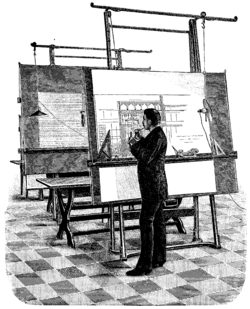
An architect, 1893.
|
|
| Occupation | |
|---|---|
| Names | Architect |
|
Occupation type
|
Profession |
|
Activity sectors
|
Architecture Civil engineering Structural engineering Construction Project management Urban planning Interior design Visual arts |
| Description | |
| Competencies | Engineering, technical knowledge, building design, planning and management skills |
|
Education required
|
See professional requirements |
An architect is a person who plans, designs, and oversees the construction of buildings.[1] To practice architecture means to provide services in connection with the design of buildings and the space within the site surrounding the buildings that have human occupancy or use as their principal purpose.[2] Etymologically, the term architect derives from the Latin architectus,[3] which derives from the Greek[4] (arkhi-, chief + tekton, builder), i.e., chief builder.[5]
The professional requirements for architects vary from location to location. An architect's decisions affect public safety, and thus the architect must undergo specialised training consisting of advanced education[6] and a practicum (or internship) for practical experience to earn a license to practice architecture. Practical, technical, and academic requirements for becoming an architect vary by jurisdiction though the formal study of architecture in academic institutions has played a pivotal role in the development of the profession.
Throughout ancient and medieval history, most architectural design and construction was carried out by artisans—such as stone masons and carpenters—who rose to the role of master builders. Until modern times, there was no clear distinction between architect and engineer. In Europe, the titles architect and engineer were primarily geographical variations that referred to the same person, often used interchangeably.[7][8] "Architect" derives from Greek ἀρχιτέκτων (arkhitéktōn, "master builder," "chief tektōn).[5]

It is suggested that various developments in technology and mathematics allowed the development of the professional 'gentleman' architect, separate from the hands-on craftsman. Paper was not used in Europe for drawing until the 15th century but became increasingly available after 1500. Pencils were used for drawing by 1600. The availability of both paper and pencils allowed pre-construction drawings to be made by professionals.[10] Concurrently, the introduction of linear perspective and innovations such as the use of different projections to describe a three-dimensional building in two dimensions, together with an increased understanding of dimensional accuracy, helped building designers communicate their ideas.[10] However, development was gradual and slow-going. Until the 18th century, buildings continued to be designed and set out by craftsmen, with the exception of high-status projects.[10][11]
In most developed countries only those qualified with an appropriate license, certification, or registration with a relevant body (often a government) may legally practice architecture. Such licensure usually requires a university degree, successful completion of exams, and a training period.[12] Representation of oneself as an architect through the use of terms and titles were restricted to licensed individuals by law, although in general, derivatives such as architectural designer were not legally protected.
To practice architecture implies the ability to practice independently of supervision. The term building design professional (or design professional), by contrast, is a much broader term that includes professionals who practice independently under an alternate profession, such as engineering professionals, or those who assist in the practice of architecture under the supervision of a licensed architect, such as intern architects. In many places, independent, non-licensed individuals may perform design services outside of professional restrictions, such as the design of houses or other smaller structures.
In the architectural profession, technical and environmental knowledge, design, and construction management require an understanding of business as well as design. However, design is the driving force throughout the project and beyond. An architect accepts a commission from a client. The commission might involve preparing feasibility reports, building audits, and designing a building or several buildings, structures, and the spaces among them. The architect participates in developing the requirements the client wants in the building. Throughout the project (planning to occupancy), the architect coordinates a design team. Structural, mechanical, and electrical engineers are hired by the client or architect, who must ensure that the work is coordinated to construct the design.
The architect, once hired by a client, is responsible for creating a design concept that meets the requirements of that client and provides a facility suitable to the required use. The architect must meet with and ask questions to the client, to ascertain all the requirements (and nuances) of the planned project.[13]
Often, the full brief is not clear in the beginning. It involves a degree of risk in the design undertaking. The architect may make early proposals to the client which may rework the terms of the brief. The "program" (or brief) is essential to producing a project that meets all the needs of the owner. This becomes a guide for the architect in creating the design concept.
Design proposal(s) are generally expected to be both imaginative and pragmatic. Much depends upon the time, place, finance, culture, and available crafts and technology in which the design takes place. The extent and nature of these expectations will vary. Foresight is a prerequisite when designing buildings as it is a very complex and demanding undertaking.
Any design concept during the early stage of its generation must take into account a great number of issues and variables, including the qualities of the space(s), the end-use and life-cycle of these proposed spaces, connections, relations, and aspects between spaces, including how they are put together, and the impact of proposals on the immediate and wider locality. The selection of appropriate materials and technology must be considered, tested, and reviewed at an early stage in the design to ensure there are no setbacks (such as higher-than-expected costs) which could occur later in the project.
The site and its surrounding environment, as well as the culture and history of the place, will also influence the design. The design must also balance increasing concerns with environmental sustainability. The architect may introduce (intentionally or not), aspects of mathematics and architecture, new or current architectural theory, or references to architectural history.
A key part of the design is that the architect often must consult with engineers, surveyors, and other specialists throughout the design, ensuring that aspects such as structural supports and air conditioning elements are coordinated. The control and planning of construction costs are also part of these consultations. Coordination of the different aspects involves a high degree of specialized communication, including advanced computer technology such as building information modeling (BIM), computer-aided design (CAD), and cloud-based technologies. Finally, at all times, the architect must report back to the client, who may have reservations or recommendations which might introduce further variables into the design.
Architects also deal with local and federal jurisdictions regarding regulations and building codes. The architect might need to comply with local planning and zoning laws such as required setbacks, height limitations, parking requirements, transparency requirements (windows), and land use. Some jurisdictions require adherence to design and historic preservation guidelines. Health and safety risks form a vital part of the current design, and in some jurisdictions, design reports and records are required to include ongoing considerations of materials and contaminants, waste management and recycling, traffic control, and fire safety.
Previously, architects employed drawings[10] to illustrate and generate design proposals. While conceptual sketches are still widely used by architects,[14] computer technology has now become the industry standard.[15] Furthermore, design may include the use of photos, collages, prints, linocuts, 3D scanning technology, and other media in design production. Increasingly, computer software is shaping how architects work. BIM technology allows for the creation of a virtual building that serves as an information database for the sharing of design and building information throughout the life-cycle of the building's design, construction, and maintenance.[16] Virtual reality (VR) presentations are becoming more common for visualizing structural designs and interior spaces from the point-of-view perspective.
Since modern buildings are known to release carbon into the atmosphere, increasing controls are being placed on buildings and associated technology to reduce emissions, increase energy efficiency, and make use of renewable energy sources. Renewable energy sources may be designed into the proposed building by local or national renewable energy providers. As a result, the architect is required to remain abreast of current regulations that are continually being updated. Some new developments exhibit extremely low energy use or passive solar building design.[17] However, the architect is also increasingly being required to provide initiatives in a wider environmental sense. Examples of this include making provisions for low-energy transport, natural daylighting instead of artificial lighting, natural ventilation instead of air conditioning, pollution, and waste management, use of recycled materials, and employment of materials which can be easily recycled.
As the design becomes more advanced and detailed, specifications and detail designs are made of all the elements and components of the building. Techniques in the production of a building are continually advancing which places a demand on the architect to ensure that he or she remains up to date with these advances.
Depending on the client's needs and the jurisdiction's requirements, the spectrum of the architect's services during each construction stage may be extensive (detailed document preparation and construction review) or less involved (such as allowing a contractor to exercise considerable design-build functions).
Architects typically put projects to tender on behalf of their clients, advise them on the award of the project to a general contractor, facilitate and administer a contract of agreement, which is often between the client and the contractor. This contract is legally binding and covers a wide range of aspects, including the insurance and commitments of all stakeholders, the status of the design documents, provisions for the architect's access, and procedures for the control of the works as they proceed. Depending on the type of contract used, provisions for further sub-contract tenders may be required. The architect may require that some elements be covered by a warranty which specifies the expected life and other aspects of the material, product, or work.
In most jurisdictions prior notification to the relevant authority must be given before commencement of the project, giving the local authority notice to carry out independent inspections. The architect will then review and inspect the progress of the work in coordination with the local authority.
The architect will typically review contractor shop drawings and other submittals, prepare and issue site instructions, and provide Certificates for Payment to the contractor (see also Design-bid-build) which is based on the work done as well as any materials and other goods purchased or hired in the future. In the United Kingdom and other countries, a quantity surveyor is often part of the team to provide cost consulting. With large, complex projects, an independent construction manager is sometimes hired to assist in the design and management of the construction.
In many jurisdictions mandatory certification or assurance of the completed work or part of the work is required. This demand for certification entails a high degree of risk; therefore, regular inspections of the work as it progresses on site is required to ensure that the design is in compliance itself as well as following all relevant statutes and permissions.
Recent decades have seen the rise of specialisations within the profession. Many architects and architectural firms focus on certain project types (e.g. healthcare, retail, public housing, and event management), technological expertise, or project delivery methods. Some architects specialise in building code, building envelope, sustainable design, technical writing, historic preservation(US) or conservation (UK), and accessibility.
Many architects elect to move into real-estate (property) development, corporate facilities planning, project management, construction management, chief sustainability officers interior design, city planning, user experience design, and design research.
Although there are variations in each location, most of the world's architects are required to register with the appropriate jurisdiction. Architects are typically required to meet three common requirements: education, experience, and examination.
Basic educational requirement generally consist of a university in architecture. The experience requirement for degree candidates is usually satisfied by a practicum or internship (usually two to three years). Finally, a Registration Examination or a series of exams is required prior to licensure.
Professionals who engaged in the design and supervision of construction projects before the late 19th century were not necessarily trained in a separate architecture program in an academic setting. Instead, they often trained under established architects. Prior to modern times, there was no distinction between architects and engineers and the title used varied depending on geographical location. They often carried the title of master builder[18][19] or surveyor after serving a number of years as an apprentice (such as Sir Christopher Wren). The formal study of architecture in academic institutions played a pivotal role in the development of the profession as a whole, serving as a focal point for advances in architectural technology and theory. The use of "Architect" or abbreviations such as "Ar." as a title attached to a person's name was regulated by law in some countries.
Architects' fee structure was typically based on a percentage of construction value, as a rate per unit area of the proposed construction, hourly rates, or a fixed lump sum fee. Combination of these structures were also common. Fixed fees were usually based on a project's allocated construction cost and could range between 4 and 12% of new construction cost for commercial and institutional projects, depending on the project's size and complexity. Residential projects ranged from 12 to 20%. Renovation projects typically commanded higher percentages such as 15–20%.[20]
Overall billings for architectural firms range widely, depending on their location and economic climate. Billings have traditionally been dependent on local economic conditions, but with rapid globalization, this is becoming less of a factor for large international firms. Salaries could also vary depending on experience, position within the firm (i.e. staff architect, partner, or shareholder, etc.), and the size and location of the firm.
A number of national professional organizations exist to promote career and business development in architecture.

A wide variety of prizes is awarded by national professional associations and other bodies, recognizing accomplished architects, their buildings, structures, and professional careers.
The most lucrative award an architect can receive is the Pritzker Prize, sometimes termed the "Nobel Prize for architecture". The inaugural Pritzker Prize winner was Philip Johnson who was cited as having "50 years of imagination and vitality embodied in a myriad of museums, theatres libraries, houses gardens and corporate structures". The Pritzker Prize has been awarded for forty-two straight editions without interruption, and there are now 22 countries with at least one winning architect. Other prestigious architectural awards are the Royal Gold Medal, the AIA Gold Medal (US), AIA Gold Medal (Australia), and the Praemium Imperiale.[23]
Architects in the UK who have made contributions to the profession through design excellence or architectural education or have in some other way advanced the profession might, until 1971, be elected Fellows of the Royal Institute of British Architects and can write FRIBA after their name if they feel so inclined. Those elected to chartered membership of the RIBA after 1971 may use the initials RIBA but cannot use the old ARIBA and FRIBA. An honorary fellow may use the initials Hon. FRIBA, and an international fellow may use the initials Int. FRIBA. Architects in the US who have made contributions to the profession through design excellence or architectural education or have in some other way advanced the profession are elected Fellows of the American Institute of Architects and can write FAIA after their name. Architects in Canada who have made outstanding contributions to the profession through contributions to research, scholarship, public service, or professional standing to the good of architecture in Canada or elsewhere may be recognized as Fellows of the Royal Architectural Institute of Canada and can write FRAIC after their name. In Hong Kong, those elected to chartered membership may use the initial HKIA, and those who have made a special contribution after nomination and election by the Hong Kong Institute of Architects (HKIA), may be elected as fellow members of HKIA and may use FHKIA after their name.


 architect (P84) (see uses)
| Types |
|
|---|---|
| History |
|
| Professions |
|
| Trades workers (List) |
|
| Organizations |
|
| By country |
|
| Regulation |
|
| Architecture |
|
| Engineering |
|
| Methods |
|
| Other topics |
|
 Outline Outline  Category Category |
|
|
Authority control databases
|
|
|---|---|
| International |
|
| National |
|
| Other |
|


Very good architectural firm in NYC. Highly recommended !

Taf was the perfect architect to complete our filing with the NYC DOB for the washer-drier we wished to install in our coop apartment.

Thank you Mr. Taf & team. We look forward to working with you again on another successful project. I hope by the this Covid pandemic will be history!

Mr Mwandiambira, gave me a thorough explanation on what to expect in navigating the DOB's complex application submission process to get approval for alterations to my home. I was pleasantly surprised at how quickly an acceptable plan was composed. I would highly recommend Baobab Architects to anyone seeking a top quality architectural firm.

Baobab Architects is an architectural firm based in Brooklyn, New York City. NYC alteration type 1 architects, NYC alteration type 2 architects, affordable housing architects, or small development, NYC, and Baobab.
Your curiosity about trends is commendable! Baobab Architects P.C. stays at the forefront of architectural innovation by actively engaging in industry events, collaborating with design influencers, and embracing continuous education. Dive into the world of cutting-edge design with us at www.baobabarchitects.com/. Ready to infuse your project with the latest in architectural style? Contact us today!


