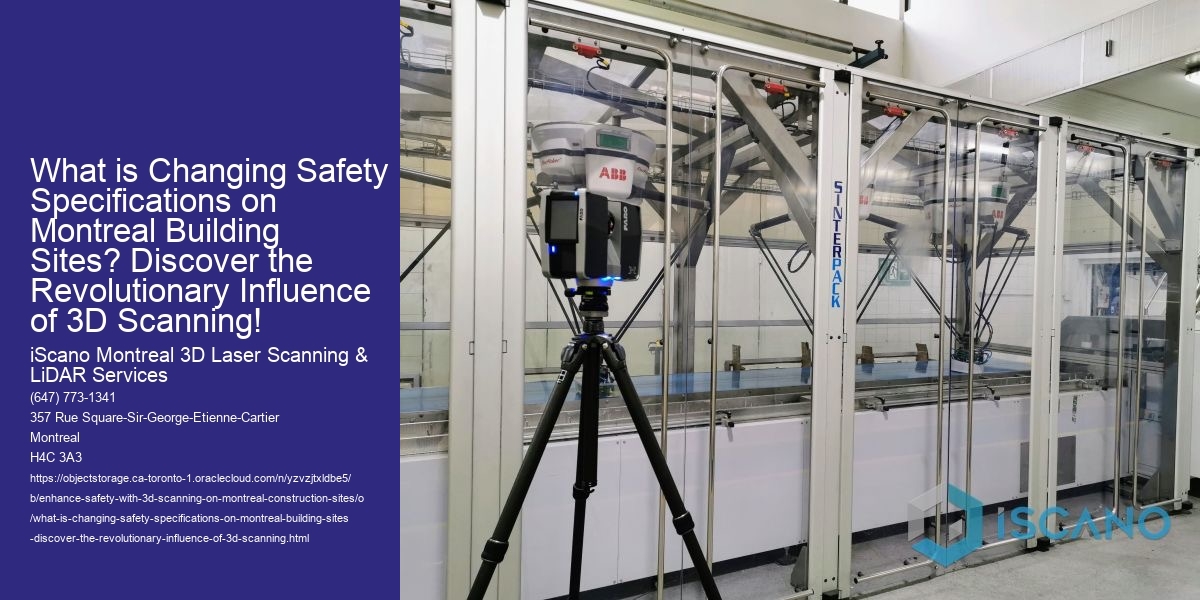
When we think about the evolution of safety and security requirements on Montreal building and building websites, we must first understand the traditional safety and security methods that have actually served as the bedrock for market techniques for decades. What is Transforming Security Requirements on Montreal Building Sites? Discover the Revolutionary Impact of 3D Scanning! . These methods include a range of procedures, including the use of personal protective equipment (PPE), adherence to building codes, routine safety and security training, and on-site danger evaluations. While these procedures have most certainly added to lowering work environment crashes and injuries, they possess integral limitations that have motivated the look for more cutting-edge options like 3D scanning innovation.
Standard safety and security methods, such as using construction hats, harness, and steel-toed boots, are designed to safeguard employees from immediate physical threats. Building ordinance help guarantee that frameworks are audio and that the products and techniques made use of during construction fulfill recognized safety and security requirements. However, these codes are often responsive, transforming in feedback to past cases instead of anticipating brand-new threats. Security training, while important, can swiftly come to be obsolete as new risks arise and as the complexity of building and construction projects boosts.
One of the essential limitations of traditional precaution is their reliance on human vigilance and compliance. Even with the most comprehensive training, human error remains a substantial danger variable. Employees may unintentionally bypass security protocols due to time restrictions, lack of understanding, or basic oversight. Additionally, typical methods for hazard evaluation and inspection can be time-consuming and might not catch every prospective danger, especially in facility or dynamically transforming atmospheres.
Enter 3D scanning modern technology, an innovative tool that is redefining safety criteria on construction websites in Montreal and around the globe. 3D scanning offers a real-time, accurate depiction of the construction site, allowing for the identification of potential dangers that might be missed out on by the human eye. This modern technology can create detailed digital models of the construction atmosphere, which can be assessed to improve website format, employee motion, and also imitate emergency situation scenarios.
The fostering of 3D scanning modern technology addresses a number of constraints of typical safety and security methods. As an example, it reduces the reliance on hands-on assessments and the connected human error by giving precise and consistent data. It enables aggressive risk recognition, allowing for the mitigation of dangers prior to they cause mishaps. The modern technology also helps with much better preparation and communication among all stakeholders, as the electronic designs can be conveniently shared and updated in real-time.
Furthermore, 3D scanning can be integrated with various other advanced innovations like Building Information Modeling (BIM) and Augmented Truth (AR) to boost training and supply workers with a much more immersive understanding of prospective threats. This combination not just
The building and construction industry in Montreal, like several other cities around the world, has commonly been fraught with risks stemming from uncertainties in planning, execution, and maintenance of developing sites. Yet, as we sail into a period punctuated by technological advancements, we witness the innovative influence of 3D scanning-- a game-changer in the area of building and construction and security requirements.
3D scanning, a modern technology that captures the shape of physical things making use of laser light, has actually begun to leave an enduring mark on how builders, engineers, and safety and security examiners approach their craft in Montreal. This modern technology gives thorough three-dimensional electronic versions of structures, frameworks, and also entire building and construction sites, which are important for identifying and reducing threats before they escalate right into costly or harmful circumstances.
The influence of 3D scanning on security standards is complex. First, it makes it possible for precise and comprehensive site analyses. Standard evaluating methods, which are often lengthy and subject to human error, pale in comparison to the swift and accurate data purchase capacities of 3D scanners. With high-resolution designs, potential concerns such as architectural weaknesses, style variances, or unpredicted obstacles can be detected early on, allowing for prompt corrective procedures.
In addition, 3D scanning fosters an aggressive safety society. By incorporating 3D models into Structure Info Modeling (BIM) systems, task stakeholders can simulate numerous building and construction phases, predict outcomes, and identify risks connected to comfort designs, devices positioning, and process. This predictive strategy to safety can substantially minimize crashes and injuries, as possible hazards are dealt with before they materialize on the physical website.
One more aspect of 3D scanning's influence is its payment to the upkeep and renovation of existing structures. Montreal's building heritage, comprising both historical and modern buildings, calls for cautious conservation. 3D scanning assists in the assessment of these structures, identifying wear and tear or damage that might jeopardize security. As a result, timely interventions can be prepared and performed with accuracy, making sure the durability and safety and security of the city's developed setting.
The fostering of 3D scanning modern technologies has also demanded adjustments in regulatory frameworks. Security standards in Montreal are evolving to include using digital versions as part of conformity confirmation. Inspectors are currently geared up with cutting-edge devices to imagine and examine intricate information, resulting in more educated decision-making and enforcement of security regulations.
Additionally, the labor force itself is going through a makeover, as the capability required for modern building jobs increases to consist of technical proficiency. Training programs and accreditations are significantly highlighting the ability to
The construction sector in Montreal, much like the remainder of the globe, is experiencing a standard shift in safety standards, driven by the advent of innovative innovations. Amongst these, 3D scanning has emerged as a revolutionary impact, changing the method structure and building and construction websites run. This brief essay explores the effective application of 3D scanning on Montreal websites, checking out how this innovation is redefining safety protocols and setting new benchmarks for the market.
Over the last few years, Montreal has actually experienced a spate of building jobs aimed at city revival and facilities advancement. With the city's abundant heritage and dynamic city landscape, building and construction websites are frequently nestled within complex settings, where the margin for mistake is minimal. Typical security methods, while reliable to an extent, have actually been not able to fully eliminate the dangers connected with such intricate projects.
Enter 3D scanning-- a technology that catches electronic representations of physical rooms with impressive precision. Its influence on website safety is complex. Firstly, it facilitates exact planning and threat assessment prior to any kind of physical work starts. By developing an exact digital twin of the site, job supervisors can determine possible dangers and design mitigation techniques proactively.
One of the case studies showcasing the successful implementation of 3D scanning in Montreal is the improvement of a historical structure in the city's midtown core. The intricacy of the structure's structure, incorporated with the demand to maintain its building honesty, made standard checking approaches both high-risk and time-consuming. Nonetheless, with 3D scanning, the project group had the ability to promptly and safely map out the structure's functions, permitting exact reconstruction job that followed stringent safety criteria.
An additional case study entails the building and construction of a new high-rise growth. In this circumstances, 3D scanning was utilized to keep track of the site's progress in real-time, ensuring that each phase of building and construction abided by the job's requirements. This not only improved safety and security by decreasing the chance of structural mistakes but also improved the performance of the building process itself.
Additionally, 3D scanning has had a profound effect on worker security. By providing detailed visualizations of the site, employees can be briefed more effectively on potential threats. Educating sessions boosted with 3D versions allow workers to acquaint themselves with their working environment, comprehend the spatial relationships in between numerous components on the website, and browse more with confidence and securely.
The information collected from 3D scans likewise adds to the upkeep and inspection procedures. It enables predictive maintenance, where potential issues can be recognized and addressed before they intensify right into
In the ever-evolving landscape of Montreal's structure and construction sector, safety and security criteria are not simply a matter of conformity, yet a cornerstone of lasting and responsible development. Among this background of consistent renovation, the assimilation of 3D scanning modern technology is revolutionizing the way safety protocols are carried out and monitored, heralding a new period of precision and performance.
As regulative adjustments are introduced to boost the safety benchmarks, 3D scanning emerges as a critical tool in the arsenal of building and construction management. Typically, safety evaluations and website assessments relied heavily on manual processes that were taxing and vulnerable to human mistake. Today, however, the fostering of 3D scanning standards is transforming these practices, supplying a level of information and precision that was once unattainable.
The innovative impact of 3D scanning on Montreal's building sites can be seen in multiple facets. First of all, it enables the production of precise digital representations of structures, frameworks, and building websites. These detailed designs offer an extensive overview of the physical room, enabling careful planning and analysis that can determine possible safety and security dangers before they become a reality.
Second of all, 3D scanning aids in keeping an eye on the structural honesty of structures throughout the building process. By contrasting scans over time, engineers and safety specialists can detect minute shifts or modifications that may suggest a risk of architectural failing. This aggressive strategy makes sure that problems can be resolved immediately, mitigating risks to workers and the general public.
Furthermore, the data collected through 3D scanning can be used to create digital fact simulations, using an immersive training setting for building and construction employees. This hands-on experience is important, outfitting workers with the knowledge to navigate complicated sites safely and react successfully to prospective dangers.
The governing adjustments that are being applied in Montreal are not only improving safety and security requirements however are likewise motivating the building and construction industry to embrace ingenious technologies like 3D scanning. With these requirements in position, building and construction companies are incentivized to buy advanced scanning tools and training, consequently focusing on the well-being of their labor force.
Finally, the fostering of 3D scanning criteria in Montreal's building and building sites is a testament to the city's commitment to security and innovation. By accepting these regulatory adjustments, the building and construction sector is set on a course to considerably decrease mishaps and improve the overall safety of its operations. The outcome is a more secure environment for construction employees and the general public, and an extra resilient and forward-thinking sector that sets a criteria for others to follow.
In the dynamic globe of building and construction, security stands as a critical problem. The industry is familiar with the dangers that feature the area, from excessive elevations to the bustle of heavy machinery. In Montreal, a city that prides itself on its architectural heritage and growing skyline, the pursuit for improved safety procedures is unending. Amongst the latest innovations changing safety standards on construction websites is the advent of 3D scanning modern technology. This breakthrough is not simply transforming safety measures; it's improving the actual nature of training and skill growth in the building industry.
3D scanning-- a technology that records digital representations of physical objects and atmospheres-- has actually become a game-changer. It allows for specific dimensions, thorough website evaluations, and the production of virtual models that can be examined and manipulated without physical intervention. The implications for safety are extensive. By making use of 3D scans, construction experts can identify potential dangers before they come to be harmful, mimic emergency situation situations, and design much safer workplace.
Nevertheless, the integration of 3D scanning right into building and construction techniques needs a brand-new collection of skills and a comprehensive training program. It's not enough to just understand the essentials of construction; workers and managers need to currently become experienced at operating sophisticated scanning tools, translating complicated data sets, and using this understanding to enhance safety procedures.
Educating programs have actually been developed to address these demands, incorporating theoretical knowledge with practical, hands-on experience. Participants discover exactly how to operate 3D scanners, procedure and visualize the gathered data, and incorporate this details right into their operations. They are shown to recognize the early indicators of structural weak points or misalignments that could result in mishaps. In addition, this technology makes it possible for the production of thorough safety and security strategies tailored to particular task needs, enabling a lot more efficient communication of potential dangers and the actions in position to alleviate them.
Ability growth does not quit at safety and security. Making use of 3D scanning in the construction market likewise promotes development in task administration, style, and quality control. As workers come to be proficient in this modern technology, they are outfitted to add to more efficient and accurate construction methods, lowering the likelihood of mistakes that can endanger security.
The influence of 3D scanning on safety standards in Montreal's construction industry is undoubtedly revolutionary. It demands a reconsidering of typical training techniques and an openness to constant knowing. As the innovation evolves, so also need to the market's approach to safety and ability growth. Those who welcome this advancement will certainly not only protect their workforce yet will certainly likewise stand at the center of a smarter
The Future of Building And Construction Safety: Forecasts and Prospective Growths
As we aim to the future of construction safety, especially on Montreal building and building and construction websites, it is clear that technological advancements are set to play a transformative function. Amongst these innovations, 3D scanning innovation attracts attention as an advanced impact that is poised to redefine security criteria in the market.
3D scanning, with its capacity to catch comprehensive and exact depictions of physical spaces, offers many advantages for building safety. By creating precise electronic models of construction sites, 3D scanners permit far better preparation and threat assessment prior to any kind of manual labor begins. This innovative degree of preparation can substantially decrease the probability of mishaps, as potential threats can be recognized and mitigated in the online atmosphere.
In Montreal, the consolidation of 3D scanning right into building process is altering how security is approached from scratch. As an example, by simulating complicated jobs in a 3D version, site supervisors can make certain that workers have a clear and extensive understanding of the tasks handy, together with any kind of associated threats. This assists in tailoring safety training to be a lot more site-specific and reliable, causing an extra informed and mindful labor force.
Moreover, making use of 3D scanning assists in the continuous surveillance of building progression, allowing the timely discovery of inconsistencies from the initial strategy that might introduce new safety threats. By maintaining a digital eye on the structural honesty and spatial restrictions of a building and construction website, job managers can proactively attend to issues before they intensify right into security incidents.
Forecasts for the future of building and construction safety and security in Montreal additionally include the integration of 3D scanning data with other innovative innovations such as Structure Info Modeling (BIM), online fact (VIRTUAL REALITY), and enhanced reality (AR). The combination of these devices can create immersive training scenarios, permit digital walk-throughs of hazardous areas, and even supply real-time information to employees via wearable modern technology, ensuring that safety and security info is accessible right when and where it is needed.
In addition, as the governing landscape evolves, it is prepared for that future safety and security standards may need the use of modern technologies like 3D scanning to preserve conformity. This would certainly make sure a baseline degree of risk monitoring that benefits everyone included, from the specific employees to the building and construction firms and the more comprehensive area in Montreal.
In conclusion, the future of construction security in Montreal gets on the cusp of a technological revolution, with 3D scanning at the leading edge. This technology not only enhances the capacity to preemptively address security issues but additionally enhances other electronic tools
Montreal is a centre of film and television production. The headquarters of Alliance Films and five studios of the Academy Award-winning National Film Board of Canada are in the city, as well as the head offices of Telefilm Canada, the national feature-length film and television funding agency and Télévision de Radio-Canada. Given its eclectic architecture and broad availability of film services and crew members, Montreal is a popular filming location for feature-length films, and sometimes stands in for European locations.[151][152] The city is also home to many recognized cultural, film, and music festivals (Just For Laughs, Just For Laughs Gags, Montreal International Jazz Festival, and others), which contribute significantly to its economy. It is also home to one of the world's largest cultural enterprises, the Cirque du Soleil.[153]
Tour de la Bourse has been home to the Montreal Exchange from 1965 to 2018, subsequently also including offices of various companies, entities and professional firms.
Montreal is also a global hub for artificial intelligence research with many companies involved in this sector, such as Facebook AI Research (FAIR), Microsoft Research, Google Brain, DeepMind, Samsung Research and Thales Group (cortAIx).[154][155] The city is also home to Mila (research institute), an artificial intelligence research institute with over 500 researchers specializing in the field of deep learning, the largest of its kind in the world.[156]
The video game industry has been booming in Montreal since November 2, 1995, coinciding with the opening of Ubisoft Montreal.[157] Recently, the city has attracted world leading game developers and publishers studios such as EA, Eidos Interactive, BioWare, Artificial Mind and Movement, Strategy First, THQ, Gameloft mainly because of the quality of local specialized labour, and tax credits offered to the corporations. In 2010, Warner Bros. Interactive Entertainment, a division of Warner Bros., announced that it would open a video game studio.[158] Relatively new to the video game industry, it will be Warner Bros. first studio opened, not purchased, and will develop games for such Warner Bros. franchises as Batman and other games from their DC Comics portfolio. The studio will create 300 jobs.
Montreal plays an important role in the finance industry. The sector employs approximately 100,000 people in the Greater Montreal Area.[159] As of March 2018, Montreal is ranked in the 12th position in the Global Financial Centres Index, a ranking of the competitiveness of financial centres around the world.[160] The city is home to the Montreal Exchange, the oldest stock exchange in Canada and the only financial derivatives exchange in the country.[161] The corporate headquarters of the Bank of Montreal and Royal Bank of Canada, two of the biggest banks in Canada, were in Montreal. While both banks moved their headquarters to Toronto, Ontario, their legal corporate offices remain in Montreal. The city is home to head offices of two smaller banks, National Bank of Canada and Laurentian Bank of Canada. The Caisse de dépôt et placement du Québec, an institutional investor managing assets totalling $408 billion CAD, has its main business office in Montreal.[162] Many foreign subsidiaries operating in the financial sector also have offices in Montreal, including HSBC, Aon, Société Générale, BNP Paribas and AXA.[161][163]
Lidar (, additionally LIDAR, LiDAR or LADAR, a phrase of "light detection and ranging" or "laser imaging, discovery, and varying") is a technique for identifying ranges by targeting an object or a surface area with a laser and measuring the time for the reflected light to go back to the receiver. Lidar might operate in a fixed direction (e. g., upright) or it may scan numerous instructions, in which instance it is known as lidar scanning or 3D laser scanning, a special combination of 3-D scanning and laser scanning. Lidar has earthbound, air-borne, and mobile applications. Lidar is generally used to make high-resolution maps, with applications in surveying, geodesy, geomatics, archaeology, location, geology, geomorphology, seismology, forestry, climatic physics, laser advice, airborne laser swathe mapping (ALSM), and laser altimetry. It is made use of to make digital 3-D depictions of locations on the Earth's surface and ocean base of the intertidal and near seaside zone by differing the wavelength of light. It has likewise been progressively made use of in control and navigating for independent automobiles and for the helicopter Ingenuity on its record-setting trips over the surface of Mars. The development of quantum innovation has actually given rise to the appearance of Quantum Lidar, showing greater effectiveness and sensitivity when contrasted to standard lidar systems.
.Montreal is the largest city in the province of Quebec, the second-largest in Canada, and the ninth-largest in The United States and Canada. Founded in 1642 as Ville-Marie, or "City of Mary", it is currently named after Mount Royal, the triple-peaked hill around which the very early settlement was developed. The city is centred on the Island of Montreal and a few, much smaller, peripheral islands, the biggest of which is Î& Icirc; le Bizard. The city is 196 km (122 mi) eastern of the nationwide funding, Ottawa, and 258 km (160 mi) southwest of the rural resources, Quebec City. Since 2021, the city had a population of 1,762,949, and an urban population of 4,291,732, making it the second-largest city in Canada. French is the city's main language. In 2021, 85. 7% of the population of the city of Montreal considered themselves proficient in French while 90. 2% could talk it in the metropolitan area. Montreal is just one of the most bilingual cities in Quebec and Canada, with 58. 5% of the populace able to talk both French and English. Historically the industrial capital of Canada, Montreal was exceeded in population and economic toughness by Toronto in the 1970s. It continues to be an important centre of art, society, literary works, movie and tv, songs, business, aerospace, transportation, financing, drugs, innovation, design, education and learning, tourism, food, style, video game advancement, and globe events. Montreal is the place of the headquarters of the International Civil Aeronautics Organization, and was called a UNESCO City of Layout in 2006. In 2017, Montreal was placed the 12th-most habitable city worldwide by the Financial expert Knowledge Unit in its annual Worldwide Liveability Position, although its ranking slipped to 40th in the 2021 index, largely because of stress and anxiety on the healthcare system from the COVID-19 pandemic. It is routinely ranked as one of the 10 ideal cities on the planet to be an university student in the QS World University Rankings. In 2018, Montreal was ranked as a worldwide city. Montreal has hosted many important international events, consisting of the 1967 International and Universal Presentation, and is the only Canadian city to have actually held the Summer Olympics, having done so in 1976. The city holds the Canadian Grand Prix of Solution One; the Montreal International Jazz Celebration, the biggest jazz festival on the planet; the Simply for Laughs celebration, the biggest funny festival worldwide; and Les Francos de Montréal, the largest French-language songs event worldwide. In sports, it is home to numerous specialist teams, most significantly the Canadiens of the National Hockey League, that have won the Stanley Mug a record 24 times.
.3D scanning is the procedure of examining a real-world things or atmosphere to gather 3 dimensional data of its shape and potentially its look (e. g. color). The gathered information can then be utilized to construct electronic 3D versions. A 3D scanner can be based upon various technologies, each with its very own constraints, advantages and prices. Many restrictions in the type of objects that can be digitised are still present. As an example, optical modern technology may run into many problems with dark, glossy, reflective or transparent things. As an example, commercial calculated tomography scanning, structured-light 3D scanners, LiDAR and Time Of Flight 3D Scanners can be utilized to construct digital 3D designs, without devastating screening. Collected 3D data works for a wide variety of applications. These gadgets are utilized thoroughly by the show business in the manufacturing of flicks and computer game, consisting of digital fact. Other typical applications of this innovation consist of enhanced reality, movement capture, motion acknowledgment, robotic mapping, commercial layout, orthotics and prosthetics, reverse design and prototyping, quality control/inspection and the digitization of cultural artefacts.
.


I requested a 3D laser scanning service in downtown Montreal by the iScano team for a 3D BIM CAD modelling job. Was very impressed about their professionalism and speed. Will certainly request them for additional architectural jobs.

Provided us a great 3D scanning service. Gave us a scan to BIM project in downtown Montreal. Will use again!

Marc and Brendan, in the iScano team helped us out in a job in Montreal for a 2D and 3D CAD with a facade markup. Brendan and Marc were fast, fair priced and knowledgable in their 3D Laser scanning services. Will use their service again in our construction site.
iScano Montreal stands out through its commitment to utilizing the latest technology, delivering accurate results, and providing exceptional customer service tailored to Montreal's construction needs.
iScano employs versatile scanning techniques to capture and adapt to the diverse architectural styles found in Montreal's construction projects.
3D laser scanning is a technology that captures the spatial data of objects or environments using laser light. In Montreal, our services aid construction projects by providing accurate measurements, reducing errors, and enhancing project efficiency.
iScano's services empower architects and engineers with detailed, accurate data, facilitating informed decision-making, and enhancing the overall design and construction processes in Montreal.
